


** CDR WineLab In-Stock - Immediate shipping available **
The Science of Fruit Wines: Technological Principles and Analytical Control in Non-Grape Fermentation
Defining Fruit Wines: Chemical and Technological Distinctions
In modern oenology, fruit wine production has transcended its origins as a rural craft to become a highly specialized sector of food science. The transition from artisanal production to a global industrial category relies on a deep-seated understanding of the unique chemical matrices presented by non-grape fruits. Unlike viticulture, where the raw material is often naturally optimized for fermentation, alternative fruit substrates—such as pomegranate, fig, and various berry species—exhibit diverse polyphenolic profiles and acid concentrations that demand precise technological interventions to ensure product stability and commercial viability.
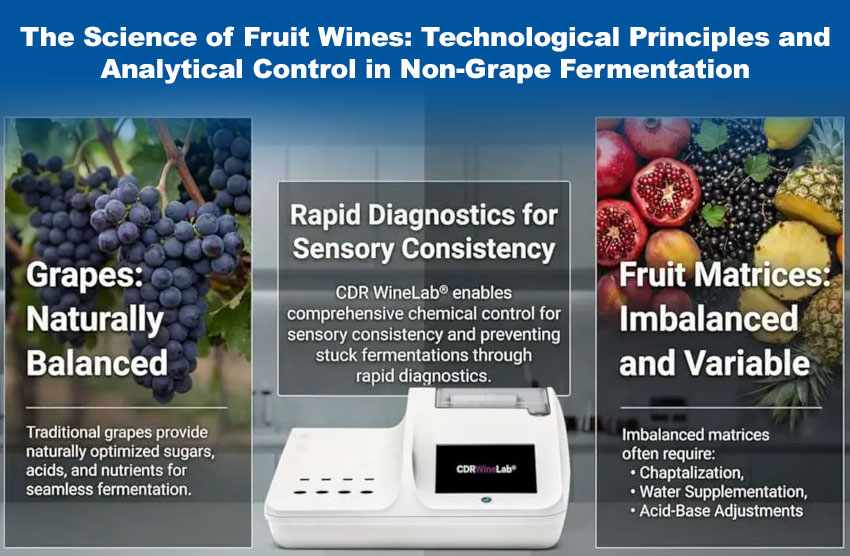
Fruit wines are characterized as non-distilled alcoholic beverages, typically containing 5% to 13% alcohol by volume (ABV), derived from the fermentation of sugar-rich non-grape matrices. Due to the inherent imbalances in many of these substrates, oenologists often utilize chaptalization (the addition of sucrose) and specific acid-base adjustments to create a viable fermentation environment for Saccharomyces cerevisiae. The following table outlines the fundamental chemical and technological divergence between traditional viticulture and non-grape oenology:
CDR ANALYSIS ON WINE AND MUST
- Alcohol by Volume
- Acetic acid (volatile acidity)
- Fermentable Sugars
- Total Acidity
- L-Lactic Acid
- L-Malic Acid
- Free sulfur dioxide
- Total sulfur dioxide
- Yeast Assimilable Nitrogen (YAN)
- Galacturonic Acid
- Calcium
- Copper
- Catechins
- Gluconic Acid
- Acetaldehyde (Ethanal)
- Citric Acid
- Total Polyphenols Index
- pH
- Glycerol
- Color (tonality and intensity)
- Total Polyphenols (Folin Ciocalteu)
- Anthocyanins Extraction on Grapes
- Total Anthocyanins