
Two years ago, I wrote an article on AI in the vineyard for WBM. Feel free to read that article here…if you want. Otherwise, my basic argument was that although AI will eventually play a role in how we farm grapes, it’s a long way off compared to other industries and even other crops. We who grow grapes are the last ones to see such innovation.
And since then, AI has grown exponentially. If two years ago you were playing around with Chat GPT to create bizarrely distorted images and learn about tax loopholes, you can now go onto the likes of Claude and have it just create a website for you from a single prompt. Chatbots like this have essentially eliminated the need for entry-level coders.
However Claude is a computer, so it makes sense that it’s gotten very good at writing code for other computers. Similarly Chat GPT has digested the entire internet, and curates any answer for you by plucking it from its vast network of information. Sometimes its correct, and other times … less correct.
Vines aren’t computers…that’s right. I went to college.
And that’s where my argument on AI in the vineyard remains unchanged. We need a lot of data to train machine learning models and we don’t have that in viticulture. Now my previous examples are generative AI’s, i.e. bots that build things. But they are a bellwether for the state of technology as a whole, which has also improved considerably. You can’t make up for a lack of information though.
Many other industries, the ones we see significantly altered in recent years, have this plethora of data. Let’s say you want to come up with a model that, for instance, maps the behavior of people in an airport. Any given airport on any given day produces millions of data points tracked via sales information, inventory, flight schedules, etc. If you wanted to target specific groups or even specific individuals most likely to buy a certain product, the footprint we leave constantly informs these models.
But in viticulture, you might have a dirty notebook somewhere or a few random excel files on cluster counts from blocks that were subdivided years ago. Even if we as an industry were better organized, gathering data in vines is hard. Seasons are variable. Blocks are variable. Measurements are time-consuming in a job where timing is everything.
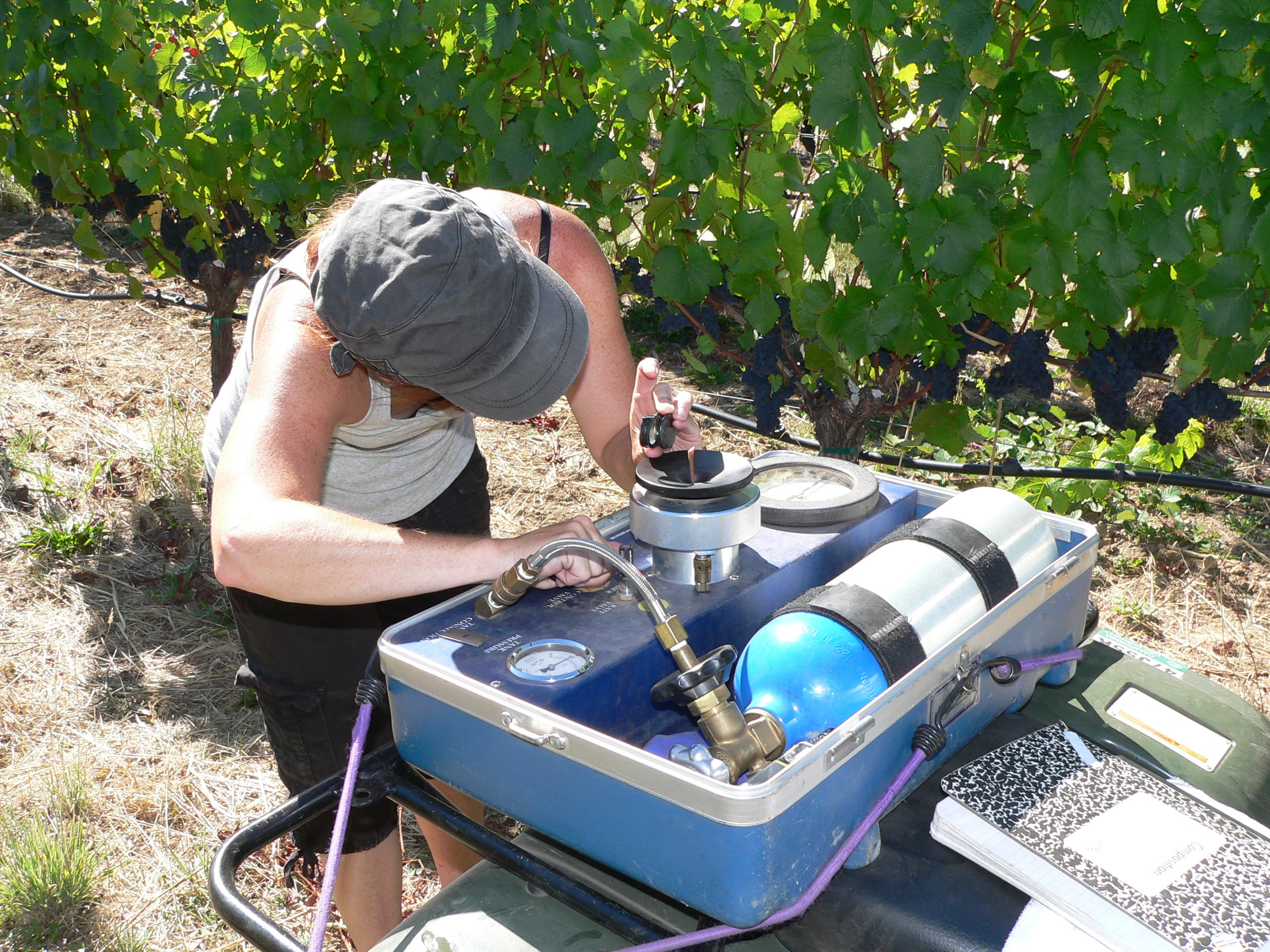 Gathering data in viticulture is an arduous task. So is keeping records of it.
Gathering data for data’s sake
If I’ve seen anything take off since I last wrote on the topic, it’s companies offering to track yield and infrastructure using AI models. The method is simple (but not easy): they put a camera on your tractor and gather data while you go about your normal operations. Then they use machine learning to count clusters in addition to giving you a count of missing vines, virused vines, emitters, and broken posts. A robot that does yield estimate is arguably pretty cool…but at what cost?
When I first heard of this, the ROI seemed fairly straight forward. Yield estimation is super important but notoriously inaccurate. Random sampling in a big block in July and August is hard even for experienced vit techs and samples are often taken and multiplied over inaccurate vine counts that don’t account for missing vines. Having an exact count of clusters alone is something worth paying for and the pricetag I would put on it is, well, probably a little more than what I would pay an intern to do it for me. I am paying for better data afterall. Then, if I want to, I can correlate that data with my actual yield and improve my predictions going forward. That’s worth something but not everything. As one grower I spoke to said, “Yield estimation is a problem, but it’s definitely not the only problem.”
As for the ability to monitor virus spread, I don’t see the advantage of having precise incidence numbers. Most growers don’t rip out individual virused vines, they rip out blocks and if a block is 25% infected, it probably pays to remove rather than farm. Do I care if that number is 27% or 32%? The decision to rip out depends on what the wineries are telling you anyway. If a block shows consistently declining quality and can’t compete in what is a cutthroat market right now, you’re going to pull it out no matter what the virus incidence is.
When it comes to vine counts, I still think a good old flyover similar to what a company like Vine View offers, is adequate enough to understand how many vines are missing. Unless you are an enormous company, having those precise numbers from an on-ground camera scan isn’t going be worth what they’re charging, at least not yet. Besides, when you put an order in for replants, you do so a year in advance. Growers are already adding in a fudge factor to their orders should anything die or weaken over the course of the season.
I think that AI used in this way is a cure in search of a disease, akin to how many people wanted to work with drones when they became affordable a decade ago. It turns out driving out to a vineyard to launch a drone is way more expensive than a fixed-wing plan flying out of an airport in Sacramento. A plane can capture thousands of acres in a single flight and isn’t limited by roads or battery life. The most I’ve seen come out of drone technology are pretty videos for the tasting room and website.
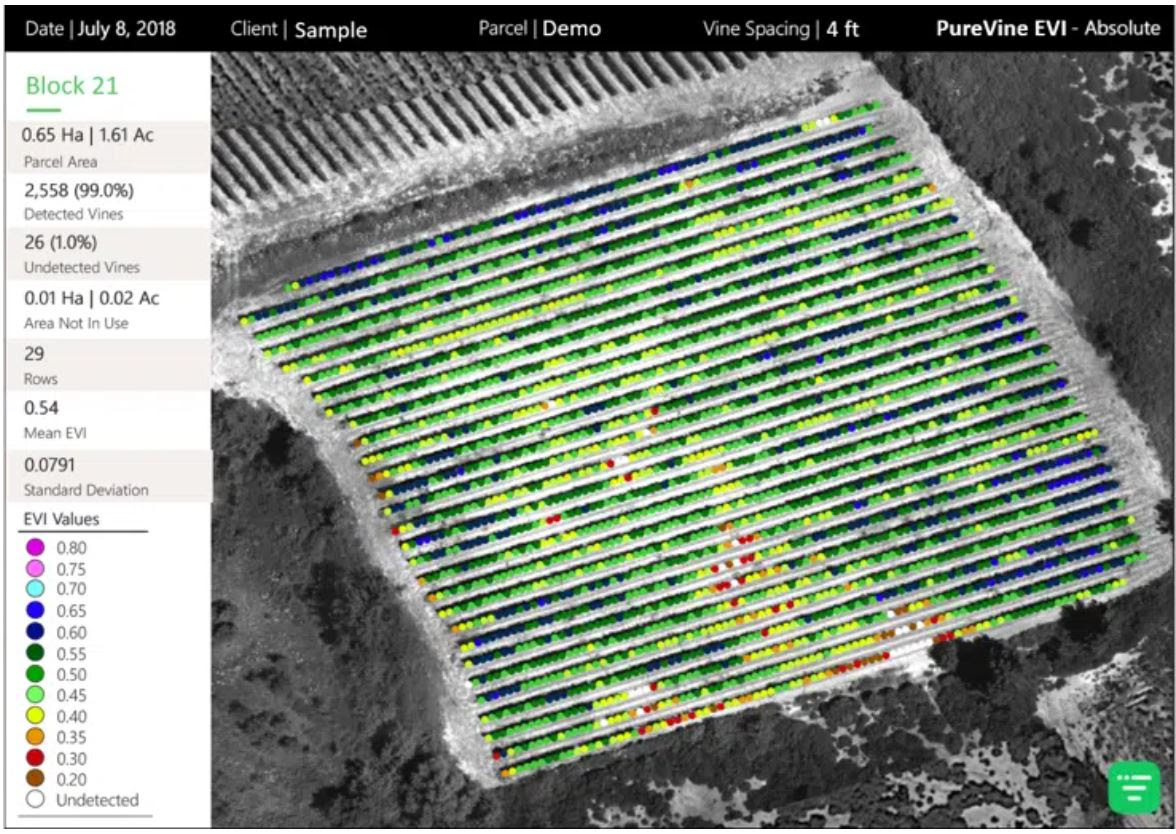 Vine View offers services such as vine counts and virus detection for much less than camera-based data collection companies.
Gathering the right data
As a viticulturist, I’m much more interested in informing the decisions you actually make in the vineyard. I think AI can eventually help growers do that in the near term. But it needs to be based on the right data, not just data in general. That’s why I recommend investing in sensor technology first.
One of the biggest problems facing growers in California is water. Having a grasp of how much water you use is vital. Companies such as Lumo allow you to monitor how much water goes into each block. This alone can help you track pressure discrepancies and leaks. It gives you information you can use. If Lumo’s out of reach for you, I would recommend adding a datalogger to your flowmeter because let’s be honest, no one is ever going to check the meter, jot it down, and put it in the speadsheet. Similarly adding a pressure transducer to your irrigation line can be done for a few hundred dollars. Knowing that you are experiencing low pressure throughout the duration of the irrigation already lets you know you should water fewer blocks at a time…or that your booster is failing. That’s something I’d rather spend money on than a precise count of bent T-posts.
There is very little that is truly “new” that comes out in Agtech, except for those rare times when it does. I’m still surprised by how under-the-radar Florapulse micro-tensiometer plant stress sensors are especially since the alternative is a pressure bomb…which sucks. We’ve been using these sensors for four years now in lieu of taking manual measurements of leaf water potential. Having a reading every 15 minutes as opposed to once every week has been a gamechanger. I can track how a vine responds to weather, how sensitive vines are to irrigations, and exactly when we reach desired stress levels at any given point in the season. One thing we can do here at AV is loop together your plant stress levels and your lab data to track what practices and seasonal conditions have historically produced the best wine. That could be used to build models eventually, but even just seeing the information graphed together allows growers to see similarities with their own eyes and make decisions accordingly.
When I first wrote about this in 2024 Li-Cor had just released their Li-710, a scaled down version of their research-grade Eddy Covariance system. While many companies claim to offer a “real” measurement of evapotranspiration(ET) or crop water use, these are all estimated in some way or another. The Li-Cor 710 actually measures your ET by measuring water vapor flux directly. Mark Greenspan has been working diligently with this sensor over the last two years and has created an exact water balance model that allows you to water back exactly what your vines are using. In the end, machine learning can’t make up for experience…so many years of experience right, Mark? He’s also found that the crop coefficient we’ve been using for grapevines (and probably other crop coefficients as well) is exaggerated almost by a factor of two.
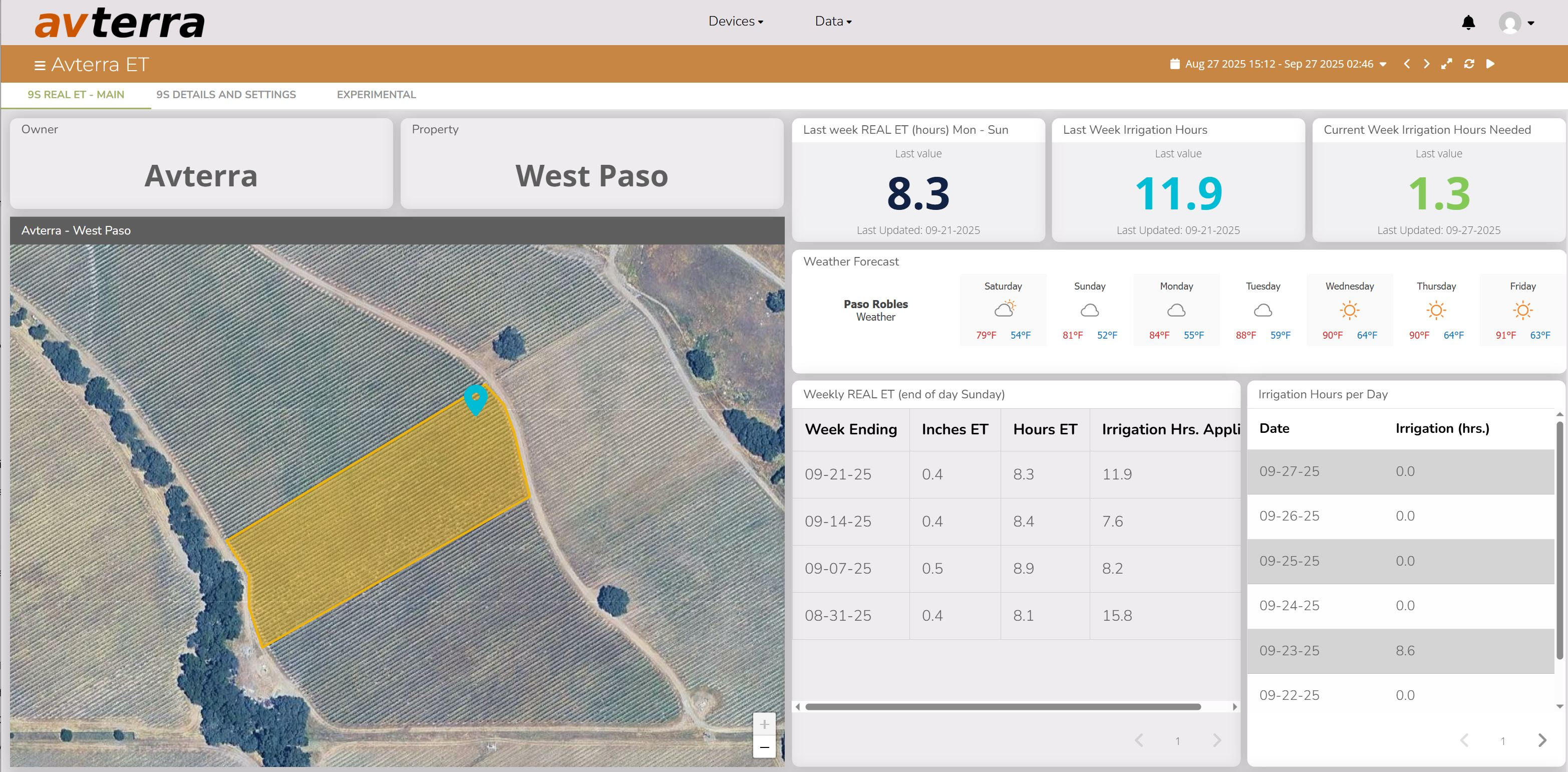 Over the last two years, Mark Greenspan has engineered an exact water balance model based on the Licor-710, the only tool capable of measuring actual ET for under $50k. No AI, just experience and collecting usable data about crop water use.
Read the rest of the article here to find out more.
How should I be irrigating?
Water is scarce and labor is expensive. Installing a soil moisture probe can show you when to irrigate, how much to water, and how often. Know where your water is and how long it stays in the rootzone.
Soil moisture probes can be integrated with any existing telemetry device or we at AV can provide inexpensive dataloggers for you.
Reach out anytime to loni@advancedvit.com for more information.
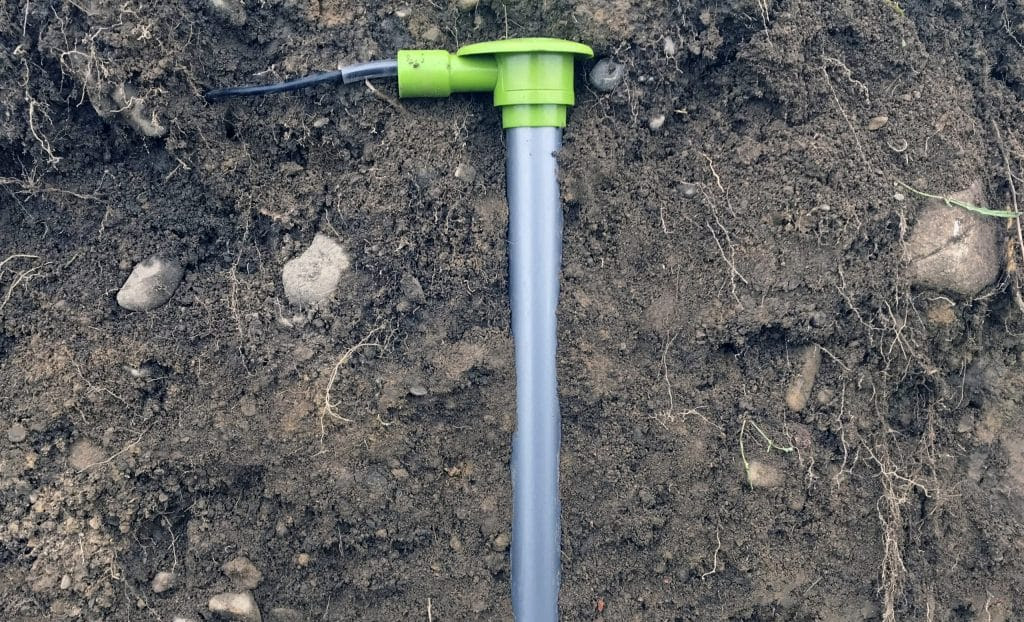 Aquacheck soil moisture probes measure soil moisture at 8" intervals down to 48". Know where roots are actively taking up water and time your irrigations to perfection.