

The following is an excerpt from a recent blogpost reprinted from WBM, 2009 by Mark Greenspan.
The moderate climate enjoyed by the North Coast is frequently interrupted by periods of high heat. The heat waves can reach well into the 100’s, sometimes reaching above 115°F. While foliage is sensitive to heat, it has the advantage of transpiration, which is a natural way in which leaves cool themselves by evaporating water from their interiors. On the other hand, fruit lack active stomatal pores and cannot cool themselves as effectively as leaves. Pigmented fruit will absorb additional energy from the sun, as it reflects less sunlight energy than light-skinned grapes. Outer berries, exposed to direct sunlight, may reach 15°F above ambient temperature. High temperatures are detrimental to fruit and wine quality. Apart from the obvious consequences, such as sunburn, shrivel and loss of pigment, the heat may also lead to changes in flavor, aroma and mouthfeel compounds and precursors. Regardless of subtleties, it is always heartbreaking to tend a vineyard all year only to have a mid- or late-season heat wave shrivel fruit, creating overly cooked, pruney and raisiny flavors in the wines. Not to mention the yield losses…
Napa vineyard cooling project
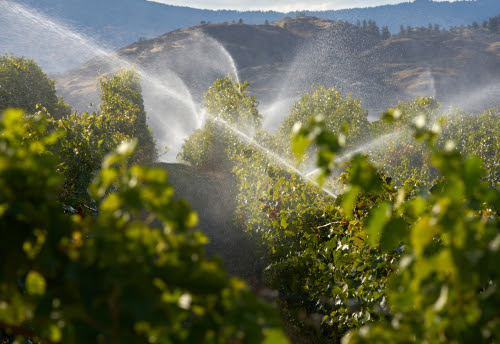
A group in Napa Valley is exploring the use of low-volume misting spray heads as an alternative to the high-volume traditional impact rotor sprinkler. The project has been largely supported by Beaulieu Vineyard (BV) and was conducted in one of their vineyards in the Oakville area. With support from numerous additional donors, this project used numerous temperature sensors within the canopies and within fruit clusters. The electronic temperature data from each sensor was automatically logged so that the information could be downloaded at the end of the trial for analysis. An ambient temperature sensor was connected to a digital readout to provide an indication of current conditions (without cooling) so that system startup and shutdown could be determined. BV uses Walsh Vineyards Management to manage the vineyard and they played a key role in the planning and execution of the project, in addition to support from Pacific Geodata and VineView Imaging companies. Advanced Viticulture, has been assisting in the data interpretation for the project.
The misters were supplied by Jain Irrigation, who modified one of their pressure-compensating emitters to produce a fine mist, rather than a drip or a coarse spray output. The idea here was to have the mist evaporate in mid-air, rather than to coat the foliage with water. The evaporation of water removes heat energy from the air, which is the desired effect. The aerial evaporation was somewhat successful, though the over-vine cooling did tend to wet the fruit and foliage. Similarly, the under-vine cooling wetted the soil below the vines. The intention was not to irrigate the vines with the cooling system, but this did occur to some extent in both systems. There was a small water stream emanating from the emitters, which drizzled down and tended to provide some irrigation to the vines, which was not a desired outcome. The manufacturer has since told us that they can improve the design so that the dripping does not occur.
The project falls somewhere between a casual grower “Side A – Side B” type of trial and a real scientific experiment. Practicality and cost made replicated field plots impossible. Nevertheless, the treatments were made thoughtfully and the temperature measurements made with replication. The vineyard block is Cabernet Sauvignon on O39-16 on a VSP trellis oriented east-west. There were three treatments each of which occupied 14 rows, with temperature monitored only within the center of each plot, so that advection effects from neighboring plots could be eliminated as much as possible. The control was un-cooled, regardless of ambient temperature. There was an “under-vine cooling” treatment, where the misters were installed below the cordon, just above the drip hose. This provided a mist pattern that remained low to the ground and did not wet the foliage or the fruit. A third treatment was an “over-vine cooling” treatment. Similar to a micro-sprinkler installation, spaghetti tube risers were raised about a foot above the canopy and terminated in the misting heads. The output rate of the mister systems were about the same as for the vineyard’s drip system, at just short of 1 gallon per minute per device, spaced out at one device per vine (compared to two half GPH emitters per vine).
The system was turned on whenever the temperature reached 93°F. This was chosen because it was determined that the intent was to have cooling engaged when temperatures rose to 95°F. It was discovered that about 30 minutes elapsed between when the system turned-on and the effective cooling was achieved, which roughly equated to 2°F of temperature rise, as was determined from plots of diurnal temperature curves without cooling. In retrospect, this was a conservative starting point, but was highly impactful at reducing some of the severe temperatures experienced in late August and early September. The system was turned off when the temperatures fell below the 95°F threshold. Additionally, the system was not activated if the 93°F threshold was attained late in the afternoon, at which time temperatures begin to cool.
Initially, heat suppression during both pre- and post-veraison periods of berry growth were planned. However, because of the small, but significant, amount of water dripped onto the ground, it was elected not to use the system prior to veraison, since the vineyard was not being irrigated at that time.
It's a long one. Read the whole article here.
Precise Irrigation with valve automation
Water is precious. Labor is expensive. So why do you still have one guy running around opening and closing valves? One block gets too much, the other too little, one block accidentally had the valve left open for three days and drained half your pond.
Farming is fun, isn't it?
Why not improve your irrigation practices with automating your valves this year? Then you can schedule exactly how long you want each irrigation. Feedback sensors will let you know it all went to plan.
Automation can be integrated into soil moisture probes, well/pond monitoring, and weather stations. Contact loni@advancedvit.com or josh@advancedvit.com to discuss the best system for your vineyard.