


This is the time of year when people begin abandoning their computers to spend time with friends and family, so before you go I want to wish you a wonderful holiday season regardless of what you may celebrate--Christmas, Hanukkah, Kwanzaa, or simply the end of one year seguing into the next. How time flies! Read more...
Lame Duck Runs
 The "Lame Duck" session of Congress between a November election and a new Congress in January is often a pretty sleepy time in DC. There are always budget-related measures that have to be passed, and which almost always come right down to the wire to create a little drama, but usually little else of note.
But the 2022 Lame Duck session has been the most active and productive in memory, with the House and Senate passing legislation to prevent a potentially devastating rail strike, the Respect for Marriage Act legally protecting same-sex and interracial unions, and several other major things that are still pending.
As for the money matters, here's where things stand at this writing: The government is due to run out of money today...yup, today...but wait, the House and Senate just passed another "continuing resolution", adding another week to the nation's solvency while legislators try to hammer out a deal to fund the government through September of 2023. (That was supposed to have been done by September 30 of this year, but why break the 25-year tradition of not passing an on-time budget?)
The politics of this are very complex and interesting. The Democrats want to pass a budget before they recess in a week or two so it will contain what they want, rather than having to negotiate a budget when the Republicans hold a slim majority in the House starting January 3. Some Republicans also want to pass the budget now, others don't, and some say they don't but actually do because the Republican leadership situation in the House is such a mess that it could be very embarrassing, possibly even leading to a government shutdown early next year for which the GOP would be blamed heading into the next election cycle. Ah, Washington...
So stay tuned for more drama, and hopefully we'll have a happy ending in a week or so.
California Wine Industry Economic Impact
While WineAmerica was working with John Dunham & Associates on our 2022 National Economic Impact Study of the Wine Industry, our colleagues at Wine Institute were also working with him on a parallel study focused on the California wine industry's impact, which also has national implications due to that industry's dominance as a wine producer.
The main difference is that our study ($276 billion total national impact) included wines from everywhere as well as state-specific economic drivers like tourism, while theirs specifically measured the impact of California wines nationally ($170 billion) and in the various states. Both studies include detailed data for all 50 wine-producing states.
The California wine industry generates about $73 billion for that state's economy, and $170 billion for the national economy. The production, distribution and sales of wine from the 4,500 bonded wineries and 5,500 winegrape growers account for 442,000 jobs in the Golden State and 1.1 million jobs across the country.
The 615,000 acres of vineyards produce 3.6 million tons of winegrapes annually, and the wine producers ship 235 million cases to the U.S. market representing a total retail value of $45.6 billion, along with $1.44 billion worth of wine sold in export markets.
Unlike WineAmerica's study, the California version measured the state's wine industry's impact even by legislative district in Congress and the California legislature. The study also highlights the California wine industry's leadership in sustainability and its generosity in supporting many charitable causes.
We applaud our many colleagues in California for their leadership, collaboration, and contributions to our industry and economy.
The Gift That Keeps on Giving
The year-end holidays are fast approaching, which means wineries can see how much they've saved in federal excises taxes this year--and every year since January 1, 2018 because of the Craft Beverage Modernization and Tax Reform Act (CBMTRA) which WineAmerica supported.
The chart below shows how much wineries of all sizes are now saving every year. (NOTE: The "Old Rate" column reflects the former Small Producer Tax Credit rate, so underestimates the true savings for wineries of many sizes. Also, the orange columns reflect the fact that wines of 14-16% abv are now considered table wines for tax purposes, leading to huge savings.)
Please note how modest WineAmerica dues are compared with savings.
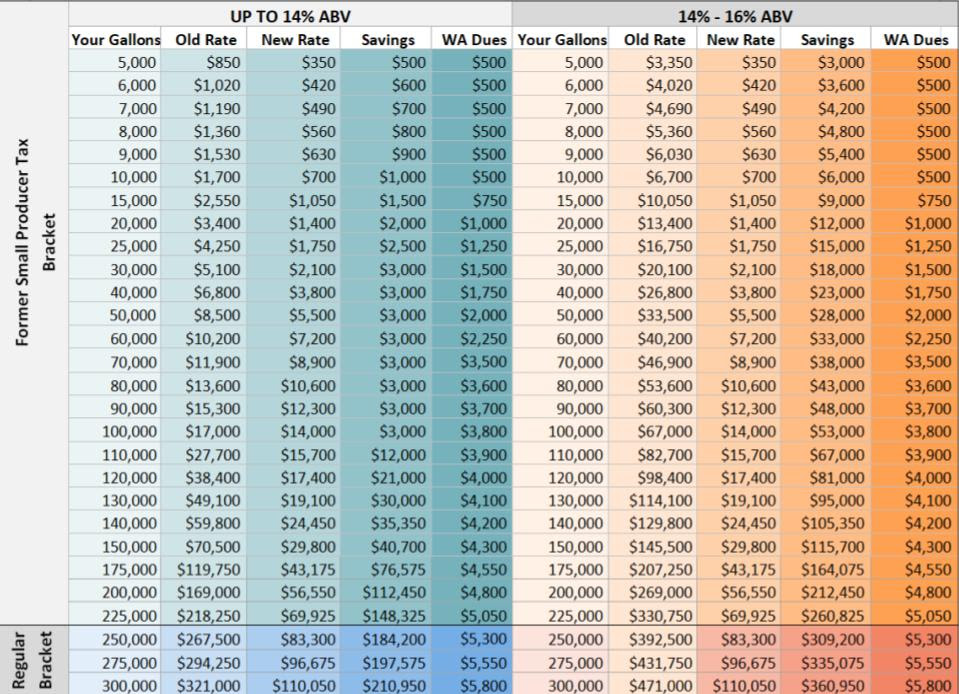
NOTE: The "Old Rate" column reflects the former Small Producer Tax Credit rate, so underestimates the true savings for wineries of many sizes. Also, the orange columns reflect the fact that wines of 14-16% abv are now considered table wines for tax purposes, leading to huge savings.