
What is Yeast?
Yeast are Eukariotic, single cell microorganisms that belongs to the kingdom of the Fungi. There are several yeast species in the Saccharomyces genera: Saccharomyces cerevisiae, S. pastorianus, S. bayanus, etc ... This diversity arises from different origins like mutations, genome assortment or hybridization. The most well- known species used industrially is Saccharomyces cerevisiae, but there are many other types of yeast. Etymologically, "saccharo" comes from sugar, "myces" from fungus and "cerevisiae" means "beers" in Latin. More commonly, Saccharomyces cerevisiae are called "brewers yeasts" and "bakers yeasts" but they may also be called "budding yeast," according to their means of reproduction.
Active Dry Yeast (ADY)
Active dry yeast is the freshest yeast format used in the winemaking industry. At Fermentis, we select and manufacture yeast that is used for a wide variety of wine styles. Our experience and expertise allow us to produce yeast that preserves all its native properties during the entire production process. In addition, as soon as the yeast is in contact with must, it is ready to ferment. This is definitively the reliable way to achieve consistent fermentations and to meet the winemakers’ needs.
How does yeast reproduce?
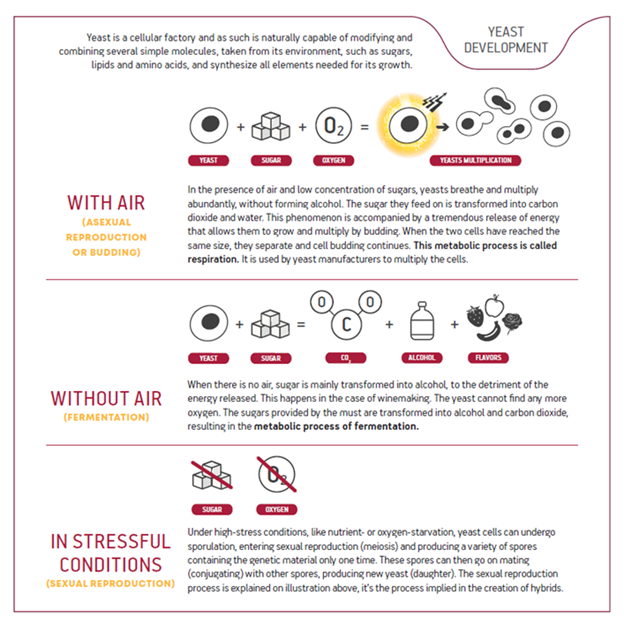
Yeast can reproduce with (aerobie) or without oxygen (anaerobie). The concentration of sugar in the environment will also play a role in the way the yeast will behave. Based on these two main parameters the yeast will produce energy in two different ways: respiration or fermentation. Yeast can also have different reproduction behaviors (budding-asexual or sporulation-sexual) according to nutrients availability and conditions. See below a summary of how growing conditions affect the outcome.
Fermentis production process
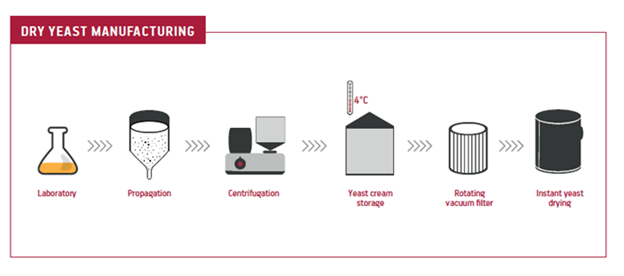
Each production starts with a cryotube containing pure yeast stored at -80°C in our Yeast Strains Bank held by our Research & Development Department. In our laboratory, the yeast cells are selected under strictly controlled conditions and propagated step by step: this is called multiplication. This small amount of any yeast strain produced in our labs then goes to our factory, where it is first propagated in very strict sterile conditions until we have enough so-called “mother yeast” that we introduce in larger-scale commercial/industrial size fermenters in which the yeast will grow on a sugar source, primarily molasses.
In these large fermentation tanks, nutrients and vitamins – amongst others – are gradually added in a process along with large amounts of sterile air in a fed-batch process. The challenge and know-how in this part of the process resides in the optimal shaping of the majority of the yeast population in its best condition, throughout the reproduction cycles during the multiplication process, for optimal subsequent drying results with preservation of all original properties of the yeast.
In a typical reproduction cycle the mother cell forms a bud, which progressively receives a duplicate of all mother yeast content (cytosol, organites, nucleus, etc.). The bud continues to grow until it separates from the mother cell, forming a daughter cell. If the mother and daughter cells are in a good medium, they both start budding again. If the yeast environment is adverse to the growth, the yeast may start to produce protective compounds like glycerol, trehalose, and glycogen. Glycerol helps the yeast to resist the osmotic pressure. Trehalose is a key contributor to the membrane stability during drying. Trehalose and glycogen are reserve carbohydrates, compounds that allow the yeast to be naturally resistant to drying. Fermentis yeasts are grown in optimum media and the recipe is specific for each strain. By the end of duplication, the yeasts are reshaped and the recipes are tuned to express resistance to drying. The yeasts then also contain all the ingredients necessary to optimally start fermentation.
After the “propagation/multiplication”, the yeast is fully grown, and the suspension is centrifuged to concentrate the yeast. It can finally be processed into three types of yeast products: liquid yeast (about 25% dry matter), compressed or crumble yeast (about 32% dry matter), and Active Dry Yeast (ADY) (over 95% dry matter). The liquid yeast, also called cream yeast, is obtained by centrifugation as it comes straight out of the fermenters and needs to be kept cold to maintain its stability. The yeast can then be further concentrated into a “solid” yeast paste called compressed yeast, by vacuum filtration. The final stage is the further drying of the yeast with a fluidized bed technology that carefully dries the yeast with hot air to a final dry matter amount of up to 96.5%.
This is how we obtain Active Dry Yeast! Our expertise allows a full conservation of the original yeast strain’s properties that are essential for proper fermentation, making it essentially the “freshest” form of yeast, while increasing at the same time the shelf-life, stability and ease of use. Learn more about our E2UTM (Easy to Use) certification on our ADY in the coming weeks!
Written by: Anne Flesch and the Fermentis team