
Sur lie (French for “on the lees”) aging sounds fairly straightforward: it is a stylistic choice to allow wine to age in contact with its lees. The overarching goal is to enhance the mouthfeel, body, and complexity of the wine by foregoing racking or other methods of lees removal for anywhere from 2 to 15 months or more (Patynowski, et al., 2002). During this time, yeast cells undergo a breakdown process called autolysis (“auto” meaning self, “lysis” meaning break apart) and release their contents, unlocking a treasure trove of beneficial compounds that enhance the finished wine. This type of aging is typically associated with white wines, such as Chardonnay from Burgundy and Muscadet from the Loire Valley, as well as sparkling wines like Champagne. Although less common, sur lie aging for red wines has also been gaining interest (Wang, 2014). Though sur lie aging has been practiced since Ancient Rome, we are still uncovering the science that enhances the complexities of the finished wines aged on their lees (Wang, 2014; Schneider, et al., 2016).
To understand the benefits and risks of sur lie aging, it is important to first define a few terms—perhaps most crucially, what exactly are “lees”? The broad definition is sediment or residue that forms at the bottom of a wine-containing vessel (Fornairon-Bonnefond, et al., 2002). Given the diversity of wines and their corresponding lees, there is no exhaustive composition, but they often contain tartaric salts, yeast and other microorganisms, and organic residues (Fornairon-Bonnefond, et al., 2002). This can be further divided into “gross” and “fine” lees, which can be crudely differentiated based on particle size. The gross (or grossier, derived from the French word for “heavy”) lees are comprised of particles over 100 microns in size that typically settle after the first 24 hours, including yeast, bacteria, tannin precipitates, and tartaric salts. Light or “fine” lees are comprised of particles one micron or smaller in size, such as yeast and lactic bacteria active at the end of the primary (yeast) and secondary (malolactic) fermentations, and often take days to settle. Although there is no rule as to which lees should be used for sur lie aging, fine lees are often preferred. The ultimate choice of lees and the timing of heavy lees separation at different stages of production is at the discretion of the winemaker and influences the sur lie aging process.
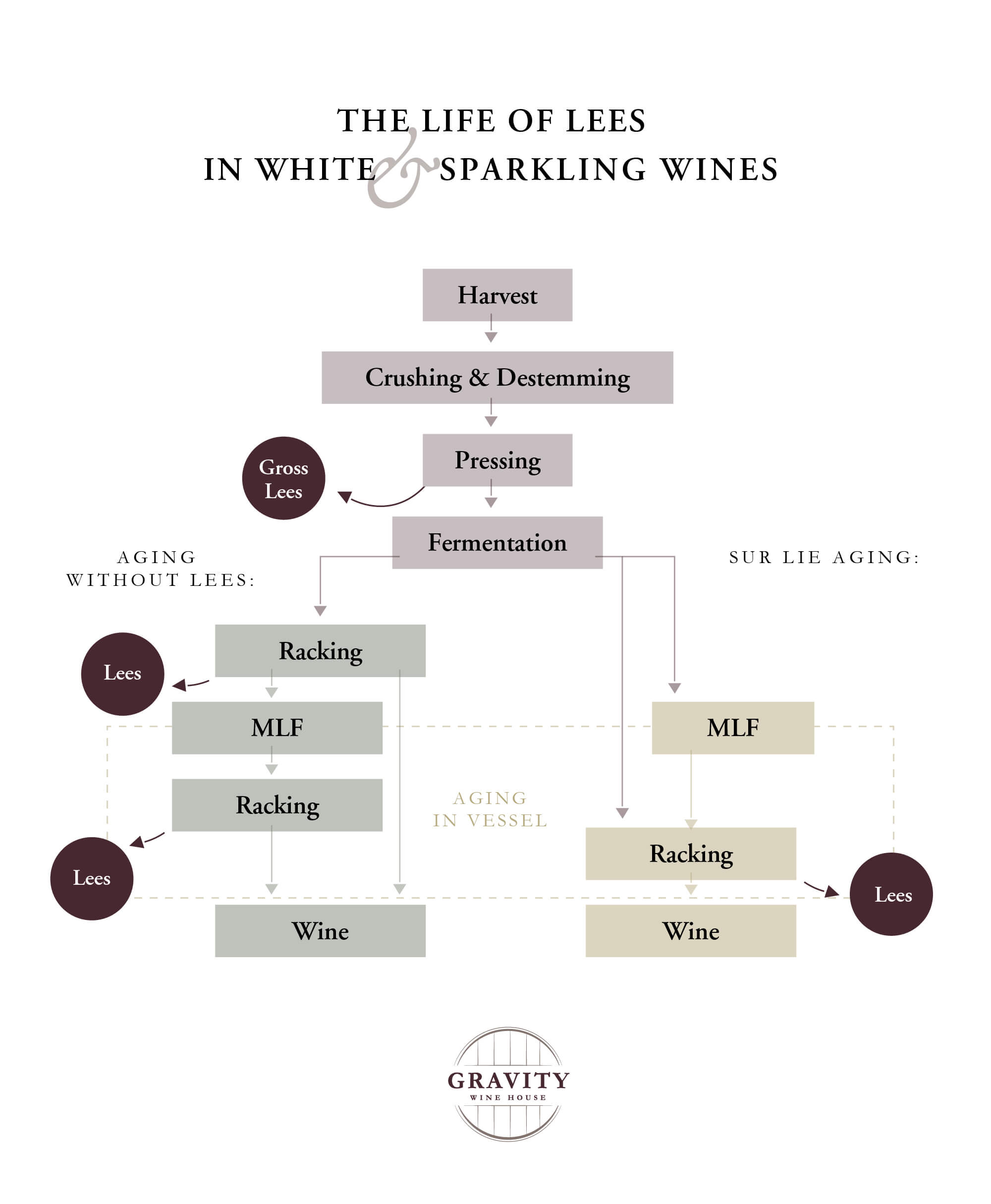
Flowchart of white and sparkling wine production showing the timing when lees can be influential or removed from an aging wine.
Why age on lees at all? When aged on lees, the wine benefits from compounds released during autolysis, such as polysaccharides, mannoproteins, amino acids, and fatty acids (see Table 1) (Pérez-Serradilla & Luque de Castro, 2008; Alexandre & Guilloux-Benatier, 2006). As the yeast responsible for fermentation run out of nutrients, the population of viable yeast shrinks rapidly as the non-viable yeast autolyze. One theory holds that compounds released by the lysed cells serve as nutrients for the viable yeast, and sustain a small but viable yeast population that can survive from several weeks to multiple years post-fermentation (Patynowski, et al., 2002; Martinez, et al., 2016). This prolonged period of autolysis and sustained release of chemical precursors for aromatic compounds allows for aging on lees to enhance the mouthfeel, body, and complexity of the wine. In particular, white wines subject to autolysis by-products have been shown to exhibit a creamy mouthfeel (Wang, 2014). The rate of autolysis is influenced by various factors, such as temperature, pH, alcohol, aeration, and presence of nitrogenous compounds (Fornairon-Bonnefond, et al., 2002). The manipulation of factors to accelerate autolysis is often desirable to reduce the risk of microbial spoilage and expedite the production process.