
Wine is the result of the fermentative activity of yeasts and bacteria. The microbiota of grape juice fermentation can vary significantly as over 40 genera and 100 different species of yeast have been isolated from grapes or wine. The genus Saccharomyces is the one that interests most winemakers. The S. cerevisiae and S. bayanus species have indeed been found capable of dominating and conducting the alcoholic fermentation with S. cerevisiae being the more prevalent. However, other yeast, collectively known as non-Saccharomyces yeast, and bacteria may also contribute to the aroma and flavor profile of the wine.
There are two basic types of wine production practices with respect to management of the microbial populations: indigenous and inoculated (deliberate addition of pure cultures of selected microorganisms).
There are two main reasons for the inoculation of selected yeasts:
1. The rapid dominance of the fermentation by a high population of Saccharomyces spp. which minimizes the contribution of the non-Saccharomyces yeast and bacteria and maximizes the chance of a good fermentation achievement.
2. The wish to accent the fruit component of the wine aroma and flavor profile, and minimize that of the wild microflora. Use of pure cultures in winemaking arose only within the last 70 years of the 7000-year history of wine production!
A HUGE IMPACT ON THE AROMATIC PROFILE!
The use of selected yeasts by winemakers is primarily intended to successfully complete alcoholic fermentation, avoiding stuck or sluggish ferments. But their impact on a wine's aromatic profile is so huge, it is also an important criterion of choice. Yeast is indeed a flavor engine responsible for up to 80% of all aroma-active compounds in wine (Ribereau Gayon 2006, Meier-Dörnberg 2017). Both varietal and fermentative aromas depend strongly on the selected yeast according to their metabolic and enzymatic characteristics.
VARIETAL AROMAS
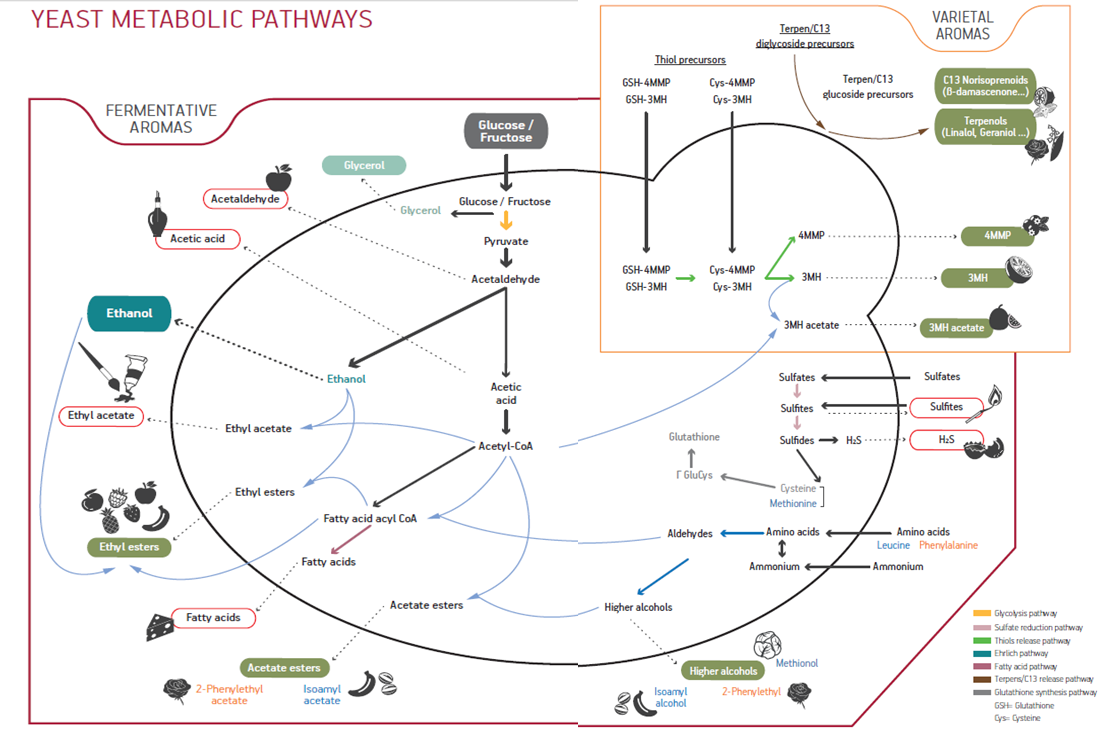
As the name indicates, they depend on the type of grapes and are mainly represented by polyfunctional thiols (Sauvignon Blanc, Colombard, etc…), terpenols (Muscat, Viognier, etc…) and C-13 norisoprenoids (Chardonnay, Cabernet Sauvignon, etc…).
The base mechanism is the same for all compounds. In the grapes, the aromas are linked to other molecules (cysteine or glutathione for thiols, sugar chain for terpenols and C13) resulting in non-volatile and odorless compounds so-called “aromatic precursors”. The volatile aroma can then be released through the action of specific enzymes (beta-lyase for thiols, glyco- and glucosidases for terpenols and C-13), their effect can be expressed by yeasts or bacteria.
The main polyfunctional thiols are the 4-mercapto-4-ethylpentan-2-one (4-MMP) with box tree, blackcurrant flavors; the 3-mercaptohexan-1-ol (3-MH) and its acetate (3-MHA) with respectively grapefruit and passion fruit flavors.
The main terpenols are the geraniol, the linalool, the nerol, the alpha-terpineol and the citronelol. They are mainly responsible for floral and citrus notes. The main C-13 norisoprenoid is the beta-damascenone, generating rose flavors and being an aroma enhancer at low concentration. S. cerevisiae have quite a weak effect on the release of terpenols from their precursors compared to certain non-Saccharomyces spp. or bacteria. Moreover, terpenols can easily be bioconverted by yeast (reduction and isomerization) into other terpenols and be naturally hydrolyzed due to the acid pH of the wine. As a consequence, their concentration is indeed affected by yeast, but it is quite complex to predict...
FERMENTATIVE AROMAS
Two of the most important compounds for winemakers are higher alcohols and esters. But we also find here ethanol, sulphur compounds, acetaldehyde or acetic acid.
Fermentative (positive or negative) aromas are generated through the metabolism of the yeast or bacteria during the fermentation process. The three sources of all these aromas are the fermentable sugars (glucose and fructose) that will undergo the glycolysis pathway, the assimilable nitrogen compounds (amino acids and ammonium) through the Ehrlich pathway, and the sulphur compounds (sulphates and sulphites) through the sulphate reduction pathway. Depending on their genetics, yeast have more or less abilities to assimilate and biotransform these compounds and to generate corresponding aromas. When we talk about fermentative aromas in wine, it generally refers to esters, as these molecules have the strongest aromatic impact.
There are two types of esters:
The acetate esters are derived from the esterification of their corresponding higher alcohols. The main ones are isobutyl acetate imparting fruity flavors; 2-phenylethyl acetate for floral flavors, and especially the isoamyl acetate, for its strong banana flavors and its ability to enhance other flavors at low concentration.
The ethyl esters are derived from the esterification of ethanol with fatty acids. Medium chain ethyl esters (ethyl butanoate, hexanoate, octanoate and decanoate) are produced inside the cell, whereas branched chain ethyl esters are produced after the autolysis of the yeast when the corresponding big fatty acids can be released by the cell. These ethyl esters are mainly responsible for fruity flavors like pear, strawberry, pineapple, etc.
VARIETAL AND FERMENTATIVE FLAVORS IN OPPOSITION?
Wine's aromatic profile is composed of a lot of different flavor molecules coming from grapes and fermentation. Together they interact and form what we call the “bouquet” or the “complexity”. Varietal and fermentative flavors are not in opposition, but in combination, and sometimes in synergy, like the release of the 3-MH by the yeast from its precursor and its esterification in 3-MH acetate (3-MHA) during fermentation. The 3-MHA having a perception threshold 15 times lower than the 3-MH, it could be very interesting to have yeast favoring the production of acetate esters!