
 I'm not going to go ahead and say that I don’t think pruning is taken seriously enough. So why is it that I see poorly pruned vineyards so often? I think that most growers and viticulturists know very well how to prune grapevines and could do a great job of it on their own—if that were possible. But most growers and viticulturists do not have the ability to prune the entirety of their vineyards on their own, so they employ a labor force to prune, just like any other manual vineyard task. All vineyard operations are important, but pruning is just a little more important because pruning affects not only the upcoming growing season’s vine balance and productivity, but potentially the longer-term ability of the vine to either build or maintain its health and productivity.
While there is certainly no problem handing over the pruning tasks to skilled laborers, it is important that the wishes of the grower or viticulturist is communicated effectively to the pruning crew, and that the crew is sufficiently supervised in order to control the quality and consistency of the job. I feel, however, that the message needs to be clear and somewhat simplified. Not to disparage anyone’s intelligence but, frankly, I think sometimes pruning plans are made overly convoluted to the point of becoming paralyzing in their complexity.
There are many methods and technologies that can be used to assist pruning decisions. Pruning formulae used to be popular (and are undoubtedly still used), where the number of buds retained per vine is based on an equation using the pruning weight of the vine. Usually, this is done on a block-by-block basis, but ideally, it is done on a more localized level. Technologies, such as LIDAR and lasers, are used to map the biomass of a vineyard on a fine spatial scale, which could add to the ability to prune to a vine-specific prescription.
Forgive me for sounding like a luddite, but unless we are pruning by machine (a perfect way to integrate those aforementioned technologies), human pruning crews are doing the job. And how are you going to communicate, on any practical level, that vine 1 needs to be pruned one way, and vine 2 another and, vine 3 a different way, etc.? The answer to that is not complexity; its simplicity. That doesn’t mean we aren’t pruning precisely. It just means we are employing some fundamentals of pruning that can be communicated to pruning crews and can be executed by them. The better pruners will adopt this and could, thereafter, prune any vineyard without much instruction. I’d like to give you what I believe to be my essentials for pruning.
Rule 1 Through 10: No Skinny Stuff
I’m not going to wait to the end of this article to state what I think is probably the most important practice, and that is to prune back to sufficiently thick, dense wood. This applies both to cane-pruned and spur-pruned systems. Don’t leave skinny wood! Why am I emphasizing this so much? It’s because I see it happen way too often, especially in cane-pruned vineyards, where it is the most detrimental and the most noticeable. Dormant buds and early-emerging shoots rely on stored carbohydrate in the woody tissues nearby. They cannot and do not produce their own photosynthetic energy until some leaves expand and become functional. Carbohydrate is stored in the permanent structure of the vine as starch during dormancy in the winter.
As the weather warms, the starch is broken down into simpler sugars. These sugars have a limited ability to move because there is little sap flowing, other than by root pressure, so the emerging buds and shoots need to feed off local carbohydrate storage. Leaving skinny wood starves the buds and young shoots for energy when they need it most.
It seems that whenever I look at a vineyard that I have not worked with before, I see excessive amounts of this skinny wood. In cane-pruned vines, this slows bud emergence, and sometimes buds don’t burst at all. Shoots that are starved of energy early in their growth usually remain stunted throughout the season. Fruit on the short shoots lag in maturation relative to fruit on stronger shoots, and short-shoot fruit is commonly dropped during one thinning pass or another. This is also true for spurs, though the effects are less dramatic because there is more permanent vine tissue near the buds of spurs than canes. Nevertheless, the same is true for spurs. Canes should be pruned back to a point where the girth of the cane is sufficient. Skinny spurs should be pruned back to one bud or even to the basal bud.
The effects are not short-term. I find that weak wood begets weak wood, and that means that the weak wood will leave weak shoots and canes that will be skinny the following year. In fact, I believe that excessive buds retained at pruning will weaken the vine over time and could potentially create ancillary problems, such as greater disease susceptibility.
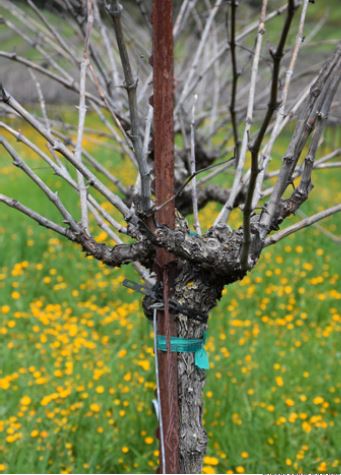
What do I use as a rule of thumb? I like to prune to wood that is no less than 1 centimeter in diameter (three-eighths of an inch). Sometimes, we can cheat just a little but not by much. I hear “pencil width” often used as a guideline, and I suggest that pencil width is an insufficient girth to use as a reference. Unfortunately, pencil width is a convenient reference because many people can intuitively “sense” it, whereas three-eighths inch or 1 centimeter is more difficult to recognize. Nevertheless, I believe it is a good rule to prune by.
Leaving thicker, stronger wood will produce more uniform and stronger shoots and canes. Vines that have been overtaxed by overly generous pruning (i.e., leaving more buds than they should have) continue to be weak. I find that pruning weak vines severely, maybe even including cutting back cordons, can allow them to regain strength if they are not diseased. A little short-term pain is rewarded with a healthy and more productive vine in the longer term.
The beautiful thing about this one simple rule? It requires no technology. Just a good eye that can recognize thick and thin wood. This rule is also site-specific. Each vine can be assessed on its own merits and pruned accordingly, which means that this is a low-tech way to prune on a vine-by-vine basis, without needing complex pruning formulae or GPS-determined locations.
There are exceptions to every rule, of course. Thick canes are good unless they are shade canes or so-called bull canes. Thick canes with long inter- nodes and that are possibly also flattened/oval-shaped, rather than round in cross-section, are often poor choices for cane-pruning. Good pruners should know that. Also, just because a cane is thick doesn’t mean it should be stretched excessively long. Cane length can be longer for thicker canes, but don’t be greedy. Eight to 10 buds per cane will usually do; any more can still lead to uneven budbreak, especially in some varieties, like Cabernet Sauvignon.
Timing
There are many aspects of timing, but often the overriding issue is the logistics of just being able to get through the pruning season in time. There are reasons to prune both early and late. Budbreak timing will be affected by the timing of pruning. However, I doubt that a shift of any more than seven to 10 days of difference will be achieved by pruning in December versus late February. Yet, that could be enough of a shift to influence a decision. Early pruning could be used where ripening is difficult for a particular variety or vineyard block. Advancing the ripening a little may make the difference between ripe fruit in October or a mercy pick in November. However, early budbreak has its pitfalls. Susceptibility to spring frosts is an important consideration as is susceptibility to poor weather during bloom and fruit set. Both risks diminish if the season is pushed back a little later, at least with typical weather patterns in the North Coast. Trunk diseases are also an important consideration. An early prune will expose vines to fungal spores much longer than a later prune. Most pruning wound protectants are effective for a short time, but they may not remain that way during the long period between pruning time and budbreak. Hence, they may need to be applied twice for early-pruned vineyards.
In other words, early pruning is really only beneficial if fruit ripening is difficult in a particular situation. Otherwise, later is better. Many growers use the double-pruning approach: They use machines or people to long-prune their vineyards early in the dormant period and then follow up late-winter with the final pruning. This is only effective for spur-pruned vines and provides good protection against trunk diseases while also reducing spring frost risk and risk of poor fruit set due to poor spring weather.
Finer Aspects of Pruning
There have been more and more discussions about some of the finer aspects of pruning; and although I have not been through the discussions offered by Simonit and Sirch, I urge you to take a look at a recent article on that very subject authored by Judit Monis in Wine Business Monthly.
The lessons are beautiful in their simplicity, which is something I can get behind. Avoid large flush cuts to older wood because they will die back and create zones of desiccation that will interfere with the vascular system of the trunk or cordon.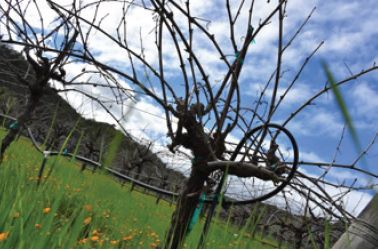
Also, avoid making cuts to both sides of a vine structure, as the dead wood will create a convoluted path for sap flow in the live wood. These poor practices not only reduce the health of the vines, by inhibiting sap flow, but also make them more susceptible to pathogen attack.
OK, you say, then what about the 100-year-old head-trained Zinfandel and Carignane vines so highly prized and so long-lived? Good question. Many of those vines beg the question, “How are they still alive?” In truth, many of those vines are barely alive and thrive only because they are pruned so severely that they are balanced. Can you buy that explanation? Hope so, because that’s all I’ve got.
That said, I usually like to see trunk and cordon suckers, if any, pruned flush to the trunk, only because we want to remove the basal buds that will push another sucker the following season. If the wood is only one-year-old, the desiccation zone into the trunk will be minimal.
Pruning is not simple. Good pruners get to be good with years of experience. I see no need or benefit in making things more complicated for them despite all of the technology we have now to make it so.
Check out Mark's full article in the January issue of Wine Business Monthly.