
Understanding the nutritional requirements of yeast is fundamental to accomplishing successful fermentations and preventing stuck fermentations. Managing yeast nutrition allows for regular and complete fermentations, as well as minimizing off-aromas and enhancing sensory qualities.
WHAT ARE YEAST NUTRITIONAL NEEDS?
Nitrogen is one of the most important nutritional factor for yeast. It is mostly used to synthesize proteins: structural proteins, necessary to create new cells; enzymes, necessary for the metabolic processes, including the conversion of sugar into alcohol, transport proteins located in the cell membrane. Saccharomyces cerevisiae can only assimilate nitrogen in the form of ammonium, amino acids, and small peptides.
Ammonium, easy to pass through the cell membrane, is the first and quickest component to be assimilated by yeast. It is used right away by the yeast.
Amino acids require more energy from yeast to be assimilated. As alcohol inhibit the amino acids uptake, the yeast, strategically, takes up amino acids in the early stages of fermentation. Once transported inside the cell, they can be accumulated in the vacuole, where they are stored and consumed slowly as the yeast needs them.
For a complete nutrition, yeast also needs vitamins (thiamine), mineral salts (Mg, Zn), sterols, and long-chain unsaturated fatty acids to succeed at fermentation. The quantity and quality of these compounds play an essential role in yeast metabolism, fermentation kinetics, and the organoleptic profile of wine.
Vitamins and minerals are cofactors in enzymatic reactions and have a role in cell growth, fermentation activity, and nitrogen metabolism.
Sterols and long-chain unsaturated fatty acids are essential component of yeast membrane and help yeast survive and resist to stress conditions.
A BIT MORE ABOUT YEAST CELL MEMBRANE…
The cell membrane is the protective barrier that allows yeast to grow and survive in the harsh environment of wine. It is composed of a double layer of phospholipids with a matrix of long-chain fatty acids, sterols, and structural and transport proteins. For proper functionment, the cell membrane must maintain its fluidity. The loss of membrane fluidity is related to the accumulation of alcohol and correlated with low sterol content and a decrease in the unsaturation index of fatty acids. This deficiency stimulates yeast to produce lipids to reconstitute the membrane, which, in anaerobic conditions, accumulate into toxins such as acetic acid and medium-chain fatty acids. To summarize, the lack of long-chain unsaturated fatty acids and sterols is one of the major causes of stuck fermentations, VA production, and toxins accumulation. To maintain a constant fluidity of the membrane and prevent stuck fermentation, it is essential to provide sterols and long-chain unsaturated fatty acids to the yeast at the early stages of fermentation and introduce oxygen during fermentation.
WHICH OTHER FACTORS SHOULD BE CONSIDERED REGARDING YEAST NUTRITION?
Temperature: An increase in temperature stimulates yeast growth and fermentation rate, thereby requiring increased levels of nitrogen.
Turbidity: In whites and rosés, juice clarification can remove some nutrients, sterols and fatty acids are essential for yeast survival.
Botrytis cinerea: Fruits affected by mold have amino acids and vitamins deficiencies.
Microbial contamination: The growth of indigenous microorganisms can cause the depletion of nutritional factors.
Yeast strains: Each yeast strain has specific nutritional requirements.
WHY USE A YEAST REHYDRATION NUTRIENT?
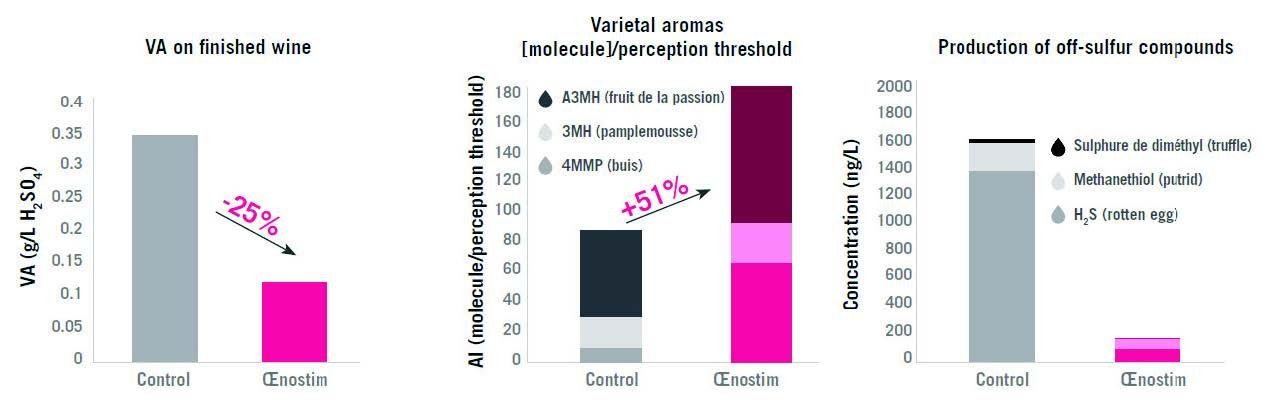
Yeast rehydration is one of the most important steps of fermentation. Sterols play a role in maintaining the integrity and the fluidity of the yeast membrane, increasing its resistance to alcohol. Adding OENOSTIM® during yeast preparation supplies them with essential vitamins, minerals, as well as lipids and sterols used to build a strong and fluid membrane and consistently improves the yeast’s health condition. OENOSTIM® ensures a healthy and complete fermentation and optimizes aromatic performance. It provides the essential building blocks for yeast membranes (long chain unsatturated fatty acids and ergosterols), guarantees fluidity of the membrane, and its correct functionment for the full fermentation. The addition of OENOSTIM® significantly reduces the production of VA and H2S and increases the expression of varietal aromas.
WHY USE ORGANIC NITROGEN FOR YEAST NUTRITION?
Organic nitrogen has been shown to be 3-5 times more efficient when compared to equivalent nitrogen values of DAP (ammonium ions). When complex nutrition strategy includes organic forms of nitrogen, the fermentation kinetic is more controlled with less heat spikes when compared to just straight DAP additions. Less stress for the yeast also helps minimize off-aromas production during fermentation. OPTIFLORE® O is a 100% organic nutrient made from inactivated yeasts rich in easily assimilable amino acids, vitamins, minerals, and micro-nutrients favoring cell multiplication. OPTIFLORE® O is an alternative to DAP in moderate nitrogen deficiency situation. It ensures regular and complete alcoholic fermentation, limits heat spikes, and is used on demand by the yeasts. The addition of OPTIFLORE® O results in more aromatic wines with less undesirable compounds such as VA, H2S, etc. 10 g/hL (100 ppm) of OPTIFLORE® O brings the equivalent of 12 mg/L of assimilable nitrogen.
WHAT TO USE IN EXTREMELY HIGH DEFICIENCY (LOW INITIAL YAN) SITUATION?
In severe nitrogen deficiencies, pure organic nitrogen is usually not enough to bring the YAN at sufficient levels for the yeast to properly conduct fermentation. It is important to use a complex yeast nutrient that brings to yeasts all essential elements for its proper development and activity, during the full fermentation. OPTIFERM® is a complex nutrient, recommended when initial YAN are low and organic nutrition is not enough to compensate the nitrogen deficiency. It is a blend of inactivated yeast, amino acids, sterols, long-chain unsaturated fatty acids, and inorganic ammonium salts (DAP). Long-chain unsaturated fatty acids and sterols are important survival factors needed to maintain the fluidity of the membrane, alcohol resistance, and fermentation activity. The presence of both forms of nitrogen provides a complex and complete nutrition. The cell wall fractions absorb short and medium-chain fatty acids that are toxic to the yeast. They also help keep the yeast in suspension.
ARE NUTRIENTS NEEDED FOR HIGH INITIAL YAN LEVELS IN MUST?
High YAN can cause yeast to produce a large biomass at the beginning of AF, which requires a high amount of nitrogen and micronutrients to maintain a healthy fermentation. The larger the yeast population, the greater the demand for YAN. High YAN musts (> 250 ppm) will benefit from an addition of nutrients at the first thid of fermentation.
WHEN IS A NUTRIENT ADDITION TOO LATE?
Nutrients are added to support the yeast metabolic processes during fermentation. When added in the last phase of fermentation (<8° Brix), yeasts are under stress and will not use all the nitrogen available. Late nitrogen additions might results in residual YAN, available for spoilage microorganisms during aging. When late additions are needed (fermentation is sluggish), we recommend to use ACTIBIOL®. ACTIBIOL® is a wine detoxifier composed of inactivated yeast, yeast hulls, and purified cellulose. ACTIBIOL® releases growth (vitamins, minerals,…) and survival factors (long-chain unsaturated fatty acids, sterols) and binds pesticide residues and inhibitory compounds such as medium-chain fatty acids. ACTIBIOL® efficiently detoxifies the wine and provides nutrients to the yeasts used for restarting the AF.
HOW MUCH YAN IS NEEDED?
The range of YAN in grapes can vary depending on the vintage conditions, vineyard practices, and grape variety. Generally, to build-up a sufficient yeast biomass for fermentation, a minimum YAN of 150 mg/L is required. The initial sugar content (°Brix) and initial YAN of juice are essential to determine the proper nutrition supplementation. Depending the yeast strain and other juice factors, nitrogen needs for yeast can vary. As a simple and quick rule, you can use the following calculation: YAN needed (mg/L) = °Brix x 10.
OUR RECOMMENDATIONS FOR YOUR GRAPES
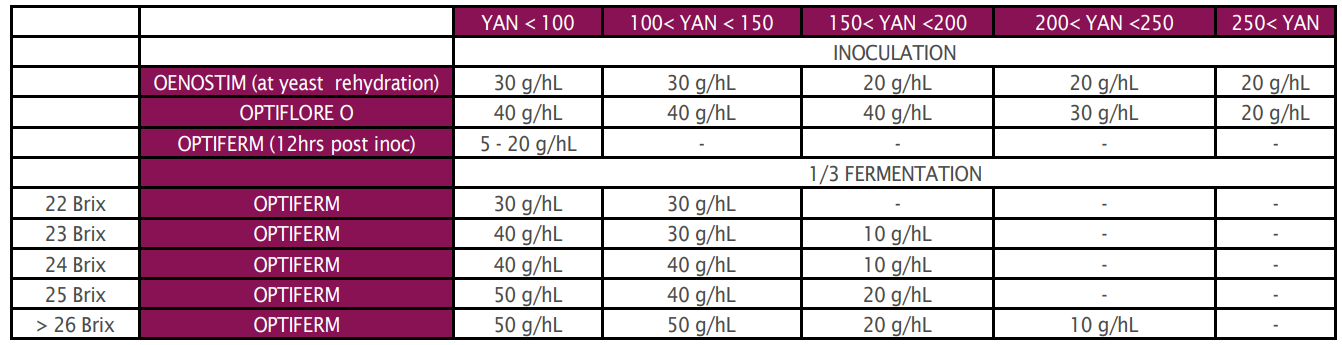
A proper yeast nutrition strategy considers the nutritional factors that are needed and at what stage they should be provided. Early in fermentation, yeast needs amino acids together with vitamins and minerals, to allow an adequate population growth without temperature increase. Encouraging an early accumulation of long-chain unsatturated fatty acids and sterols helps increase yeast endurance and survival all along the fermentation. At one-third of the fermentation, oxygen and ammonium can be supplied to ensure the cell membrane remains functional until complete sugar depletion. The nutrition strategy should also be adjusted to fermentation conditions and winemaking practices. Here some guidelines we have put together to help you decide on your yeast nutrition. If you have any questions, please contact us at bvna@buchervaslin.com
WHAT ABOUT YEAST NUTRITION AND AROMAS PRODUCTION?
Amino acids can also be used by the yeast for production of aromas. Sulfur-containing amino acids such as glutathione and cysteine derivates are precursors of thiols. Other amino acids are used by the yeast as precursors of esters and acetates. These amino acids are usually harder to assimilate; they should be used at the early stage of fermentation.
OPTITHIOLS® is a yeast nutrient rich in cysteine derivates and glutathione, giving yeast precursors for thiolic compounds, thus increasing thiols aromatic potential in wines and an antioxidant protection. This double role of anti-oxidant and varietal aroma booster increases the wine’s aromatic potential, leading to significantly greater quantities of thiols.
OPTIESTERS® is a yeast nutrient composed of inactivated yeasts naturally rich in amino acids and ergosterols. The specific formulation of OPTIESTERS® ensures the availability of the precursors of higher alcohol acetates and fatty acid ethyl esters. These compounds are precursors of fermentary esters, contributing to fruity and floral aromas. They are only formed by yeasts during the alcoholic fermentation and are optimized by the fermentation conditions: low temperature, low turbidity, yeast metabolism and yeast nutrition.
https://www.bvnorthamerica.com/news/2022/8/30/yeast-nutrition