
As Fermentis launched two new hybrid strains on the market, it can be useful to remind ourselves what hybridization is - both to demystify the term (so that everyone understands what it covers) and to clarify what winemakers can expect from it. And no less importantly, to explain why Fermentis chooses to invest time and resources to it and consolidate valuable partnerships.
A reproduction method as old as the world
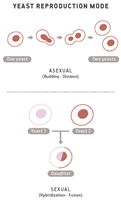
“Hybridization” is simply the production of offspring from the union of two different parents (from the same specie - intraspecific hybrids or from different species - interspecific hybrids). It is a widespread phenomenon, more common amongst the plant kingdom than in animals. Yeast, together with mushrooms and molds, occupies a place between the plant and animal kingdoms reserved for “fungi.” Like all fungi, yeast has asexual and sexual reproductive cycles. Yeast is most commonly the result of the asexual cycle (asexual because reproduction is the product of single parentage), in which a process called “budding“ occurs. “Budding” is the process in which a yeast cell divides, producing a protuberance from the side of the cell- (the “bud”), which develops to become a new cell.
Each bud or new cell, is genetically a replica of its mother cell and therefore, a clone. All it takes is a little oxygen and sugar for a yeast cell to replicate identically. As each cell can produce multiple (new) cells which in turn can do the same (thanks to budding), we can understand why budding at the core of Lesaffre’s business, i.e. to grow yeasts in sufficiently good conditions to enable them to multiply most efficiently. Then it's the task of Fermentis to understand the properties of these yeasts in order to help winemakers use them in the applications for which they are intended.
Today, our range includes thirteen strains of yeast whose biomass production comes from this asexual mode of reproduction. Among these strains, four out of the five last ones launched in the market over the past four years are coming from an hybridization process: the SafOEnoTM HD S135 and the SafOEnoTM HD S62 (launched respectively in 2016 and 2017), the SafOEnoTM HD T18 and the SafOEnoTM HD A54, launched on the market this summer 2019. HD stands for hybrid.
The objective: to take the best of each parent
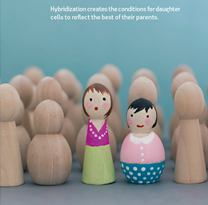
The creation of these hybrid strains was made possible with the help of our parent company, Lesaffre, which has been working for over 165 years on this wonderfully versatile micro-organism - yeast. As a global player in the world of yeast, Lesaffre supplies every yeast market: baking, pastry, food, human and animal health, plant care, new fuels... and, of course, the wine, beer, spirits market and finally, all the producers of fermented beverages. For hybridization, we defer to and benefit from Lesaffre’s genetics department to produce the best conditions for our strains to produce spores (like gametes) and to organize their “mating” while ensuring a large number of descendants. Just as happens when a spermatozoid meets an ovocyte, the “daughter” yeast cell created in the laboratory receives 50% of its genes from its first parent and 50% from its second. As Tiffany Poletti, wine engineer at Fermentis points out: “We ensure that the two selected strains meet each other although they normally could not have done so. We create nothing ex nihilo, we do not modify the genes, we simply encourage a natural phenomenon. The qualities we seek to combine in the daughter cell already exist in her parents.”
A funnel selection
We verify that transmission has taken place and that the daughter cells have inherited the intended features of their parentage, by a process of sorting and testing. Once the crossing of the strains has been achieved and cell reproduction has occurred in sufficient numbers, the daughter cells are subjected to several tests. In a process known as "screening," these tests allow us to observe their behavior and measure their resistance to sulfites, acidity, variations of temperatures, low nutrient intake, etc. As the tests progress, scrutiny increases and only the most efficient cells remain - those that meet the pre-defined genetic criteria. As a result, we have the best specimens - samples which give us complete satisfaction in laboratory conditions. It is then necessary to test these samples in real life "in the field." Trials are organized in which strains are tested in cellars on grape must, in real-life conditions - not supervised by genetecists, but by winemakers.
Championships organized on grape must
The purpose of these trials is to confront the yeast strains with the reality of use in wineries in different regions. We ask winemakers to divide their must into two homogenous tanks and to follow the exact same winemaking protocol for both. The only difference is that they use our yeast in the test tank while using their reference strain in the control tank. Fermentis provides technical support if needed together with a kit enabling wine samples to be taken towards the end of fermentation. This allows them to carry out PCR analyses to check the implantation of the yeasts for a rigorous exploitation of the results.
Everyone benefits
All this research and development, first in the laboratory and then in the cellars, is time-intensive. For example, Fermentis started working on the SafOEnoTM HD-S135 in 2010 and released the product only in 2016. The marketing of a hybrid is always an important event that is of mutual benefit globally - it confirms the robustness of the results obtained during the microvinification, while also confirming the interest of such yeast in different markets, which involves our partners (distributors and wineries) in its potential future commercialization. It is important to Fermentis that we collaborate with our research partners (private and public institutes, experimental cellars, laboratories, etc.) in these developments, so we can all move forward sharing skills and equipment, and bring our combined knowledge and expertise to a positive reality.
4 POINTS TO REMEMBER
1. The “classic” method of selecting new strains consists of isolating yeasts in cellars, on grapes in the vineyard... and cultivating them - seizing a biodiversity that exists in the winemaker’s environment andemploying it “naturally.”
2. Hybridization is different, rather like mixing colors. First we set ourselves a target of a new strain (the color) that we wish to achieve. We then select specific yeasts from our existing range which we hope, when mated, will combine to produce the target qualities we specified.
3. Our priority when creating hybrid yeasts is to always meet the needs of winemakers. For example, the need to secure fermentation despite ever higher level of alcohol, due in part to climatic variations, and the need to create wines with very few or no sulphites.
4. Each hybridization can require three to five years of research and development - with no guarantee of a satisfactory result.
 Let's meet in a few weeks to talk about our new hybrids strains!