
Based the know-how and knowledge of the Lesaffre group, the world's leading yeast producer, Fermentis – the business unit of Lesaffre for beverage fermentation- has developed a specific production and drying process of yeast that confers to them a strong resistance to a wide range of inoculation conditions while preserving their fermentation performances and their aromatic characteristics.
Fermentis uses independent laboratories and technical institutions to perform analysis and microvinification trials to certify and label its E2U™ yeasts. To better understand our validation processes, you will find below four examples of technical partnerships realized with SafŒno™ SC GVS107, SafŒno™ CK S102 and SafŒno™ STG S101 and SafŒno™ HD S135, four yeasts with very different technical and aromatic characteristics. These portions of studies are extracted from our global certification programs. The results presented below show that for any yeast pitching conditions, the yeasts maintained their viability and their vitality, assessed by their fermentative performance. In addition, the organoleptic profile of the resulting wines obtained was of equivalent quality.
√ PRESERVED VIABILITY
SafŒno™ GV S107 trial was carried out by the INSTITUT MEURICE, Belgium. This strain was selected for premium elegant white wine with an elegant fruity profile such as Chardonnay.
Conditions: SafŒno™ GV S107 was rehydrated in distilled water at different temperatures, left to rest for 15 minutes and then moderately stirred (100 rpm) for another 30 minutes.At 37°C, 2 other rehydration media were tested: 10% and 25% sugar in distilled water (Glu:Fru ratio 1:1).
Resulting viability in different rehydration condition
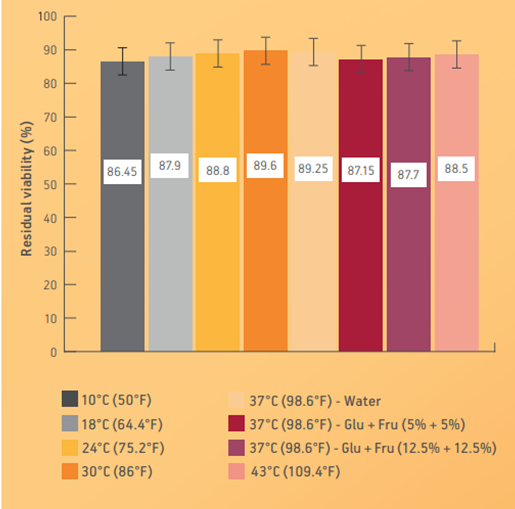
Results: SafŒno™ GV S107 showed high viability under wide rehydration conditions, even in extreme conditions (10°C and 43°C) and at different concentrations of sugar.
√ PRESERVED FERMENTATION PERFORMANCE
SafŒno™ CK S102 test was performed by INTELLI'OENO, France. This strain is a great choice of yeast for aromatic white and rosé wines even under difficult fermentation conditions.
Conditions: SafŒno™ CK S102 was tested on Sauvignon Blanc in microvinification and in a thermoregulated chamber at 18°C following different rehydration protocols and via direct inoculation:
- A: Rehydration for 35 minutes in pure water at 37°C
- B: Rehydration for 35 minutes in pure water at 17°C
- C: Rehydration at 37°C (15 min) with gradual acclimatization to 30°C (10 min) and to 23°C (10 min)
- D: Direct inoculation
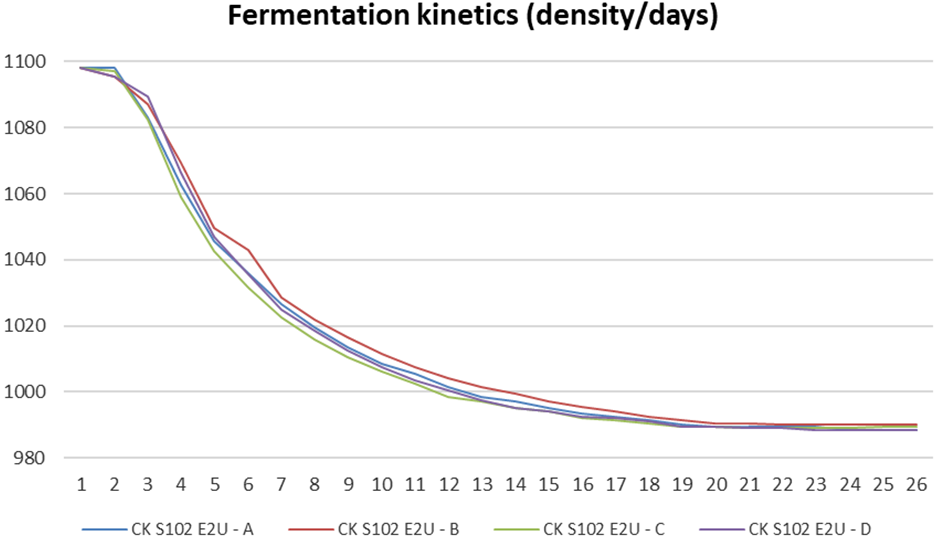
Results: The conditions under which SafŒno™ CK S102 was inoculated did not affect its excellent fermentation and analytical performance. The very fast kinetics of SafŒno™ CK S102 were maintained, confirming the benefit of direct inoculation for fast-moving wines.
√ EQUIVALENT ORGANOLEPTIC PROFILE AND QUALITY
SafŒno™ STG S101 trial was performed by SICAREX Beaujolais, France. This strain was selected and is best performing on primeur red wines.
Conditions: The SafŒno™ STG S101 was tested, following widely differing methods of inoculation, on Gamay in microvinification according to a Beaujolais Nouveau protocol with hot pre-fermentation maceration.
- R1: Rehydration for 20 minutes in sugar water (6%) at 35°C
- R2: Rehydration for 20 minutes in mineral water at 15°C
- R3: Direct inoculation / pitching
*means significant parameter at 5%.
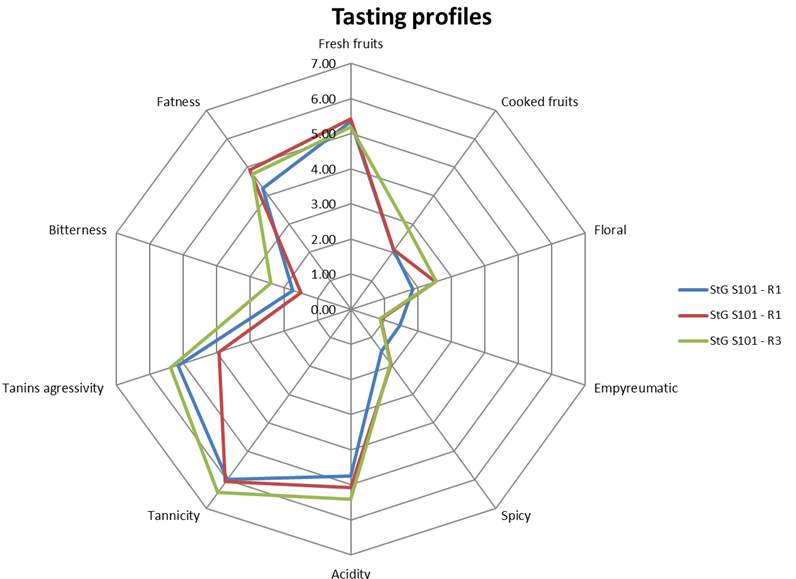
Results: The direct inoculation of SafŒno™ STG S101 yeast does not negatively significantly impact the analytical profile of the wine. On an organoleptic level, the wines obtained are judged of the same quality.
SafOenoTM HD S135 trials were carried at BIOVIN, Argentina. This strain is issued from Fermentis hybridization program for the production of full bodied and smooth red wines.
Conditions and methods : The yeast was inoculated with 3 methods to a Malbec must :
- Usual: rehydration in tap water at 35/37°C (95-98,6°F) then progressive acclimatization to must temperature with must addition before inoculation.
- Cold: rehydration in tap water at 15/17°C (59-62,6°F),
- Must: direct pitching / inoculation
A triangular tasting was performed 2 weeks before bottling with a panel of 11 professional tasters. Among 3 samples in which 2 are from the same condition and 1 from another condition. the panel must identify which one is different from the others. The objective is therefore to assess the existence of significant organoleptic differences between conditions.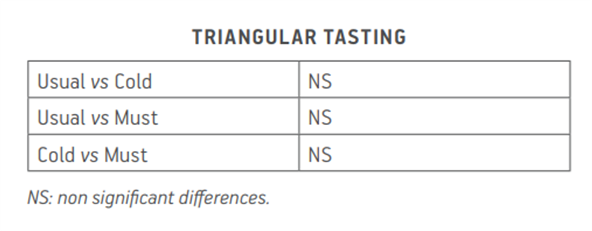
Results: The direct inoculation or cold rehydration of SafŒno™ HD S135 had no impact on global organoleptic profile compared to usual rehydration and acclimatization. The panel judged the wines as non significantly different.
When a SafOeno yeast fulfils our 3 specifications of preserved viability, preserved fermentation performance and wine of equivalent quality and aromatic profile (with descriptive tasting or triangular tasting) we certify it E2U™. Winemakers then have the possibility to use an E2U™ yeast in flexible ways and safely, via direct inoculation or rehydration without changing their fermentative and organoleptic characteristics. We now have 13 strains for winemakers certified E2U™.
More information on Fermentis strains: www.fermentis.com
And a full webinar on best practices: https://wineindustryadvisor.com/event/win-webinar-fermentis