
Filter Post Type
NewsVideoProductEventLink
Sort:
Relevance
1–10 of 43
November 29, 2022
Usually, California employers need to be prepared for the possibility of new employment laws signed during the legislative session, which adjourned on August 31. This year, there was some additional wrangling in the legislature that took a little longer. But, as expected, Governor Newsome signed several bills expanding employee workplace protections on September 29th and 30th. Below are the top laws that we believe could impact our clients. Read on, the fun has just begun! Before you start, we suggest you have your heartburn medication handy, or maybe some coffee or some other drink of choice. . . we’re HR people, and can’t tell you what kind of drink to choose, but we think you might already know. Ok, ready? Set? Here we go. . . 1. COVID-Related Bills: AB 152, AB 2693, and AB 1751 California COVID-19 Supplemental Paid Sick Leave Effective now through the end of the 2022 (But you’re already compliant, right?) Ok, we know, we’re all done with COVID, right? N
00
Check out our new video which summarizes a few new employment laws effective January 2021.
00
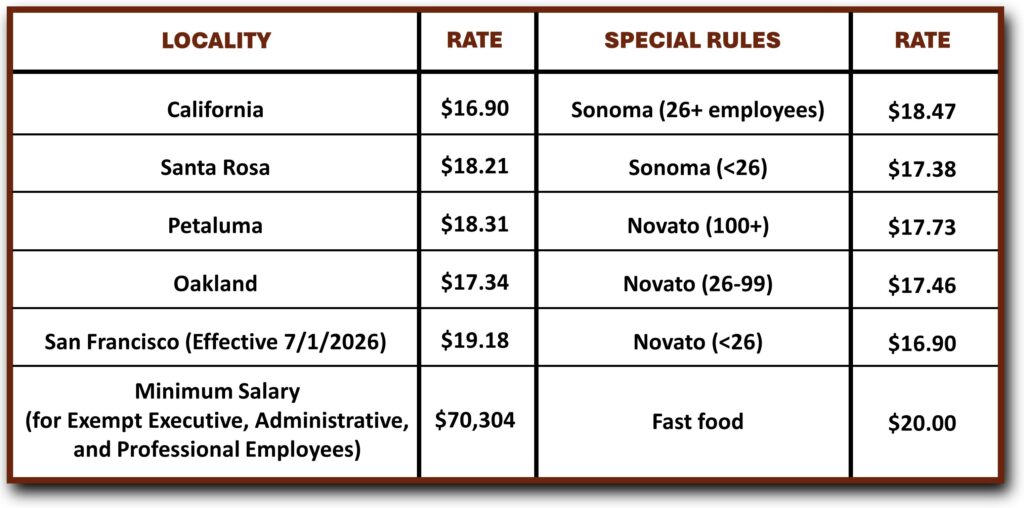
It is time to dust off the employee handbook, review your policies and procedures, and make sure they comply with all the new laws, regulations, and interpretations that went into effect during 2025, became effective in late 2025, or January 1, 2026. Below, we have identified our “top 10” changes. Please keep in mind there were hundreds of laws, regulations, and changes implemented at the local, state, and federal levels throughout 2025. This summary highlights selected changes most likely to impact California employers and is not intended to be exhaustive. So, if you need a handbook/policy review or have any questions, please call us! 1 – Minimum Wage Update: Updates happen every year. It’s best to put a calendar reminder in November, to make sure your payroll is ready! Action: Review your payroll to ensure all employees are being paid the new minimum wage, send written notice of the wage change to affected hourly employees, and be sure your salari
00
November 20, 2025
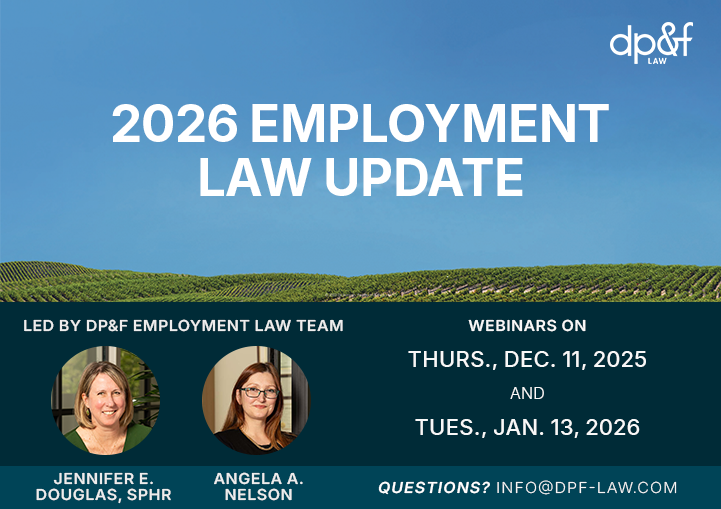
DP&F partner Jennifer E. Douglas, and employment law attorney Angela A. Nelson, will be presenting two 2026 Employment Law Update webinars this winter, sharing updates for California employers on December 11th, 2025 and January 13th, 2026. Each session will feature a legal update for changes to employment law in 2026, including updates to employer pay data requirements, minimum wage increases, tip theft laws and new stay-or-pay contracts. Jennifer and Angela will also address ongoing employment law requirements that continue to cause employers difficulty. There are two dates to choose from, one on Thursday, December 11th, and one on Tuesday, January 13th. The topics covered will be the same for both sessions, and registration links are below. Webinar Registration December 11, 2025 | January 13, 2026
00
November 19, 2025
Event Type: Webinar
Date: 1/13/2026
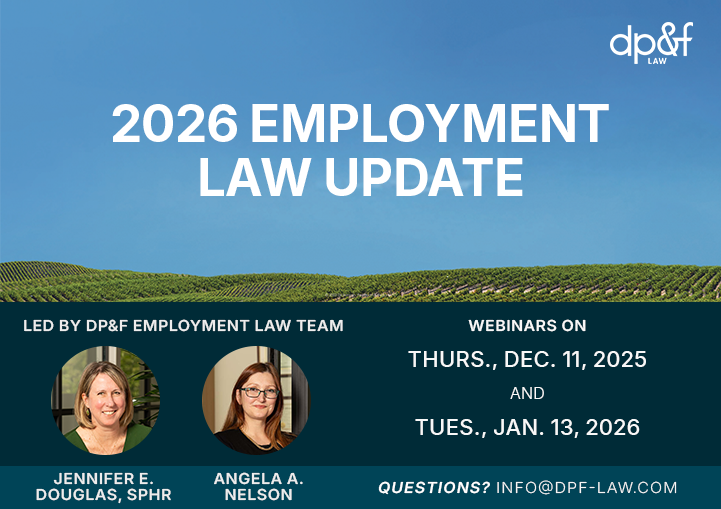
DP&F partner Jennifer E. Douglas, and employment law attorney Angela A. Nelson, will be presenting 2026 Employment Law Updates, sharing updates for California employers on December 11th, 2025 and January 13th, 2026. Each session will feature a legal update for changes to employment law in 2026, including updates to employer pay data requirements, minimum wage increases, tip theft laws and new stay-or-pay contracts. Jennifer and Angela will also address ongoing employment law requirements that continue to cause employers difficulty. There are two dates to choose from, one on Thursday, December 11th, and one on Tuesday, January 13th. The topics covered will be the same for both sessions, and registration links are below. Webinar Registration December 11, 2025 | January 13, 2026
00
November 19, 2025
Event Type: Webinar
Date: 12/11/2025
DP&F partner Jennifer E. Douglas, and employment law attorney Angela A. Nelson, will be presenting 2026 Employment Law Updates, sharing updates for California employers on December 11th, 2025 and January 13th, 2026. Each session will feature a legal update for changes to employment law in 2026, including updates to employer pay data requirements, minimum wage increases, tip theft laws and new stay-or-pay contracts. Jennifer and Angela will also address ongoing employment law requirements that continue to cause employers difficulty. There are two dates to choose from, one on Thursday, December 11th, and one on Tuesday, January 13th. The topics covered will be the same for both sessions, and registration links are below. Webinar Registration December 11, 2025 | January 13, 2026
00
August 5, 2025
If you employ full-time staff, seasonal crews, or part-time help in Oregon’s wine industry, there’s a new law that could change how you approach labor planning and workplace disputes—especially during your busiest seasons. Oregon Senate Bill 916 (SB 916) makes Oregon the first state in the country to offer unemployment insurance (UI) benefits to both public and private sector employees who are engaged in a labor strike. Why Provide Unemployment Benefits to a Striking Workforce? Lawmakers behind the bill say it’s about fairness. Their argument is that workers who are lawfully on strike shouldn’t be forced to choose between standing up for better conditions and being able to pay their bills. They point out that most strikes in Oregon don’t last long—about eight or nine weeks on average—and believe a short-term safety net could lead to more productive negotiations. But not everyone agrees. Many employers, especially in agriculture and manufa
00
July 11, 2022
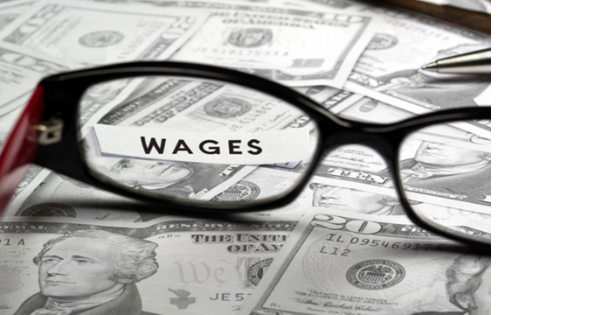
On May 23, 2022, the California Supreme Court issued a decision in Naranjo v. Spectrum Security Services, Inc., finding that meal period and rest break premium pay are considered wages. This is in accordance with the purposes of the California Labor Code’s provisions regarding timely wage payment and wage statements. As a result, the failure to pay and include meal period and rest break premium pay on wage statements can support additional penalties for wage statement violations under Labor Code Section 226 and waiting time penalties under Labor Code Section 203. What We Thought The Law Was Under California law, employees are entitled to rest breaks and an unpaid meal period. The number of breaks and periods depended on the number of hours worked but was typically two 10-minute rest breaks and one 30-minute unpaid meal period, per regular, 8-hour shift. An employer who failed to provide the requisite number or duration of the breaks during each workday
10
California Employers Face Everchanging Barrage of Information on OSHA COVID Rules Here’s What You Need to Know Compliance with OSHA COVID regulations has become extremely complicated, with almost daily changes to the requirements that California employers are subject to both under federal and state laws. Set forth below is a summary of the current status of the continually changing legal landscape on this subject and recommendations on how to proceed in the coming weeks to keep your workplace and employees safe and avoid significant OSHA penalties. 1. Federal OSHA or Cal/OSHA? As a starting point, it is important to keep in mind that Cal/OSHA is separate and distinct from federal OSHA. Although a majority of states are covered directly by federal OSHA on issues relating to workplace safety, California is one of 22 states with their own OSHA-approved occupational safety and health plan (also known as State Plans). Pursuant to this arrangement, federal OSHA and Cal OSHA hav
10
August 4, 2021
CALIFORNIA SUPREME COURT ADDS TO COST OF DOING BUSINESS BY REQUIRING EMPLOYERS TO PAY FOR MISSED BREAKS AT A HIGHER RATE OF PAY On July 15, 2021, the California Supreme Court decided in Ferra v. Loews Hollywood Hotel, LLC, that employers must pay premium payments to employees for missed meal, rest, and recovery breaks at the employee’s “regular rate of pay” (used to calculate overtime payments) instead of the employee’s base hourly rate, as most employers have always done. The Court further held that the ruling is retroactive, which will likely result in a new wave of class action suits alleging that employers who have paid meal and rest period premiums over the last four years have done so at the incorrect rate, which in turn will trigger penalties and/or attorney’s fees. This Alert evaluates the nature and extent of the likely liability risk raised by this new decision, outlines proactive steps employers can take to reduce exposure, and explores other ar
10