

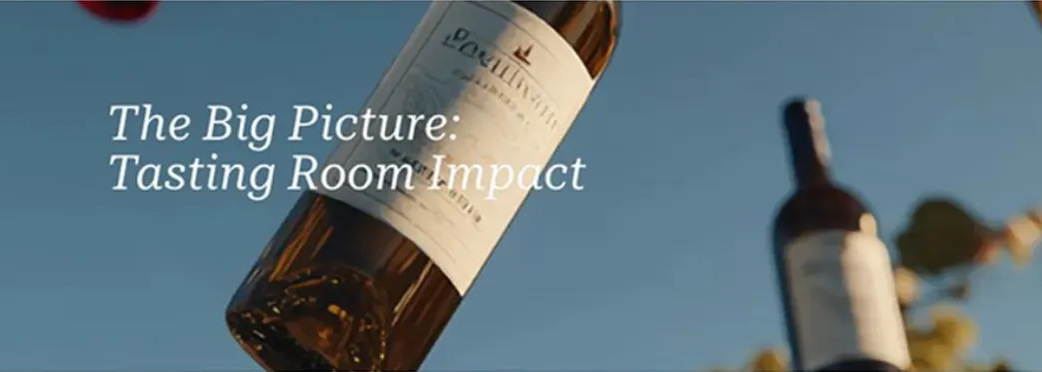
Every winery knows the tasting room matters. Few know just how much.
Commerce7 analyzed data across six global markets, and one thing kept showing up. The tasting room isn't just a sales channel. It's where most new customer records get created. Where most DTC transactions happen. Where first-time guests become regulars.
Commerce7's latest Data Drop, "The Tasting Room Effect," breaks it all down:
→ Where the revenue is actually coming from
→ The opportunities most wineries are leaving on the table
→ What growing wineries are doing differently
The Commerce7 Data Drop series is an ongoing series designed to deliver timely, digestible insights that help wineries understand what is really driving direct-to-consumer performance. What was once a single yearly data book will now be published in shorter pieces that arrive throughout 2026, giving the industry faster access to trends, benchmarks, and opportunities backed by the largest DTC dataset in wine.
Powered by anonymized data from wineries across the Commerce7 platform, Data Drops turn the company’s scale into practical knowledge any winery can use. This series is built for the entire industry, not only Commerce7 clients. Whether a winery runs on another platform or is just beginning to build out its DTC strategy, the content offers clear, actionable intelligence designed to push the industry forward.

Event Type: Webinar
Date: 2/20/2026
Curious what the new Commerce7 reporting powered by WinePulse looks like and how it works?
Join us at 10am PT/1pm ET for a practical walkthrough of how to use WinePulse to make reporting faster, easier, and more actionable—featuring special guest Remy Sabiani, Founder of WinePulse and now, Head of Insights at Commerce7. In this session, we’ll show you how to access WinePulse from the Commerce7 Admin, explore the core features and dashboards you’ll use most, and walk through common reporting workflows every winery should know.
February 20, 2026 at 10:00 am
Can't attend live?
Book a time to chat with our team to see how Commerce7 reporting works in practice. We’ll walk you through the reports and dashboards wineries use most, answer your questions, and show how better reporting can support smarter DTC decisions.
WineDirect to Commerce7: 19% Growth in Club Customization, 50% Less Support, and the End of "Batch Day"
TL;DR: Faced with manual bottlenecks on WineDirect, Hill Family Estate migrated to Commerce7 to empower their members. The results were immediate: a 19% increase in customized club shipments and a 50% reduction in support volume. Most importantly, the team reclaimed 4-5 hours of manual labour per club run by allowing their customers to customize their orders online and move to fully automated background processing.
Founded by third-generation farmer Doug Hill, Hill Family Estate is a family-run operation in Napa Valley that blends deep vineyard expertise with approachable hospitality. Their winery and tasting room experiences are known for being family-friendly, intimate, and deeply rooted in the land they have farmed for decades. For Allison Negrón, DTC Manager at Hill Family Estate, the goal is always to provide a seamless, personalized experience that reflects these core values.
As the business evolved, the team recognized that their legacy technology required a significant amount of manual effort to maintain. While they remained deeply connected to their members, the administrative overhead of their previous platform, WineDirect, was beginning to pull focus away from strategic initiatives. They needed a more intuitive system to help them scale their operations without compromising the intimate touch their brand is known for.
A Strategic Pivot Toward Scalability
Hill Family Estate chose Commerce7 because they needed a solution that could handle modern DTC complexities while ensuring a smooth transition for their 2,000 members. Rather than viewing migration as a disruption, the team saw it as an opportunity to implement a more professional, automated way to work.
A critical component of this success was a collaborative, team-based approach to the transition. Hill Family Estate partnered with the team at Vinbound Marketing, who managed the heavy lifting of the technical migration. By working closely with Vinbound on a customized migration plan, the winery ensured that their complex data and unique business needs were aligned with the new system.
This effort was bolstered by the high-touch support provided by Commerce7’s onboarding team. "Our onboarding specialist was wonderful," Allison said. "She was very knowledgeable and made the process feel manageable." Leveraging the expertise of both Vinbound and Commerce7 allowed Hill Family Estate to remain focused on their daily operations, ensuring that the migration was an additive experience for both the staff and their customers.
Reclaiming the “Batch Day”
Before migrating to Commerce7, club processing was a high-stress, manual ritual. Under their previous system, the team had to manually oversee every club run to account for complex shipping requirements and compliance rules, often processing orders state-by-state.
"We used to come in at 8:00 AM and start running the club, and we wouldn’t be done until about 1:00 PM," Allison recalled. "Then we’d still have to go through all the quarantines, clear those, and coordinate with our shipper. Now, we just come into work and the club runs itself!”
By moving to Commerce7, Hill Family Estate effectively retired the manual batch. The system handles shipping and compliance complexities automatically in the background, saving the team 4 to 5 hours of manual administrative labor per club run. This shift from manual processing to automated oversight allowed the team to reclaim their time and focus on high-value member engagement.
Club Member Empowerment: Driving 19% More Customizations and 50% Less Support
The most significant impact of the migration was the shift toward member self-service. By implementing User Choice with a Minimum Dollar Spend, Hill Family Estate gave members the freedom to tailor their own shipments: swapping bottles and adding extras directly through the website.
"When members feel in control of their own experience, the friction of administrative support disappears," Allison noted. This empowerment led to a 50% decrease in support volume during the club season.
This improved digital experience did more than just save time; it drove deeper engagement. By providing a modern, easy-to-use interface, Hill Family Estate saw a 19% increase in the number of club members who chose to customize their shipments versus taking the standard release. This shift towards personalized orders ensures that members receive the wines they love most, fostering long-term loyalty and satisfaction.
Operational Agility: Ship It Now and Instant Updates
A standout feature in Hill Family Estate’s new toolkit is Ship It Now. By sending out club notification emails two weeks in advance, the winery allows members to trigger their shipments immediately. This has created a triple-win:
- Customer Delight: Members receive their wine faster, and on their own terms.
- Accelerated Revenue: The winery begins seeing club revenue hit the books two weeks earlier than before.
- Risk Mitigation: Processing early “Ship It Now” orders gives the team a “sneak peek” into potential shipping or inventory errors before the entire club processes.
The practical simplicity of Commerce7 is also visible in the day-to-day management of the online shop. Allison highlighted that in their previous setup, updating a product required manual entries across several disparate systems. With Commerce7, product management is instantaneous. Toggling a product to "Off" takes less than a second and removes it from the site immediately, allowing the team to manage inventory in real-time.
A Partnership Built for the Future
With the time reclaimed from manual processing, Hill Family Estate is now leaning into a future focused on innovation. They are currently exploring the implementation of subscription models and more creative bundling strategies during club windows. These are strategic initiatives that were once difficult to manage but are now part of a natural progression toward a more flexible, modern way of selling.
As Allison Negrón reflects on the transformation, the value of the switch is clear. "Time is money," she explained. "When you see your staff expending so much energy in areas that could be freed up to drive revenue in other places, that’s very valuable."
Today, the team at Hill Family Estate is no longer just managing a database; they are nurturing a thriving community. With the support of a system built for the future, they are ready to continue their legacy of excellence for generations to come.
 VANCOUVER, BC – January 12, 2026 – Commerce7, the leading DTC sales platform for the wine industry, today announced the launch of Commerce7 Lite. This new entry-level plan provides small and emerging wineries with the industry-leading tools they need to scale with confidence, with an affordable price tag.
For years, smaller wineries have been forced to choose between high-end systems they couldn't yet afford or entry-level platforms that lack the sophistication needed to scale. Commerce7 Lite removes that barrier, offering a flat $59 monthly fee with no transaction fees and providing access to the platform’s core suite of solutions: Point of Sale, Ecommerce, CRM, Wine Club management, Reservations, and Analytics.
“Personally, I love small wineries, and at Commerce7 we wanted to give them access to great sales tools without the complexity,” said Andrew Kamphuis, President of Commerce7. “Lite removes the technical and financial barriers that often make it harder for small wineries to grow.”
Commerce7 Lite is a powerful growth engine for wineries with under $100,000 in annual DTC revenue, ensuring smaller brands never have to compromise on the customer experience.
Key benefits of the Lite plan include:
A Complete Ecosystem: A single source of truth that unites point of sale, web, club, reservations, and customer data, eliminating the manual work of managing disconnected systems.
Sales Oriented Growth Tools: Access to features proven to increase revenue and retention, such as Personalization, Cart Carrots for relevant upsells, Campaigns, and Smart POS Notices.
Seamless Scaling: As wineries surpass the $100,000 revenue milestone, they transition naturally into the Basic tier, ensuring their technology grows alongside their success.
A Clear Choice for the Industry
The launch of Lite redefines what an entry-level platform can be by offering a superior feature set without the complexity. For wineries currently feeling limited by basic systems or struggling with a patchwork of disconnected tools, Commerce7 Lite provides an accessible path to the industry’s most innovative DTC sales technology.
“There is no longer a reason for a winery to settle for a limited, low-cost platform,” continued Kamphuis. “We’ve removed the price barrier so that small wineries can focus on making great wine and building strong relationships with their customers.”
Wineries interested in Commerce7 Lite can learn more at https://commerce7.com/demo/
If we had to sum up the year in one word, it would be resilience. The data reveals a shift in where revenue came from this year, and who was willing to spend.
But when you look past the top-line numbers, three distinct signals emerge:
- The Tasting Room is the Volume Driver: In a shifting landscape, the in-person experience captured 35% of total market share. Your physical space is working harder than ever to convert foot traffic into transaction volume.
- The Club is the Value Driver: While guests tightened their belts (POS average order value $97), average club order value climbed to $257. Your members aren't just loyal; they are the only group increasing their average spend.
- Choice Creates Loyalty: With net club growth down industry-wide (-8.3%), retention is the priority for 2026. The good news? Clubs that offer "User Choice" are seeing average member tenure extend to over 3 years (1,159 days).
Read the full breakdown on LinkedIn
This is just the first sip.
Make sure you are following us so you don't miss the rest of the C7 Bottled series.
We aren't hiding this data behind a form or burying it in a long PDF. Between now and New Year's Eve, we are delivering these insights directly to your feed.
Here’s to a strong finish to 2025.
Cheers,
The Commerce7 Team
Commerce7 today announced the launch of Data Drops, a new ongoing series designed to deliver timely, digestible insights that help wineries understand what is really driving direct-to-consumer performance. What was once a single yearly data book will now be published in shorter pieces that arrive throughout 2026, giving the industry faster access to trends, benchmarks, and opportunities backed by the largest DTC dataset in wine.
Powered by data from across the Commerce7 platform, Data Drops turn the company’s scale into practical knowledge any winery can use.This series is built for the entire industry, not only Commerce7 clients. Whether a winery runs on another platform or is just beginning to build out its DTC strategy, the content offers clear, actionable intelligence designed to push the industry forward.
“Data is only useful when it helps you take the right next step. With Data Drops, we’re making the industry’s biggest DTC dataset readable, practical, and ready to act on. Our hope is that wineries of all sizes can use these insights to build experiences their customers actually want and find growth they might not have seen otherwise,” said Kendra Sellick, Head of Marketing at Commerce7.
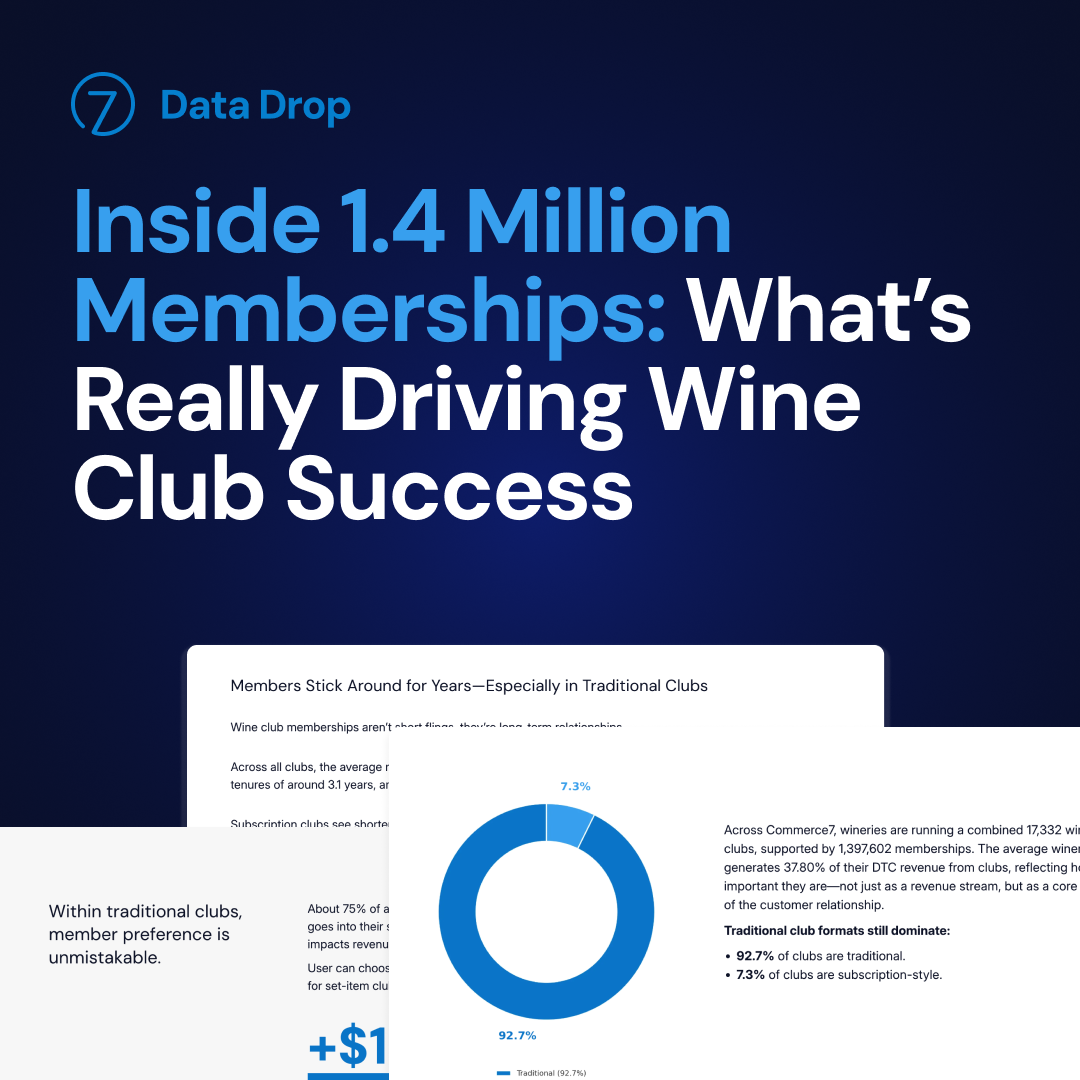
The first release in the series, titled Inside 1.4 Million Memberships: What’s Really Driving Wine Club Success, highlights the behaviors, patterns, and opportunities shaping one of the most important revenue channels in DTC wine. Based on data from 1.4 million memberships and more than 17,000 active clubs, the report reveals what top-performing clubs are doing differently, how flexibility influences retention, and where wineries are leaving value on the table.
- Key themes from this first Data Drop include:
- How customizable shipments consistently lift order value and strengthen engagement
- How editing patterns and preferences point to a growing demand for flexibility
- How different club structures influence long-term retention and overall membership tenure
- Where the clearest opportunities remain for wineries building or optimizing their club programs
Wine clubs remain one of the biggest drivers of DTC revenue, yet performance varies widely. By turning broad industry data into clear patterns, this Data Drop gives wineries a grounded view of what is working now and what they can adjust for better results.
This series reflects a larger strategy across Commerce7 to give the industry more transparency, more insights, and more opportunities to learn from real customer behavior. With more wineries on Commerce7 than any other DTC platform, the company is uniquely positioned to surface trends that help wineries personalize experiences, improve conversion, and grow with confidence.
This series will continue throughout 2026 with focused reports on ecommerce, tasting room behavior, retention, personalization, and more.
 Migrating to a new DTC platform can feel like a heavy lift. Between data transfers, integrations, and retraining staff, it is easy to delay the move until it becomes unavoidable.
But waiting is not the only risk. Choosing the wrong platform can be just as costly.
When Raj Patel of PATEL Napa Valley decided it was time to upgrade his winery’s technology, he knew the process would take effort.
“We were originally with Vin65, which was later sold to WineDirect,” Raj said. “Over the years, we considered moving from WineDirect, but the process of migrating our data and setting up a new platform always seemed too monumental, so we postponed it. When Commerce7 acquired WineDirect, it prompted us to seriously re-evaluate our options.”
Raj’s story reflects a common challenge: deciding when and how to take on a migration, and ensuring it’s the right move for the long term. Based on his experience, and what we’ve seen from thousands of wineries navigating change, here are five key questions to ask before choosing a new platform.
1. What problem are we actually trying to solve?
It’s easy to be drawn in by a fresh interface or the idea of $0 monthly fees, but the most successful migration decisions start with clarity, not cost. Before comparing platforms, take a step back and define what isn’t working today.
“We did explore other platforms and, in hindsight, made the mistake of putting Commerce7 on hold to try another provider,” Raj said. “After 60 days, countless hours, numerous data transfers, integration issues, and a lot of money, we realized our error and quickly converted back.”
For Raj, the end goal wasn’t just to switch platforms. It was to create a more flexible, efficient foundation for PATEL’s DTC business. When you understand your real priorities, you’re less likely to be distracted by pricing headlines and more likely to choose technology that truly supports your team and long-term goals for your winery.
Efficiency can also be a powerful signal that it’s time for change. If you’re still spending hours processing club shipments, managing multiple plug-ins, or juggling systems just to complete basic operations, that’s a clear indicator your platform is limiting growth. The right technology should simplify, not complicate, your day-to-day work.
2. How much of the migration will our team need to handle?
Every migration requires coordination, but the level of effort can vary dramatically between systems. Some platforms offer full-service onboarding, while others expect wineries to manage most of the process internally.
“Once we made the decision to move again, the difference in structure and guidance was night and day,” Raj said. “The migration process was clear, efficient, and well supported.”
Before committing, ask for a detailed breakdown of who is responsible for what—from data cleanup to testing and training. A structured onboarding plan prevents surprises and helps your team stay on track.
3. Will it integrate with the tools we already rely on?
Most wineries depend on multiple tools—accounting software, marketing platforms, reservation systems, fulfillment providers, and more. Ensuring these connect smoothly is critical to your daily operations.
Raj’s team learned how much integration reliability impacts overall performance.
“We spent so much time managing workarounds during our first attempt,” he said. “When integrations don’t work as expected, everything slows down.”
When evaluating platforms, ask for proof of compatibility with the tools you use most. A few extra calls or demos upfront can save weeks of frustration later.
4. What kind of support and updates are included after launch?
Launching on a new system is only the beginning. Long-term success depends on how well your team is supported once you’re live.
Ask potential vendors what post-launch help looks like. Do they offer live support or just documentation? How often are updates released, and are they included in your plan?
“The difference for us was having a clear process and responsive support,” Raj said. “That level of communication made all the difference in getting our team comfortable with the new system.”
A good migration ends with confidence, not confusion. Make sure the partner you choose invests in your success long after onboarding is complete.
5. What is the real cost of standing still?
Migration takes effort, but staying on outdated systems has its own costs—lost efficiency, limited flexibility, and missed opportunities.
For PATEL, the move unlocked a new level of control and insight.
“Ultimately, finding the right fit was what mattered most,” Raj said. “It gave us a foundation to build on for years to come.”
The lesson is simple: choosing not to move can be just as risky as choosing the wrong platform. Data-driven tools and insights give wineries the agility to adapt as the industry evolves.
--
Migration is not just a technology decision. It’s a business one. The more intentional you are about what you need and why you’re moving, the smoother the process—and the stronger your foundation for the future.
If you have questions about anything we covered in this article, reach out to us at info@commerce7.com.
In our most recent Free Training Friday, we focused on one thing: helping wineries convert holiday browsers into buyers. With peak shopping season approaching, this session was all about small, actionable tweaks you can make right now to ensure your site is ready when customers start searching for gifts.
1. Make Holiday Intent Obvious
 When shoppers land on your homepage, they're looking for one thing: the confidence that you can help them find (and ship) the perfect gift on time. That's why it's so important to give them clear visual and navigational cues that say, "Yes, we've got you covered."
That doesn't mean covering your site in red and green. Instead, aim for subtle seasonal touches that align with your brand, like warm seasonal messaging, photography, or gift-centric cues.
Two Key Updates to Add Now:
- Shipping Timelines: Clearly state cutoff dates ("Order by Dec 18 for delivery by Dec 24").
- Corporate Gifting Entry: Include an entry point high on the homepage or navigation. Even a simple "Bulk Orders? Start Here" banner can capture high-value buyers who don’t want to dig.
And don't forget: create a Holiday Collection in Commerce7 and move it above your standard release list. If a customer has to scroll or search to find your seasonal lineup, they’re more likely to bounce.
2. Simple Bundles that Sell
Holiday shoppers crave simplicity and speed, especially when buying gifts. The fastest way to get them to click "buy" is by packaging the decision for them.
Focus on Curated Gift Packs
Instead of forcing a shopper to build a multi-bottle order, present them with ready-to-ship collections. Curated gift packs eliminate friction and showcase immediate value, which is crucial for gift buyers.
- Suggestion: Aim for two to four bundles that hit different price points and gifting occasions:
- The Entry-Level Gift: A popular two or three-bottle pack (<$100).
- The Collector's Gift: A premium, higher-value six-pack featuring exclusive wines.
- The Themed Gift: A "Sparkling Celebration" or "Fireside Reds" set for a specific event.
Price Strategically
The goal isn't just to sell wine; it's to make the total cost of the bundle feel like an easy upgrade compared to buying the bottles individually.
- Tip: Set the bundle price to land on a "clean" or friendly number. A bundle priced at $115 instead of $123 is faster for the eye and the brain to process as a simple, good deal. You want the buyer to feel like they saved time and got better value.
Pre-Order and Prep Packaging Early
December delays are brutal, especially for gifts that need to arrive by Christmas. Getting ahead on fulfillment materials gives you crucial breathing room.
- Suggestion: Whether you’re fulfilling in-house or with a partner, pre-order all necessary holiday packaging now: custom boxes, filler, branded tissue paper, and gift cards or hang tags. Confirm your supply chain can meet your holiday volume so you don't face stressful stock shortages in the peak season.
Invest in High-Impact Visuals (Build Trust)
If a product looks premium, the buyer assumes the gift is premium. Don't underestimate the impact of quality photography on a gift page.
- Suggestion: If you don't have new photography lined up for your seasonal packs, consider the Outshinery Lite App for Commerce7. It offers clean, photo-realistic bottle renders at roughly $29/image—a quick, cost-effective way to level up your product pages without the time and expense of staging a physical shoot.
3. Nudge at the Right Moment: Cart Carrots for Instant Upsells
When a customer adds a product to their cart, they’re showing high intent and that’s the best time to upsell. Cart Carrots let you deliver targeted prompts directly in the cart, helping customers increase order value without ever leaving the checkout flow.
A Few Winning Ideas We Spotlighted:
- Threshold carrots like "Add 2 more bottles to unlock free shipping."
- Product-aware carrots such as "Love this Rosé? Grab our 6-pack deal."
- Gift add-on carrots offering quick gift card options ($25, $50, $100) with a single click.
- Gift wrap add-ons like "Make it a gift! Add our premium black-box wrapping.”
Because carrots can be based on collections, tags, or cart value, you can personalize offers for every segment. Plus, they can be scheduled to activate and deactivate on set dates, meaning you can prep all your holiday promotions now and let them roll out automatically later. When offers are well-timed and relevant, they don’t feel pushy, they feel helpful.
4. Personalization: The High-Value Welcome
Even small personalizations can make a big difference. A Personalization Block that welcomes returning customers by name or recommends products based on their last purchase can turn a casual visitor into a repeat buyer.
Start with easy wins like highlighting gift cards to customers who’ve purchased last-minute before, or surfacing club-exclusive bundles to logged-in members.
Example: Use the Customer Tag filter to greet buyers who purchased during last year's holiday with a banner offering early access to this year's top bundle. This simple action makes them feel valued and drives early sales.
5. A Holiday Classic: Gift Cards
Gift cards remain one of the most flexible and powerful tools in your holiday toolkit. They are crucial for your business because they lock in revenue now while delaying the cost of goods and fulfillment until the recipient redeems the card later.
The Dual Advantage: Last-Minute Sales and Zero Shipping Stress
Gift cards excel because they solve two common holiday problems for shoppers:
- The Perfect Last-Minute Gift: When shipping deadlines have passed or a shopper is simply unsure what wine to buy, a gift card is the instant, stress-free solution. By making e-gift cards highly visible, you capture sales right up to Christmas morning.
- No Fulfillment Hassle (for the winery): You secure the cash immediately, but you don't have to package, ship, or track the order right now. This shifts fulfillment volume out of the brutal December peak and into the quieter post-holiday months.
Focus on Simplicity and Flexibility
Make sure your customers know how easy and flexible the options are.
- Virtual and Physical Options: Commerce7 supports both virtual (e-gift) and physical cards. Clearly feature both options, as some shoppers prefer a tangible gift to wrap, while others just need an instant email delivery.
- Redeem Everywhere: Highlight that the cards can be redeemed across your entire ecosystem: online, through the POS, or in the tasting room. This adds maximum value and convenience for the recipient.
- A "New Customer" Acquisition Tool: Every gift card redeemed brings a new or existing customer back to your site or tasting room, virtually guaranteeing a follow-up visit and often leading to an upsell beyond the card's original value.
6. Remove Friction and Build Checkout Confidence
Your checkout experience should feel fast, familiar, and reliable, especially during the holidays when shoppers are buying gifts on tight timelines. Every extra click or unnecessary field introduces hesitation, and hesitation often leads to abandoned carts.
A great place to start is guest checkout. Keep it visible right away so shoppers can complete a purchase without creating an account. Most gift buyers are focused on speed, not long-term logins.
From there, look at how customers are paying. Enabling Apple Pay or Google Pay gives mobile shoppers a seamless, one-tap checkout that builds trust and saves time. It’s a small update that can have an outsized impact on conversion rates. When checkout feels quick and predictable, buyers not only finish their purchase, they’re more likely to return the next time they shop.
7. Keep Learning and Get Ahead
Everything covered in this session—from Cart Carrots to shareable links—is detailed in Commerce7 Docs and C7 Academy courses. If you’re short on time, aim to implement one improvement per day this week. By the time the holiday rush hits, you’ll have learned how to implement a smarter, smoother shopping experience built to convert.
Up next: Common Mistakes Haunting Wineries
Our next Free Training Friday dives into the most common pitfalls that quietly cost wineries sales—and how to fix them before the holiday rush. Join us for Common Mistakes Haunting Wineries: Banish Them Before the Holidays Hit to learn what to check, change, and clean up now.