
 The U.S. Department of Agriculture (USDA) is offering up to $1 billion of financial aid to American producers of certain specialty crops, including growers of wine grapes, through its new Assistance for Specialty Crop Farmers (ASCF) program. Per USDA’s recent press release, the goal of the ASCF program is to “help address market disruptions, elevated input costs, persistent inflation, and market losses from foreign competitors engaging in unfair trade practices that impede exports.”
USDA’s Farm Service Agency (FSA) is responsible for administering the ASCF program and will issue one-time bridge payments to qualifying farmers. To be eligible for an ASCF payment, specialty crop producers must meet the following requirements:
- Be actively engaged in farming;
- Have risk and interest in the eligible planted commodity; and
- Report 2025 planted acreage to FSA by 5 p.m. ET on March 13, 2026.
ASCF payments will be calculated based on reported 2025 planted acres, and commodity-specific rates for ASCF payments are expected to be released by the end of March. The first step for reporting 2025 planted acreage is to email the completed USDA Form AD-2047 (a fillable PDF copy of this from can be found at https://www.fsa.usda.gov/documents/ad-2047) with proof of ownership (deed of trust), lease(s), or property tax statement for the applicable parcel of farmland to your local FSA office (FSA.Vacaville.ca@usda.gov for Napa County).
After submitting the 2025 acreage report, eligible producers must then apply for an ASCF payment online at Login.gov or in-person at their local FSA office. The local FSA office address and contact information for Napa County is provided below. Local offices for other counties can be found at https://www.farmers.gov/working-with-us/service-center-locator.
Vacaville Service Center, Farm Service Agency Office
Attn: Gizela Meirinho Gover
810 Vaca Valley Parkway
Vacaville, CA 95688
E-mail: gizela.gover@usda.gov
Phone: (707) 448-0106
For additional information regarding the ASCF program, please visit www.fsa.usda.gov/fba or contact your FSA county office for further assistance.
On February 20, 2026, in a victory for American beer, wine, and spirits importers, the Supreme Court in Learning Resources, Inc. v. Trump, 607 US ____, Slip Op., February 20, 2026 (“Learning Resources”) struck down President Trump’s imposition of tariffs under the International Emergency Economic Powers Act (“IEEPA”). The Trump administration had used IEEPA to justify certain tariffs imposed on imported goods from various countries in 2025, including beer, wine and spirits.
Despite the decision in the importers’ favor, no one is popping the Champagne quite yet. First, while the Court’s opinion invalidated the Trump administration’s IEEPA tariffs, it has no effect on the administrations’ ability to rely on other statutes to impose tariffs. Second, on the same day that the Supreme Court issued its decision, the President issued a proclamation imposing a 10% worldwide tariff under a different federal law (discussed in more detail below). This new tariff is set to go into effect for a 150-day period starting at 12:01am EST on Tuesday, February 24. Then, over the weekend, the President announced on social media that this new tariff was being increased to 15%, though as of this writing, no new official proclamation has been issued. Finally, there is significant uncertainty regarding how and when importers will be refunded for tariff payments previously paid on these unconstitutional IEEPA tariffs. Indeed, administration officials have signaled that they will wait for a court order before they specify a tariff refund process.
In short, alcohol beverage importers will continue to have the unenviable task of navigating their business through tariff and trade uncertainty for the foreseeable future. We have included guidance from the National Association of Beverage Importers below on potential next steps, but ultimately, importers should seek advice from experienced trade counsel on these fast-moving issues.
Case Background
As background, IEEPA grants the President the authority “to deal with any unusual and extraordinary threat, which has its source in whole or substantial part outside the United States, to the national security, foreign policy, or economy of the United States, if the president declares a national emergency with respect to such threat.” IEEPA expressly grants the President the right to “regulate…importation or exportation of…any property in which any foreign country or a national thereof has any interest...”
Shortly after taking office, President Trump declared a national emergency with respect to two stated foreign threats: (i) drug trafficking into the United States at the northern and southern United States borders, specifically the influx of illegal drugs from Canada; and (ii) “large and persistent” trade deficits with other countries, which the President argued undermined American manufacturing. The President subsequently imposed a 10% tariff on nearly every county in the world, and higher tariffs on key U.S. trading partners including Canada, Mexico, China, the European Union, Japan and South Korea, citing his right to regulate importation under IEEPA.
The IEEPA tariffs disrupted and burdened the already struggling beverage alcohol industry by creating widespread uncertainty amongst importers, affecting cross-border sales, and eventually driving up prices for imported products.
Learning Resources and Hand2mind, two family-owned educational toy companies, filed suit in the U.S. District Court for the District of Columbia challenging the constitutionality of the IEEPA tariffs and arguing that the statute did not authorize the President to impose tariffs. In a separate action, V.O.S. Selections, a New York based wine and spirits importers, and four other small businesses filed suit in the U.S. Court of International Trade (“CIT”) raising similar arguments to those made by plaintiffs in the Learning Resources case. The plaintiffs in both cases prevailed. In Learning Resources, the administration filed an appeal with the D.C. Circuit Court of Appeals, and plaintiffs quickly filed a petition for certiorari before judgment, and the Supreme Court granted the petition. In VOS Selections, the Federal Circuit Court of Appeals affirmed the CIT decision in favor of the plaintiffs and the government filed a writ of certiorari to appeal the decision to the Supreme Court. The Supreme Court consolidated the appeals in both cases and heard oral argument on November 5, 2025.
In the consolidated Learning Resources decision, the Supreme Court held that the IEEPA does not grant the President the authority to impose tariffs. The majority first acknowledged that the power to impose tariffs is a taxing power delegated to Congress under Article I of the Constitution and therefore has “unique importance.” As the Court stated, because these taxing powers are typically reserved to Congress, “[w]hen Congress grants the power to impose tariffs, it does so clearly and with careful constraints.” See Learning Resources, Slip Op. at 17. Although IEEPA grants the President the power to “regulate” importation, the Court held that “regulate” under IEEPA does not include the power to impose taxes or tariffs because Congress did not provide clear congressional authorization granting the President the specific right to impose taxes or tariffs in IEEPA. See Learning Resources, Slip Op. at 15-17. In making these statements, the Court made clear that tariffs imposed on imported goods are a form of taxation on United States importers, and absent clear congressional direction otherwise, this is a power reserved to Congress. See Learning Resources, Slip Op. at 17.
Non-IEEPA Tariffs and New Tariff Announcements
Although the Court’s decision invalidated the Trump administration’s IEEPA tariffs, importers are unfortunately not yet out of the woods with respect to global tariffs. The Court’s decision in Learning Resources focused specifically on IEEPA tariffs, leaving the dispute between the United States and Canada with respect to tariffs imposed under Section 232 of the Trade Expansion Act of 1962 largely undecided.
Additionally, the Trump administration has made clear it will continue its tariff strategy by relying on alternative statutory support. In fact, as noted above, shortly after the issuance of the Court’s opinion on Friday, President Trump signed a Proclamation (“Imposing a Temporary Import Surcharge to Address Fundamental International Payments Problems”) imposing a temporary 10% global “surcharge” under Section 122 of the Trade Act of 1974. This provision allows a president to impose an “import surcharge” of up to 15% for up to 150 days (absent Congressional approval for extension) to address problems caused by “fundamental international payments problems” or “serious United States balance-of-payments deficits.” The next day, the President declared in a social media post that the new tariff would go up to 15% effective immediately, but no new proclamation or more official action has taken place as of the publication of this post. It is possible that importers will also challenge Section 122’s applicability and whether its requirement for a “balance-of-payments problems” is met by virtue of the deficits with other countries but that remains to be seen.
For good measure, the administration is laying the groundwork for tariffs under Section 301 of the Trade Act of 1974. That provision grants the U.S. Trade Representative (“USTR”) the ability to impose tariffs if an investigation determines that “the rights of the United States under any trade agreement are being denied” or “an act, policy, or practice of a foreign country…is unjustifiable and burdens or restricts United States commerce.” The USTR announced that it is initiating “several” such investigations “to deal with unjustifiable, unreasonable, discriminatory, and burdensome acts, policies, and practices by many trading partners.”
Uncertainty Regarding Tariff Refund Process and Timing
While the Supreme Court ruled that the IEEPA tariffs were unconstitutional, it did not provide any guidance on the process by which refunds should be issued. In his dissent, Justice Kavanaugh predicted consequential refund chaos, writing: “The United States may be required to refund billions of dollars to importers who paid the IEEPA tariffs, even though some importers may have already passed on costs to consumers or others. As was acknowledged at oral argument, the refund process is likely to be a ‘mess.’”
Now that the Supreme Court has weighed in, one would think that importers are entitled to a refund for payments made in response to the unconstitutional IEEPA tariffs. Indeed, the government has on multiple occasions in front of multiple courts, expressly stated that importers would have a right to refunds should the tariffs be deemed unconstitutional. For example, in opposing plaintiffs’ motion for a preliminary injunction in the Learning Resources case before the District Court, the government stated, “[E]ven if a stay is entered and defendants do not prevail on appeal, plaintiffs will assuredly receive payment on their refund with interest.” Learning Resources, Inc. v. Trump, No. 25-cv-01248 (D.D.C. filed Apr. 22, 2025), June 2, 2025, ECF No. 41. The CIT included a laundry list of similar government statements in footnote 1 of this decision. Accordingly, in any court action, the government would appear to be judicially estopped from arguing that importers are not entitled to refunds.
The executive branch, however, appears unwilling to make the road to refunds efficient or easy for U.S. importers. During an interview on Sunday, Treasury Secretary Scott Bessent claimed that the Supreme Court had remanded the question of refunds to the lower court. On the same day, U.S. Trade Representative Jamieson Greer stated the Court of International Trade will “have to step in and give some direction on how they want [tariff refunds] to be done.” And President Trump himself signaled that the process of tariff refunds could take years of litigation. Indeed, in an election year, the issue of tariff refunds may become a political football. Congressional Democrats are pressing the administration to provide a detailed explanation of how it will process tariff refunds, and administration officials have stated that refunds would constitute a “corporate boondoggle” for importers that have raised prices on down-stream purchasers (including consumers).
There are several moving pieces, and it is unclear whether importers will simply be able to rely on an administrative process to seek refunds, or whether they will have to file suit before the CIT in order to do so. Earlier today, the National Association of Beverage Importers (NABI) provided members with the following input regarding refunds (reprinted here with permission from NABI):
Refunds were not addressed by the Supreme Court’s majority, but when a tax is found unconstitutional, the money collected under that tax is refundable, unless the court expressly limits its holding to the parties. The court did not do that, so under ‘normal’ circumstances importers are entitled to refunds (plus interest). That is not to say that refunds will be automatic—they are not. The president hinted during his Friday press conference that refunds would need to be sought through litigation, though there is similarly nothing that indicates litigation is required across the board.
The standard refund process is either a post summary correction (PSC) for those entries which have not liquidated, and will not liquidate for at least 15 days. The standard refund process for entries which have liquidated is to file a protest.
There are unknowns with either route, and no guarantees for approval, but the costs of filing either a protest or a PSC are relatively low and would serve as the starting point for potential future litigation, should importers seek to file claims with the CIT. At this time, however, importers should be considering internally, and/or with counsel, whether they should submit through the standard Customs process to preserve their rights to a refund. Most tariffs paid on alcoholic beverages should not yet be liquidated so many entries should be ‘refundable’ via PSC.
DP&F will continue to monitor both the IEEPA refund question and the Trump Administration’s pursuit of alternative statutory authorities in support of a new tariff agenda and will publish updates as this matter evolves.
For further questions regarding IEEPA tariffs and potential refunds, or other alcohol beverage matters, please reach out to DP&F’s Alcohol Beverage Law and Compliance team.
Thank you to Andrea Nappi Conforme, President of the National Association of Beverage Importers (NABI) for assistance in reviewing this blog post with our DP&F Alcohol Beverage Law and Compliance team and in allowing us to incorporate information they previously sent to NABI members. NABI is a national trade association representing U.S. importers of beer, wine and distilled spirits. For more information about NABI or membership inquiries, please contact NABIpresident@bevimporters.org.
This blog post summarizes the process by which licensed wineries can obtain local government approval for events in Napa County held pursuant to their California Department of Alcoholic Beverage Control (“ABC”) Type 93 Estate Tasting Permit.
As discussed in our prior post, last year Governor Newsom signed into law AB720, granting California wineries that hold an ABC Type 02 winery license the ability to host events, up to 36 times per year, where they exercise tasting room privileges for wine manufactured by or for the winery on either: (1) property adjacent to the licensed premises or (2) a nonadjacent vineyard provided that such property or vineyard is owned by or under the control of the winery. (Cal. Bus. Prof. Code 23399.03.) Neither ABC nor Napa County have provided guidance as to what degree or proof of “control” is required.
Under AB 720, these new Type 93 estate tasting events are also subject to local land use controls that can “restrict, but not eliminate” the privileges granted under the ABC Type 93 Permit. Local governments have been weighing what restrictions, local permits, or authorizations are required to conduct events on vineyards located within their boundaries.
On December 16, 2025, the Napa County Board of Supervisors approved an 18-month pilot program to implement AB 720, which requires wineries wishing to conduct such events to obtain a local permit and includes certain parameters and restrictions on how such events are conducted. Here’s a run down of the application process and restrictions.
How to Apply for a Napa County Type 93 Permit
Note up front that a threshold aspect of Napa County’s implementation, discussed in more detail below, is that the property used for the Type 93 event must be on a separate parcel from the permitted winery. That means that if you own a parcel in Napa County and your Type 02 winery is located thereon, you must comply with your current use permit for events and tastings conducted on that parcel rather than make use of the 36 Estate Tasting events otherwise allowed by AB720.
Otherwise, existing Type 02 license holders can now apply online for a permit to host limited outdoor wine-tasting events on certain vineyard property pursuant to their ABC Type 93 Permit. We refer to that local permit in this blog post as the “Napa Type 93 Permit.” This pilot program expires on July 1, 2027, but could be extended by the Napa County Board of Supervisors.
The Napa County application is live and can be accessed by visiting the Napa County Online Permit Center and selecting “Start a New Application” under Napa County Fire. Each Type 93 application must include the following 4 items:
Annual Local Type 93 Permit Application: signed by the property owner or authorized operator, including primary and secondary contacts responsible for all events.
Valid ABC License: a copy of current Type 02 ABC license will suffice.
Fire and Safety Acknowledgment Form.
Aerial Site Map: to show property boundaries, agricultural and/or commercial access roads, emergency access routes (including the minimum 14-foot clearance and required turnouts/turnarounds per County standards), event activity areas, and parking areas outside emergency lanes.
The Napa County Fire Marshal’s Office will charge a flat fee of $343 for review, processing, and safety evaluation. This flat fee will be charged per application, which is specific to a vineyard parcel. This is in addition to the ABC fees referenced in DP&F’s blog post published on January 22, 2026. In total, a winery seeking to use all 36 events on one vineyard parcel in Napa County would incur Type 93 related fees (ABC and County) of $4,158.
The Napa Type 93 permit will be valid for one calendar year (from January to December). The permit must be renewed annually. Note that each event must be separately applied for with ABC, but not with Napa County.
Napa Type 93 Permit Compliance and Approval
Continued compliance with applicable ABC regulations, and other state or local provisions, remains necessary. Napa Type 93 Permit approval does not imply compliance with or approval of any other federal, state, or local law or regulation. Permit holders remain solely responsible for ensuring all event activities comply with such laws and regulations, and need to sign a form attesting that they will do so.
Approval of the permits by both ABC and the Napa County Fire Marshal does not override or impact the restrictions or limitations of any use permit or winery entitlement on the winery parcel separate from the vineyard used for the Type 93 events.
Limitations Placed on Napa Type 93 Permit Events
The Napa County Fire Marshal’s Office has published important limitations and parameters that ABC Type 93 Permit holders must abide by:
A permit holder can host up to 36 events per calendar year (consistent with the ABC Type 93 permit restrictions) with a maximum of 49 attendees per event, including staff and guests.
Each event must occur within one calendar day and can only be held during daylight hours. However, not all attendees must be present at the same time – there could be multiple smaller groups throughout the day so long as total attendance does not exceed 49 persons.
Events may not take place during days subject to Red Flag Warnings set forth by the National Weather Service and CAL FIRE.
Events may not take place inside structures requiring a permit, including residences, barns, tasting rooms, event buildings, enclosed structures, or temporary tents/structures. However, smaller (under 120 sq. ft.) structures not requiring building permits such as pop-up shade tents may be used.
All events must comply with Napa County land use regulations, fire and life-safety requirements, and applicable agricultural road standards.
All vehicle circulation must maintain unobstructed emergency access, including a minimum 14-foot clear width and all required turnouts.
Each event must remain below a total of 40 Average Daily Trips (“ADT”; or daily vehicle trips); meaning 20 vehicle round-trips total, including staff and guests.
Napa County’s Pilot Program currently prohibits wineries from hosting Type 93 events on parcels on which their ABC licensed premise is located.
As noted above, Napa County has interpreted AB 720’s requirement that the Type 93 event take place on “adjacent” property to mean a separate legal parcel from the licensed winery. Thus, in Napa County, Type 93 events are allowed only if the vineyard, or property on which the event is to be held, is on a separate parcel from the winery itself. Wineries otherwise must continue to operate consistent with their existing use permit restrictions on marketing events on those permitted winery parcels.
This means that producers that own only one parcel with a winery use permit in Napa County are not able to exercise the privileges granted under ABC Act Section 23399.03(a)(1) on that parcel. One of the statute’s proponents, the Wine Institute, has noted it disagrees with that interpretation. Tim Schmelzer, vice president of California State Relations for the Wine Institute, has been quoted as stating: “The intent for AB720 (was) to cover any vineyard next to the licensed premises so long as it is owned by or under the control of the licensee,” he said. “I’d not previously heard anyone mention this separate parcel issue.” Jess Lander, A new California law aims to help the struggling wine industry. Will it work? (S.F. Chronicle Jan. 7, 2026.)
As Napa County is currently operating the Local Type 93 permit program as an 18-month interim pilot program, feedback on the implementation will be taken and it will be revisited in the near future.
For more information on the new Napa Type 93 Permit and the application process, please contact DP&F’s Land Use and Alcohol Beverage Law and Compliance groups.
With the expected continuing market correction of the alcohol beverage industry to consumer demand, wine producers are preparing for potential bankruptcies or shuttering of trade purchaser businesses at the distribution and retail levels. This article explores how alcohol beverage producers should prepare for trade disruption caused by bankruptcies.
Bankruptcy is governed by federal law, and bankruptcy cases are exclusively handled in federal bankruptcy courts. When a business files for bankruptcy, its creditors (including suppliers with unpaid invoices) face significant uncertainty as to their ability to get paid.
Alcohol beverage producers should be aware of three key issues that will impact their contracting relationships and products in the market in the context of the bankruptcy of a distributor or retailer: (1) the effect of an automatic stay; (2) the potential for recouping certain inventory; and (3) the potential of having certain payments received from the entity filing for bankruptcy clawed back by the court. Because of the intricacies of bankruptcy law, we highly recommend you seek experienced bankruptcy counsel to help guide you through your options on how to deal with unpaid invoices, remaining inventory, and potential contract termination.
Impact of the Automatic Stay – Once a party files for bankruptcy, federal law imposes an “automatic stay” against most creditors and parties. See 11 U.S.C. § 362. An automatic stay prohibits creditors and parties from taking further action (i.e., sending collection letters or filing lawsuits) against the debtor or the debtor’s property to collect debts. The automatic stay is one of the most powerful protections for a debtor because it provides the debtor breathing room to address it’s financial situation under the supervision of the bankruptcy court. Violation of the automatic stay may result in contempt proceedings and potential damages. However, creditors and parties may still file and prosecute certain types of actions, such as criminal prosecutions, perfection and enforcement of liens, tax administration, and civil contempt sanctions. See 11 U.S.C. § 362(b). If there is any question whether the automatic stay applies, consult with a bankruptcy attorney before taking any action.
The automatic stay also limits the ability of third parties to terminate certain “executory contracts” (which may include certain distribution agreements) without obtaining relief from the automatic stay from the bankruptcy court or an order compelling the debtor to reject (terminate) the executory contract. Moreover, the Bankruptcy Code prohibits the enforcement of contract provisions that would allow parties to terminate a contract due to the bankruptcy or insolvency of another party (often referred to as “ipso facto” clauses). As a result, the ability of a supplier to terminate a distributor that has filed for bankruptcy may be limited even in states that have franchise laws that otherwise allow for termination upon distributor bankruptcy. As a result of the specific and unique constitutional preemption principles that apply to alcohol beverage regulation, there is a colorable, if not strong, 21st Amendment case to be made that federal bankruptcy law does not preempt state alcohol beverage laws, but we’ll save that discussion for another time. Again, if there is a question about the applicability of the automatic stay to contracts relating to the sale of alcohol, consult a bankruptcy lawyer.
45 Day Reclamation of Goods Shipped – If a supplier shipped goods within 45 days of the recipient’s bankruptcy filing, there is a possibility of the supplier reclaiming those goods. A supplier can make a reclamation demand, in writing, to recover such goods under 11 U.S.C. § 546(c). The goods must have been sold in the “ordinary course” of the creditor’s business, and the debtor must have received the goods while insolvent. The creditor must deliver its written reclamation demand within 45 days of receipt of the goods by the debtor, or if the 45 days have expired, the creditor must make the reclamation demand within 20 days after the bankruptcy filing which is a quick time window so it is important to make sure bankruptcy counsel is aware of the bankruptcy filing as soon as possible
Jumping Ahead of other Unsecured Creditors – Under 11 U.S.C. § 503(b)(9), unsecured creditors can elevate their claim status and potentially secure payment. Under this section, if a supplier delivered goods to a debtor in the 20 days before the debtor filed for bankruptcy, and those goods were delivered in the ordinary course of business, then the supplier can obtain administrative claim status of the amount of the goods delivered. See 11 U.S.C. § 503(b)(9). On the priority scheme detailing when claims against a debtor are paid, distributions to holders of administrative expenses are prioritized over other non priority unsecured creditors. In other words, if the administrative claim (which is only for the value of goods, excluding taxes, shipping fees, etc.) is allowed, you could jump ahead of other non priority unsecured creditors. Typically, there is a deadline for seeking a section 503(b)(9) claim set by court order, so it is imperative to closely review all relevant pleadings to ensure no deadline is missed.
90-Day Claw Back – The Bankruptcy Code allows the debtor who has filed for bankruptcy (or a trustee in a chapter 7 bankruptcy) to bring legal actions within its own bankruptcy case to recover funds or property that were transferred by the debtor to third parties 90 days before the bankruptcy petition was filed. See 11 U.S.C. § 547. These legal actions are considered “claw back” or “preference” actions. Under this section, the debtor or trustee is authorized to initiate an action to recover certain payments or property transfers made to a third party during the 90 days immediately preceding filing of the bankruptcy petition, when specified criteria are met. The goal of the 90-day claw back action is for a debtor to recover funds or property from a third-party entity or individual who received them, to then include those funds or property in the bankruptcy estate that is later distributed to creditors on the scale of priority and on a prorated basis. Additionally, for transfers to insiders (i.e., relatives, corporate officers, directors, or affiliates), the look back period is extended to one year before the bankruptcy filing date. See 11 U.S.C.§ 547(b). There are defenses to a preference claim which include payments made in the ordinary course of business, transfers where payment was made contemporaneously (COD), and where additional product was shipped after the payment which remains unpaid ie “new value.” If you think the company paying your invoices may file bankruptcy, best practice is to accept the payment (of course) with the understanding that it may be subject to a preference claim. Since these claims historically settle for much less than the fact value of the claim, a bird in hand is always advisable.
Potential Impact of Certain Statutory Liens – In California, a grower of farm products (including grapes) enjoy an automatic lien, sometimes referred to as a “secret lien,” on all products sold and processed items made from the grower’s produce until the grower is paid in full. See Cal. Food and Agricultural Code §§ 55631, 55633. For wine grape growers, this means that their lien applies not just to the grapes they sold, but the resulting wine produced from those grapes and (arguably) the proceeds of those sales. This lien is considered automatically “perfected” (i.e., valid against third parties) upon delivery of the grapes to a processor and generally has priority over all other liens, claims, or encumbrances. There does not appear to be any case law that expressly addresses whether the grower’s lien (assuming it applies to proceeds from the sale of wine) would also extend to unpaid payments due from a distributor or retailer to the processor. Any such argument presumably will need to overcome the following language found in Cal. Food and Agricultural Code § 55634: “Every lien which is provided for in this article is on every farm product and any processed form of the farm product which is in the possession of the processor without segregation of the product.” (emphasis added).
Disclaimer: This blog post is provided for general informational purposes and does not constitute legal advice. Reading this post does not create an attorney-client relationship. Bankruptcy law is complex and fact specific. For questions about your particular circumstances, please consult a qualified bankruptcy attorney.
Thank you to Chris Kuhner, a partner in the bankruptcy group of Kornfield, Nyberg, Bendes, Kuhner & Little P.C., for co-authoring this blog post with members of DP&F’s Litigation, Business, and Alcohol Beverage Law and Compliance practice groups.
For more information about legal issues surrounding alcohol beverage producer/trade buyer relationships and transactions, reach out to DP&F. For more information regarding bankruptcy law, please reach out to Chris Kuhner at Kornfield Law.
Alcohol beverage importers may finally get their answer from the United States Supreme Court this week on the validity of the Trump Administration’s tariffs issued pursuant to the International Emergency Economic Powers Act (IEEPA).[1] Recent news reports suggest that the Court’s answer may come as early as this Friday, when the Court is scheduled to issue opinions on pending cases. Based on the questions posed by both liberal and conservative justices during oral argument, many commentators expect the Court to conclude that the president exceeded his authority by invoking IEEPA to issue those tariffs.
There are, however, a lot of open questions beyond just the validity of the tariffs. Most importantly, if the Court finds the tariffs are invalid, will importers that have already paid the tariffs be entitled to refunds and what will the process be for getting those refunds. Questions also remain as to whether the case will be remanded to a lower court to determine the appropriate relief and whether it will fall to the Customs and Border Patrol to establish a refund process.
In considering a strategy for navigating the uncertain tariff environment, some importers have taken proactive steps in an attempt to protect any right they may have to claim a refund should the Court invalidate the tariffs. For example, a number of companies filed suit with the U.S. Court of International Trade (CIT) to preserve their ability to receive tariff money back should the Supreme Court deem tariffs unconstitutional. Costco, in one of the most publicized CIT cases, sought a preliminary injunction, along with several other plaintiffs, to suspend the liquidation of certain Customs entries for goods subject to IEEPA tariffs, in part based on concerns that the CIT may not have authority to order refunds through reliquidation. The other concern driving the filing is that a standard protest would not be appropriate as the actions taken by Customs in the application of duties (and tariffs) are purely ministerial in nature, and therefore not protestable.
In mid-December, CIT denied the consolidated plaintiffs’ motion for preliminary injunction finding that it was moot because (as CIT confirmed), it has the authority to reliquidate entries. The court did not address whether the liquidated entries would be protestable, implying that they may not be. More importantly, the government stated that it would not challenge a future reliquidation order by CIT and the CIT confirmed that based on its statements, the government would be judicially estopped from doing so in the future.
Notwithstanding CIT’s denial of plaintiffs’ motion, importers may ultimately be required to file an action with CIT to obtain a refund. The CIT noted in its opinion and denial of Costco’s motion that injunctions were not the appropriate tool to prevent entries from liquidating as Customs would be overrun and unable to process the volume of requests. This implies that CIT filings from every affected importer would not be encouraged for the same reason.
While it is difficult to predict the future, we can take court opinions and orders in the IEEPA cases to draw some reasonable inferences. At this stage, assuming the IEEPA tariffs are invalidated, it is most likely that CIT will consolidate pending cases and issue a ruling on how refunds will work for all importers.
In the meantime, there are some actions importers can take to be in a position to pursue a tariff refund.
Take steps to confirm current access to CBP’s Automated Commercial Environment system (ACE).
Maintain records (separate from the ACE System) in case the ACE system is overwhelmed or otherwise made inaccessible should the tariffs be invalidated by the Supreme Court.
Make sure documentation and records are complete, including (for each entry of goods): entry number; entry date; HTS code and description; type and amount of duties paid; country of origin; projected liquidation date. Importers should also have copies of 7501s, entry summaries, commercial invoices, packing slips, and bills of lading.
Note also that the first alcohol imports subject to IEEPA tariffs will begin to liquidate in mid-February.
Thank you to Andrea Nappi Conforme, President of the National Association of Beverage Importers (NABI) for co-authoring this blog post with our DP&F Alcohol Beverage Law and Compliance team. NABI is a national trade association representing U.S. importers of beer, wine and distilled spirits. For more information about NABI or membership inquiries, please contact NABIpresident@bevimporters.org.
For further questions regarding IEEPA tariffs and potential refunds, or other alcohol beverage matters, please reach out to DP&F’s Alcohol Beverage Law and Compliance team.
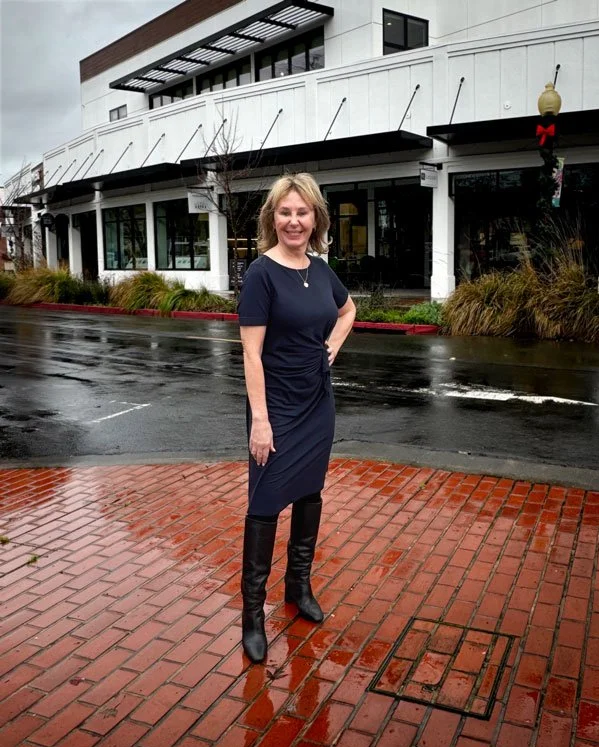 Napa, CA (January 6, 2026) – Dickenson Peatman & Fogarty (DP&F) is pleased to announce that attorney Tracy Genesen, former Vice President and General Counsel for Wine Institute, has joined the firm’s Alcohol Beverage Law and Compliance (ABLC) practice group.
Tracy is internationally recognized for her legal work in the alcohol beverage industry. At DP&F she will continue providing incisive, strategic counsel to help business owners and operators successfully navigate the challenges inherent to highly regulated industries, including those for wine, spirits, and ready-to-drink beverages (RTDs).
“We are thrilled to have Tracy join our team and further expand our deep bench of attorneys with expertise in the alcohol beverage space,” said DP&F managing partner John Trinidad. “She has been at the forefront on the key legal and policy issues – both domestic and international – that alcohol beverage businesses face: advertising and marketing, e-commerce and direct-to-consumer sales, climate change, distributor relationships and barriers to trade. We are excited to have her collaborate with our clients and help them successfully navigate this heavily regulated industry and achieve their business goals.”
Partner Bahaneh Hobel, who leads the ABLC practice group at DP&F, shares, “DP&F’s ABLC practice is built on decades of experience across all facets of alcohol beverage law and regulation, and we are proud to represent wineries, breweries, distilled spirits producers, importers, wholesalers, retailers and third -party players nationwide. Tracy’s extensive, practical experience aligns seamlessly with our practice and strengthens the guidance we provide clients, whether its advising on strategies for starting new lines of business or partnering to craft sophisticated and creative marketing and promotional initiatives.”
Prior to joining DP&F, Tracy served as Vice President & General Counsel for Wine Institute from 2016 to 2024, providing strategic legal counsel and risk management leadership for the public policy advocacy group, which represents 85% of U.S. wine production, and 90% of U.S. wine exports. Following her tenure at Wine Institute, Tracy served as Associate General Counsel at E. & J. Gallo Winery where she provided strategic legal direction for the organization’s U.S. Spirits and Malt Business Sector, including the company’s RTD division. She previously served as General Counsel of Edrington Americas, the United States arm of the ultra-premium global spirits company, and before that, was a partner at law firms Reed Smith LLP and Kirkland & Ellis LLP.
While at Kirkland & Ellis, Tracy acted as lead industry counsel for Granholm v. Heald, the landmark U.S. Supreme Court case that has become the legal cornerstone of today’s national direct-to-consumer shipping landscape. Tracy also is a lecturer at the University of California at Berkeley School of Law where she teaches a Wine Law course with DP&F Managing Partner John Trinidad. Over the past fifteen years, Tracy has held faculty positions at UC Berkeley School of Law and the UC Davis School of Law. She served as a lecturer at Stanford and Harvard law schools, and guest lecturer at Stanford Graduate School of Business and the Santa Clara University Leavey School of Business, and also taught under special appointment at the Université de Reims in France.
“I am privileged to join the exceptional legal team at DP&F, a firm that has been a storied torch bearer for the law and policy in the alcohol beverage industry,” said Tracy, “I look forward to serving as a strategic business partner and practical risk management advisor to firm clients.”
DP&F Of Counsel and foundational wine law attorney, Richard Mendelson shares, “Tracy continues the tradition and legacy of DP&F as a leader in alcohol beverage law and policy. We were the first firm in Napa Valley to specialize in wine law, and now, with the addition of Tracy, joining John, Bahaneh, and me, we have multiple layers of local, national and international expertise and relationships across the wine, beer, and spirits sectors. We are glad to welcome Tracy to DP&F.”
About DP&F
Dickenson, Peatman & Fogarty PC (DP&F) is a full-service law firm serving clients in wine country and worldwide with individualized and sophisticated counsel, delivering pragmatic solutions to advance our clients’ business goals. We advise businesses throughout their lifecycle—from formation to transition—in key areas of law: business transactions, intellectual property, labor and employment, land use, litigation, real property, alcohol beverage regulation and compliance, and wine law.
POSTED BY Theresa Barton Cray
As we near the close of a challenging year for the alcohol beverage industry, suppliers are understandably looking for creative marketing campaigns to boost sales. Unfortunately, given the highly regulated world of alcohol beverage marketing, creative marketing ideas can sometimes hit the proverbial brick wall of regulatory restrictions. All is not lost, however, and there is still room for creativity provided suppliers work within the parameters of alcohol beverage regulations.
To start, below are some common pitfalls that suppliers should avoid when marketing their alcoholic beverages in California and elsewhere.
Retailer Partnerships
Suppliers should closely examine any new marketing programs that involve or mention licensed alcohol beverage retailers. Partnerships with, or sponsorships of, retailers are in most cases going to run afoul of the tied-house laws in California, and in most other states, which prohibit suppliers from giving (directly or indirectly) money or any other “thing of value” to on- or off-sale retail licensees absent an applicable statutory exception.
The California Department of Alcoholic Beverage Control (“ABC”) interprets the “thing of value” concept broadly, viewing anything from prepaid gift cards to free or discounted event tickets or airfare as potential trade practice violations. Even a social media post mentioning an individual retailer on a supplier’s account is a “thing of value” (i.e., a free advertisement for the retailer), absent an exception that otherwise allows it.
And while there are a number of exceptions to the above rule, including certain exceptions allowing the listing of retailers in association with certain events or permitted non-profit sponsorship, these exceptions are interpreted extremely narrowly. As the ABC recently noted in an Industry Advisory issued earlier this month:
“When utilizing an authorized tied house exception, licensees are responsible for complying with all the requirements, notifications, or other limitations exactly as provided, as each exception is narrowly constructed and may only occur within the parameters of that law. If no exception exists, then an action is always considered illegal…”
Free Goods to Consumers
The California ABC Act bars licensees from giving premiums, gifts, or free goods to consumers in connection with the sale of alcoholic beverages. Although there are a few exceptions to the general rule (e.g., refunds for returned products, consumer contests or sweepstakes, advertising specialties, certain coupons or rebates, charitable marketing), those exceptions are narrow and subject to very specific limitations and conditions. A promotion offering a free gift or some type of bonus with purchase may seem like a great marketing tool, but these types of promotions are permitted only if expressly authorized by (and subject to the conditions of) an applicable statutory exception.
For example, outside of prizes related to permitted contests or sweepstakes or coupons/rebates, any gifts given to a winery’s customers cannot cost more than $1 per item. For beer and spirits, the limits are also different: any free goods offered to consumers must not exceed $3 per item if offered by a beer manufacturer or $5 per item if offered by a distilled spirits supplier.
It is not all doom and gloom, however, when it comes to alcohol beverage marketing! DP&F advises clients regularly on the permissibility of novel marketing programs, identifying areas of risk and collaborating with clients to develop exciting and new programs.
For more information about regulatory restrictions, or to discuss your own novel alcohol beverage marketing initiatives with one of the attorneys on DP&F's Alcohol Beverage Law and Compliance team, reach out to Bahaneh Hobel, John Trinidad, or Theresa Barton Cray.
 Napa, CA (December 2, 2025) – Dickenson Peatman & Fogarty (DP&F) is pleased to announce the election of Melissa Granillo, a member of DP&F’s Litigation group, to the firm’s partnership.
Melissa is an experienced litigator who has represented businesses and individuals in a wide variety of general litigation matters such as contract disputes, trust and estates litigation, and real property law. She has also handled a broad array of matters for DP&F’s wine industry clients, including matters pertaining to grape purchase, alternating proprietorship, production, custom crush and distributorships, as well as smoke taint claims and collections.
Partner David Balter, who leads the firm’s Litigation Group, shared, “Melissa is an accomplished litigator who has had enormous success obtaining favorable results on behalf of clients over the last fifteen-plus years of her practice. Guided by her character and integrity, Melissa approaches every matter with sound judgment and exceptional legal skills, which has earned her the respect of her clients and peers. We are very pleased to expand Melissa’s role at DP&F.”
Melissa joined DP&F in May of 2023 from a well-respected litigation firm in Southern California, where she gained extensive litigation experience, primarily defending governmental entities in state and federal courts through all stages of litigation, including trial and appellate work. She has made significant contributions to the firm and the legal community since joining DP&F, previously serving as a judge pro tem and now serving as in-house Associate General Counsel to the firm. In addition to general litigation and wine-industry related practice, Melissa’s litigation experience comprises general torts, premises liability, civil rights, police liability, real estate law, insurance claims, ADA claims, and employment matters. She received her law degree from Loyola Law School at Loyola Marymount University, graduating cum laude and Order of the Coif, and is a graduate of University of California, Los Angeles.
About DP&F
Dickenson, Peatman & Fogarty PC (DP&F) is a full-service law firm serving clients in wine country and worldwide with individualized and sophisticated counsel, delivering pragmatic solutions to advance our clients’ business goals. We advise businesses throughout their lifecycle—from formation to transition—in key areas of law: business transactions, intellectual property, labor and employment, land use, litigation, real property, alcohol beverage regulation and compliance, and wine law.
For more information, please visit our website at www.dpf-law.com.
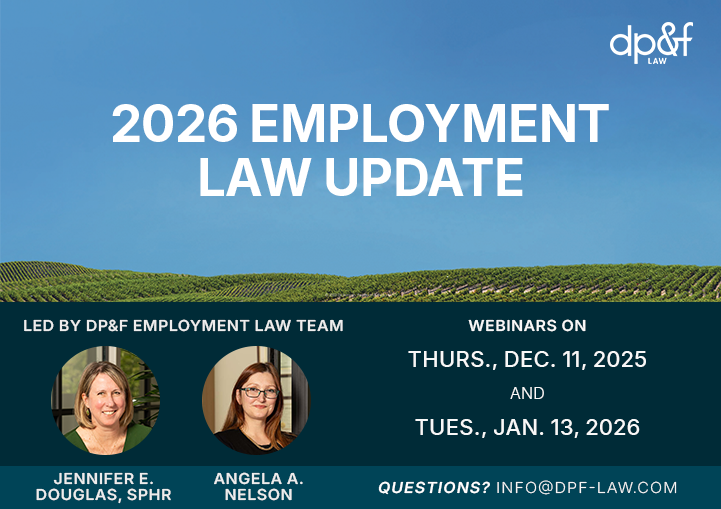
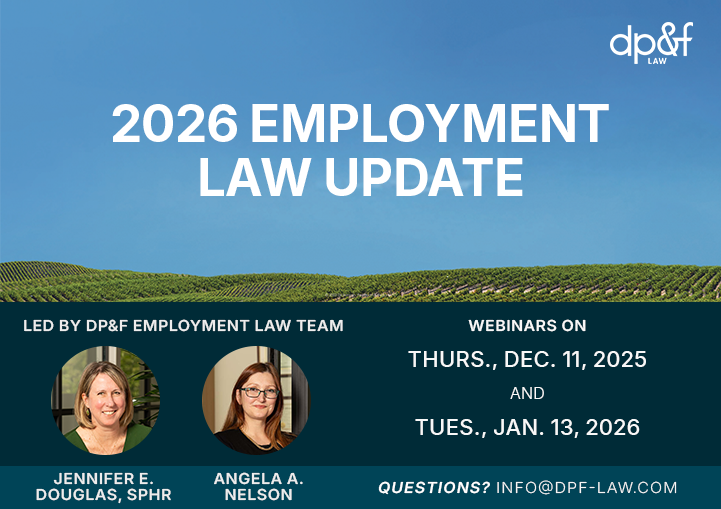
DP&F partner Jennifer E. Douglas, and employment law attorney Angela A. Nelson, will be presenting two 2026 Employment Law Update webinars this winter, sharing updates for California employers on December 11th, 2025 and January 13th, 2026.
Each session will feature a legal update for changes to employment law in 2026, including updates to employer pay data requirements, minimum wage increases, tip theft laws and new stay-or-pay contracts. Jennifer and Angela will also address ongoing employment law requirements that continue to cause employers difficulty.
There are two dates to choose from, one on Thursday, December 11th, and one on Tuesday, January 13th. The topics covered will be the same for both sessions, and registration links are below.
Webinar Registration
December 11, 2025 | January 13, 2026
Event Type: Webinar
Date: 1/13/2026
DP&F partner Jennifer E. Douglas, and employment law attorney Angela A. Nelson, will be presenting 2026 Employment Law Updates, sharing updates for California employers on December 11th, 2025 and January 13th, 2026.
Each session will feature a legal update for changes to employment law in 2026, including updates to employer pay data requirements, minimum wage increases, tip theft laws and new stay-or-pay contracts. Jennifer and Angela will also address ongoing employment law requirements that continue to cause employers difficulty.
There are two dates to choose from, one on Thursday, December 11th, and one on Tuesday, January 13th. The topics covered will be the same for both sessions, and registration links are below.
Webinar Registration
December 11, 2025 | January 13, 2026