

Recent-vintage stocks growing tighter
The 2026 harvests in the Southern Hemisphere are in full swing – a number are ahead of a typical schedule, in fact – and this month’s Global Market Report provides the latest on conditions, grape quality, and crop-size expectations.
With one exception, the bulk markets of the world have been quiet over the past month. The introduction to our March 2025 report applies again 12 months on: “The bulk market can be characterised as slow and steady since mid-February, with the Southern Hemisphere focused on harvest and demand in the Northern Hemisphere dampened by flat or declining retail sales and, in Spain, some elevated pricing.” Wary buyers are waiting to see how the harvests affect availability and pricing before committing, perhaps using the intervening time to take the industry pulse at shows like Wine Paris (growing in prominence; we review its recent instalment here) and ProWein, and generally try to gain a read on retail sales performances since the turn of the year.
The mood music on the US market is that easier comparisons with a very challenging 2025 create the opportunity for wine sales figures to stabilise, with 2026 potentially a “transitional moment” before performance improves later in the year or in early 2027. Only time will tell if this proves accurate and if it can also be said of Europe and beyond. Recent developments in the Middle East at the very least raise a serious question mark over this view, with the strong possibility of an energy price shock and logistics disruption leading to added inflationary pressure on consumers already possessing reduced purchasing power since the 2021-23 inflation surge.
If the severer economic consequences do not come to pass, and wine sales do concertedly start to stabilise in key markets, ongoing supply adjustments such as the current crisis distillation and uprooting schemes in France, green harvesting in Spain, and vineyard removals in California, could tip rightsizing into overcorrection as 2026 turns to 2027. “Undersupply” is not a word that has featured much in our reports in recent years – and as the France page states this month, “the market is not there yet” – but some current/recent-vintage wine stocks in some supplier countries are becoming tight.
Click on the button below to go through to the full Ciatti Global Market Report for March. The Global Pricing Grid, with all the latest pricing tables, will arrive into your email inbox soon.
Read the full Ciatti Global Market Report for March
Ciatti at ProWein
Are you reading this while at ProWein? Come see our international broker team on Stand K02 in Hall 6 to get the latest market intel and discuss buying and selling opportunities. Click here to find our stand on the interactive hall plan.
California’s smallest winegrape crush since 1999
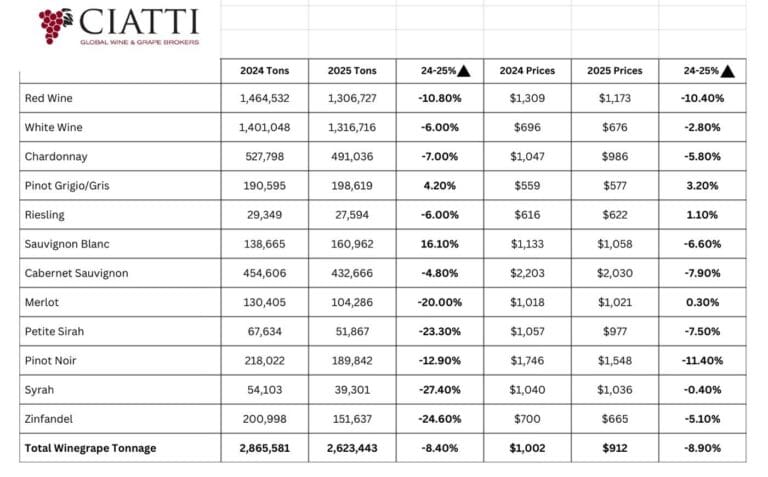
March 13, 2026 — The California Department of Food & Agriculture’s Preliminary Grape Crush Report for 2025 was released today, March 13th. The winegrape crush of 2,623,443 tons was down 8.4% versus 2.866 million tons in 2024 and the smallest since 2.617 million tons in 1999, but above the Ciatti Company’s guesstimate of 2.4 million tons.
The final tonnage, although lighter than 2024, was perhaps slightly higher than many expected. This may be an indication that yields were larger than anticipated, as there was a significant portion of unpicked grapes.
Some observations:
- The harvest in District 4 (Napa) was down overall by 2.2%, with Cabernet Sauvignon down slightly by 1.4%.
- Cabernet production was down 4.8%, with a total of 432,666 tons in 2025 versus 454,606 tons in 2024.
- Chardonnay production was down 7%, totaling 491,036 tons versus 527,798 tons in 2024.
- Pinot Noir production was down 12.9%, totaling 189,842 tons versus 218,022 tons in 2024.
- Pinot Grigio (+4.2% to 198,619 tons) and Sauvignon Blanc (+16.1% to 160,962 tons) were the only major varieties to see larger production than in 2024.
- The harvest in District 8, Santa Barbara/San Luis Obispo counties (which includes Paso Robles), was up 4.5%, largely due to Cabernet Sauvignon increasing 12.7% from 2024.
- In the Interior, the harvest in Lodi District 11 was down overall by 11.2%.
The full preliminary crush report can be found here.
The Ciatti California Report for April will dive deeper into the results. Our March report can be found here.
Green shoots: Is this a “transitional moment”?
With spring getting underway, this month’s California Report assesses vineyard conditions, grape demand, and whether the bulk wine and grape markets are seeing the first tentative green shoots of recovery: Is the industry in a “transitional moment” before growth returns later this year or next? We dive into recent reports that case-good sales declines in the US are slowing, using the latest SipSource US wholesale depletions data to pick out some sales trends.
The convergence of pricing toward California-appellation levels on all but a select handful of wines theoretically enables bulk wine buyers to make their decisions based purely on which samples best meet their quality/character specifications. This has opened up product development and scope for wine companies to attack potential retail opportunities. With wine aisles growing shorter, this is a challenging time to “buy the dip” with innovative SKUs, but we have seen it happening.
The state-wide convergence in bulk pricing is being assisted by a bifurcation of the supply-demand dynamics between the Coast and the Interior. The latter is a year or two more advanced in its supply-demand readjustment, and therefore a good barometer of what we might expect to see more generally later this year, or next. This month’s report continues to relay how these two regions, in differing stages of their adjustment, are affecting each other. It also extends last month’s deeper dive into the make-up of the bulk inventory currently listed with us, by analyzing Cabernet and Chardonnay specifically.
This month’s Saxco Update on beverage packaging details how recent developments in the Middle East are affecting logistics and the price of imported glass bottles, and provides the latest on US import tariffs: “In conversations with wineries over the past month, many teams are once again evaluating their packaging sourcing strategies as global logistics and trade policy continue to shift.”
Read the full Ciatti California Report for March
Keep an eye out for our 2025 Grape Crush Report release, landing in your email inbox after the CDFA’s Preliminary Grape Crush Report is published this Friday 13th.
Bulk wine suppliers are invited to list their 2025 wines with us and send in samples, and ensure they have their 2024 wines on our inventory list, so we are able to harness buyer interest as it arises.
Grape growers are recommended to inform us of the grapes they may have available next year, in 2026, so we can work to match-up suppliers with buyers.
Please contact Mark (+1 415 630 2548 / mark@ciatti.com), Michael (+1 415 630 2541 / michael@ciatti.com) or the Ciatti Customer Account Team (cargroup@ciatti.com).
Market slow; older stocks skew availability picture
In this month’s Global Market Report, all countries are united in reporting the symptoms of an industry entering the fourth year of a challenging environment: late loadings, late payments, cashflow shortages, and vineyard removals. Already gathering momentum is a belief that 2026 will be another “transitional” year before market stability finally arrives, hopefully in 2027. But many wine industry operators are running out of time for things to improve.
On the supply side, strides have been made over the past two years, assisted by shorter winegrape crops across the world: thanks to a combination of Mother Nature and human hand, global production in 2024 was estimated to have been the lowest since 1961, and 2025 production registered only a slight uptick. A significant challenge is the “polluting echo” of older inventory, which gives buyers a skewed perception of abundance. Current or recent-vintage supply, most commonly requested by buyers, is generally closer to balance. On some bulk markets, a lack of buying activity can be mainly attributed either to a shortage of the most requested wines (sending buyers to alternative supplier countries), or elevated prices stimulated by the shortage (encouraging buyers to secure wines incrementally, or seek out alternative countries).
The main problem is that, all the while the supply side has made positive strides, demand has continued to retreat. The decline in wine consumption in North America and Europe shows few if any signs of abating. As Italy’s page observes this month, if the wine industry cannot work out how to stabilise sales in its largest consumption markets, enhancements in production and efficiency will “merely become excess capacity”. The Italy page argues for “investment in communication and intelligent marketing”.
But while innovations in messaging, packaging and “gateway” products such as wine-based RTDs can help turn the tide of consumer perception, value-oriented wines – possessing a taste profile the consumer actively enjoys, priced at where the consumer is prepared to pay – are ultimately what will sustain long-term growth. Given the opportunities currently sitting on the bulk market, including wines diverted from the bottled trade, now is an advantageous time for buyers to secure supply that, ultimately, hits the price-quality sweet spot the next generation of wine consumers – more indebted, less flush with discretionary cash than its predecessors – is looking for.
To harness the best of what the market has to offer and make the most informed choices, get in touch directly with the Ciatti broker team, which can leverage its global reach and local connections. The team enjoyed meeting faces old and new at Wine Paris this month, and looks forward to meeting many more at ProWein in March.
Read the full Ciatti Global Market Report for February.
Ciatti at ProWein
Ciatti will be attending ProWein 2026, being held at Messe Düsseldorf on 15-17th March. The international broker team will be out in force around the show and on Stand K02, Hall 6. Click here to find us on the interactive hall plan.
To set up a meeting with Ciatti brokers ahead of time, head to our contacts page.
Market rich in strategic buying opportunities
With 2026 already six weeks old, this month’s California Report relays the bulk wine and grape activity levels that we have seen since the turn of the year: What has been receiving buyer interest, and at what kind of pricing? As well as updating our monthly bulk inventory charts, we drill down deeper into the inventory we have listed with us, finding the availability picture a little more nuanced than might be assumed.
Cashflow is now an almost universal concern throughout the industry, and late payment has become a common issue. Many growers are minimizing farming until their vines are contracted, some uprooting altogether. Buyers – outside of those fulfilling private-label programs – are wary of committing; some even have wine or grapes to sell. Adding to buyer hesitancy is the lack of evidence that case-good sales are stabilizing – this month’s report has the latest from SipSource on US wholesaler depletions – and the significant adjustments underway in the distributor/wholesaler channel: A churn in operators and a rationalization of SKUs is clogging up a supply pipeline already clogged by a high inventory-to-sales ratio.
Many have already tempered their expectations for 2026, considering 2027 the year that could herald a more stable grape and bulk wine picture. However, given the price, quality and availability of what is currently on the market, now is an opportune time for buyers to secure grapes or bulk wine that, ultimately, hit the price-quality sweet spot the next generation of wine consumers – more indebted, less flush with discretionary cash than its predecessors – is looking for.
While “gateway” products such as wine-based RTDs, and innovations in packaging and messaging, can help turn the tide of consumer perception, value-oriented wines – possessing a taste profile the consumer actively enjoys, priced where the consumer is prepared to pay – are ultimately what will sustain growth in the long term. Current availability provides plenty of scope for those buyers who believe they have identified, or are seeking to fulfil, a growth opportunity.
Read the full Ciatti California Report for February.
Bulk wine suppliers are invited to list their 2025 wines with us and send in samples, and ensure they have their 2024 wines on our inventory list, so we are able to harness buyer interest as it arises.
Grape growers are recommended to inform us of the grapes they may have available next year, in 2026, so we can work to match-up suppliers with buyers.
Please contact Mark (+1 415 630 2548 / mark@ciatti.com), Michael (+1 415 630 2541 / michael@ciatti.com) or the Ciatti Customer Account Team (cargroup@ciatti.com).
2025 reviewed; 2026 opportunities set out
This month’s Global Market Report reviews the bulk wine and grape markets of 2025 and sets out, country by country, the opportunities – and the potential pitfalls – that 2026 brings. Will this be the year that wine consumption in Europe and North America finally stabilises, so the wine industry can turn its attention from rationalisation to growth? We asked the same question a year ago of 2025 and, ultimately, the answer was a firm ‘no’.
The “vibecession” that characterised 2024 – a disconnect between reasonably stable economic indicators and consumer perceptions of the economy – continued into 2025, exacerbated by political volatility around the world. Earnings increases have continued to lag the 2021-23 inflation spike induced by the pandemic, and some more localised inflation since, shortening the shopping list of grocery items consumers consider necessities and extending the list of items they consider discretionary.
As the Global Market Report’s sister publication, the California Report, put it this month: “Much has been made of health messaging, but wine’s uncompetitiveness on a price-per-unit basis versus a proliferating array of alternative alcohol products is likely a significant handicap among younger consumers and the 2020s consumer in general, whose spending power remains reduced versus pre-pandemic. In those countries in which wine tends to be priced as an everyday item and not a discretionary purchase – Spain and South Africa, for example – consumption has been stabler.”
Buyers seeking to fulfil the retail market’s need for wines and innovative wine products that offer the cost-conscious shopper a convincing price-quality ratio will find plenty of eye-catching opportunities listed in the following report. Suppliers, too, will learn where they can best funnel their wines.
In general, in a number of markets, competitively-priced generic wines feel closest to some semblance of supply-demand balance. This has potentially been caused by an accumulation of shorter harvests over the past three years, at a time when increased price-sensitivity among bulk-wine buyers has seen some focus more on availability at the lower end of the price hierarchy. It will be interesting to see whether the 2026 harvests in the Southern Hemisphere – now imminent – preserve or disrupt this tentative sign of balance on entry-level wines that currently exists in some markets.
With its global reach and local connections, Ciatti is uniquely positioned to facilitate the just-in-time operating model that has become increasingly common in recent years and is set to continue doing so in 2026. The whole team would like to wish all of its friends, clients and business associates a very happy and prosperous year ahead.
Paying and complimentary subscribers can read the full Ciatti Global Market Report for January Here. A brief review of currency exchanges in 2025 pertinent to the bulk-wine market can be read here. The Global Pricing Grid, with all the pricing tables, will arrive into your email inbox soon.

Ciatti at Wine Paris
Ciatti’s international broker team will be out in force at Wine Paris 2026, being held at Paris Expo Porte de Versailles on 9-11th February.
Last year’s edition saw exhibitor numbers surpass 5,000 (exceeding ProWein’s 4,200) and visitor numbers reach a record 53,000 (greater than ProWein’s 42,000). Some 45% of attendees hailed from outside of France. This year, Wine Paris says it will welcome over 6,000 exhibitors representing 60 countries and over 60,000 visitors from 155 markets.
To set up a meeting with Ciatti brokers ahead of time, head to our contacts page.
2025 in review; looking ahead to 2026
This month’s California Report looks back at 2025 on the bulk wine and grape markets and ahead to what we might expect to see in 2026. Bulk inventory charts for a number of 12-month ranges – and updated for January – are included, so too SipSource US wholesaler depletions data that takes in the opening two months of the important OND sales period, and the first packaging bulletin of the year from our friends at Saxco. A Q&A with Ciatti broker Chris Welch, discussing the current wine consumption and bulk market situation, will be published in the coming days.
It is fair to say 2025 – like 2023 and 2024 before it – was not an easy year for California’s wine industry, nor was it for the wine industry globally. Evolving consumer preferences as the Baby Boomer generation shrinks, persisting post-pandemic inflationary tailwinds, and economic and political uncertainty, have been eroding sales in most major wine-consuming countries. Both the extent and the duration of the sales decline have surprised many, and – now we are almost five years on from the pandemic’s demand spike – cannot be attributed simply to destocking of accumulated inventories.
Much has been made of recent health messaging, but wine’s uncompetitiveness on a price-per-unit basis versus a proliferating array of alternative alcohol products is likely a significant handicap among younger consumers and the 2020s consumer in general, whose spending power remains reduced versus pre-pandemic. In those countries in which wine tends to be priced as an everyday item and not a discretionary purchase – Spain and South Africa, for example – consumption has been stabler.
This month’s report states that, in 2025, “negociant buyers seeking to fulfil private-label programs represented a greater proportion of the reduced buyer pool” in California, fueling the “rising suspicion that private-label sales at club store chains were outperforming the rest of the wine category”. The issue is that production costs for many of California’s growers and wineries are close to, or greater than, the California-appellation pricing levels much of the state’s bulk wines currently command. Consequently, the industry – “from grapevine nurseries right through to wine SKUs on the retail shelf” – has been in retreat.
Are there green shoots of recovery as 2025 turns to 2026? It would be surprising if two consecutive crops below 3.0 million tons, and reduced custom-crushing by growers, do not lead to a bulk market more stable than it was in 2023-25, but only time will tell if the most important factor – retail sales stabilization – finally occurs.
Ciatti’s broker team stands ready to draw upon its many decades of combined experience to help guide buyers and sellers through 2026 and beyond – and would like to wish all its friends, clients and business associates a very Happy New Year.
Read the full Ciatti California Report for January (for subscribers)
Bulk wine suppliers are invited to list their 2025 wines with us and send in samples, and ensure they have their 2024 wines on our inventory list, so we are able to harness buyer interest as it arises.
Grape growers are recommended to inform us of the grapes they may have available next year, in 2026, so we can work to match-up suppliers with buyers.
Please contact Mark (+1 415 630 2548 / mark@ciatti.com), Michael (+1 415 630 2541 / michael@ciatti.com) or the Ciatti Customer Account Team (cargroup@ciatti.com).
Incremental buying keeps bulk market ticking over
In its ‘World Production Outlook: First Estimates 2025’, published in late November, the Organisation of Vine & Wine (OIV) estimated global wine production at between 228 and 235 million hectolitres. The mid-range projection – 232 million hectolitres – would, the OIV stated, represent a 3% recovery from the provisional 2024 figure of 225.8 million.
We suspect the OIV’s midrange projection could be an overestimate, as it includes a questionable expectation of the US harvest: rather than larger as the OIV states, California’s 2025 crop is widely assumed to have come in even smaller than 2024’s twenty-year low. Widespread non-harvesting of uncontracted grapes meant a disparity between crop potential and the tonnages that in fact crossed the scales.
The OIV’s estimate of Italy’s harvest could also be downwardly revised, after reports that some deleterious effects from adverse conditions were manifesting themselves later in picking. A downward adjustment in Italy’s crush – from 47.4 million hectolitres to something closer to the 44 million proposed by Legacoop Agroalimentare – would confirm that only South Africa and New Zealand of the major wine-exporting countries crushed above their five-year averages in 2025. Generally, around the world, we see production being proactively reduced as the industry searches for supply-demand balance, and we are potentially seeing some results of that on the bulk market.
In the final quarter of the year, most of those markets experiencing slow activity could blame low inventory and/or elevated pricing, which has sent buyers looking elsewhere for supply. The more ‘normal’ overall feel of the market pace is likely due to two years of smaller harvests in combination with the just-in-time sourcing model, widely adopted in order to reduce exposure to risk: securing volumes in smaller, more numerous increments, rather than one large annual purchase.
January’s Global Market Report stated: “Steps to right-size supply into better balance with demand will yield results all the quicker if consumption stabilises in North America and Europe. All hope 2025 will be the year.” Unfortunately, 2025 did not turn out to be that year.
The ongoing consumption decline, and how much more rebalancing has to take place, were naturally a central topic of conversation at the World Bulk Wine Exhibition in Amsterdam last month. WBWE was, as ever, an important networking opportunity – Ciatti’s brokers, and Ciatti’s stand, were kept busy – but reflected the current bulk market reality: a good number of enquiries, but more for smaller volumes than in the past.
With its global reach and local connections, Ciatti stands ready to help buyers and suppliers navigate the market challenges through 2026, and beyond. In the meantime, the team would like to wish all of its friends, clients and business associates a Happy Holidays and a prosperous New Year.
For the very latest bulk wine and grape market developments and opportunities, subscribers can read to the full Ciatti Global Market Report for December on Substack.
Supply-demand alignment: Signs of progress?
“All will be hoping 2025 is the year sales stabilization finally arrives,” the California Report stated in January. Unfortunately, those hopes were not realized, and case-good sales have continued to be fragile. As a consequence, California’s bulk wine market has remained lackluster even after a 2025 harvest widely expected to have been smaller than last year’s twenty-year low of 2.88 million tons.
This month’s report relays what wines have been receiving buyer interest and at what pricing, and considers whether – after two consecutive very light crops and widespread vineyard removals – some bulk supplies are finally becoming better aligned with demand. As every month, the Ciatti bulk inventory charts by total volume and by varietal are updated, and the report carries some of the latest consumption indicators from our friends at SipSource.
We suggest that now could be considered a “strategically opportune time for buyers to lock-in high-quality grapes at pricing most amenable to them,” and explore whether buyers are thinking the same.
Ciatti partners Todd Azevedo and Glenn Proctor, and company president Greg Livengood, held a conference session on ‘Navigating the Bulk Wine & Grape Markets: Trends, Pricing & Strategic Insights’ at the 13th Annual North Coast Wine Industry Expo in early December. Coverage of what they said can be read here, and slides from their joint presentation are included in this month’s report.
Ciatti’s broker team stands ready to draw upon its many decades of combined experience to help guide buyers and sellers through what remains a challenging time for the industry. All would like to wish you and yours a very Happy Holidays and a prosperous New Year.
Read the full Ciatti California Report for December (for subscribers)
Bulk wine suppliers are invited to list their 2025 wines with us and send in samples, and ensure they have their 2024 wines on our inventory list, so we are able to harness buyer interest as it arises.
Grape growers are recommended to inform us of the grapes they may have available next year, in 2026, so we can work to match-up suppliers with buyers.
Please contact Mark (+1 415 630 2548 / mark@ciatti.com), Michael (+1 415 630 2541 / michael@ciatti.com) or the Ciatti Customer Account Team (cargroup@ciatti.com).
Some markets active amid persistent global weakness
Three bulk wine markets – France, Italy and Chile – entered November having experienced good activity levels through October. “Activity” is the key word: sample requests and price discussions have constituted most of the activity in southern France; actual transactions have been limited. Likewise, a steady stream of enquiries into Chile’s remaining 2025-vintage supplies, and its prospects for 2026, have outnumbered transactions. But there have been good transaction levels in Italy, as it has become clear all of Europe’s three major harvests came in short of their five-year averages.
This month’s Global Market Report provides information on what Italian wines transactions have been occurring, which 2025 wines are being released early to bridge a supply gap, and what 2025-vintage stocks Chile still possesses. The latest prices on all these items, as well as France’s new 2025-vintage pricing, will appear in this month’s Global Pricing Grid, arriving into your email inbox soon.
The aforementioned activity levels come as a reassurance after a third quarter of the year that was even quieter than is typical when the Northern Hemisphere is holidaying and harvesting, following an already quiet opening six months of 2025. With the major consumption markets of North America and Europe still soft, China not the bulk buyer it once was, and some micro- and macro-economic uncertainty around, the industry is finding it hard to come by cashflow and financial distress is widespread.
The 17th annual edition of the World Bulk Wine Exhibition – in Amsterdam on 24-25th November – is going to be a well-timed barometer of industry mood, activity and buyer need. Last year, the WBWE hosted exhibitors from 25 producer countries and received footfall from 70 nations. Ciatti brokers will be out in force and on the Ciatti stand, D32/34 in Hall 5, and look forward to seeing you. To set up a meeting in advance, check out our contacts page here.
In the meantime, there continues be a number of outstanding buying opportunities on the bulk market, in terms of price-quality ratio and/or volume; plenty have the potential to be multi-year. From a supplier’s standpoint, there is buyer demand on a range of wines – especially whites – so suppliers should ensure their wines are listed with us.
For information on these buying/selling opportunities and more, paying and complimentary subscribers can read the full Ciatti Global Market Report for November on substack.
If you are not yet a paying subscriber and would like access to the full Ciatti Global Market Report, including –
monthly deep-dives into the recent bulk wine and grape activity in the major wine-producing countries/regions;
updates on price trends, vineyard conditions, harvests, currencies, and local and international economic developments that could affect the bulk wine market, such as tariffs, FTAs and shipping;
the monthly Global Pricing Grid, with the latest bulk wine pricing from each country in local currencies and US dollars;
access to the Global Market Report’s PDF archive dating back to 2018;
– you can upgrade your subscription by clicking here.