
The later-than-usual release of the Grape Crush Report had everyone doing what this industry does best: guessing. And when the number finally dropped, it landed somewhere between “not great” and “not nearly low enough to matter.”
At approximately 2.6 million tons, the 2025 crush came in higher than most had hoped, and, more importantly, higher than many believe the market actually needs.
The Facts: What the Crush Report Tells Us
Data released by the California Department of Food and Agriculture shows that the 2025 grape crush totaled approximately 2.6 million tons. That represents a decline of just over 8% from the prior year and marks the smallest crop since the late 1990s.
On the surface, that’s a meaningful shift. After several years where production consistently exceeded 3 million tons, supply is clearly beginning to respond.
But the details matter.
Key premium varieties such as Cabernet Sauvignon, Chardonnay, and Pinot Noir all declined, while certain white varieties, most notably Sauvignon Blanc, continued to grow. Regionally, the contraction was uneven, with larger bulk-producing areas seeing sharper reductions than some premium regions.
And then there is what the report does not fully capture: unharvested fruit.
Grapes left on the vine are not just a footnote; they are a signal. They indicate that the final crush number reflects not only what was grown, but what the market was willing, or unwilling, to take.
So while the number is down, it is important to recognize what is driving that decline. This is not purely a supply-side correction. It is also a demand-driven constraint.
What It Means
Market commentary from Ciatti Company helps clarify the implications.
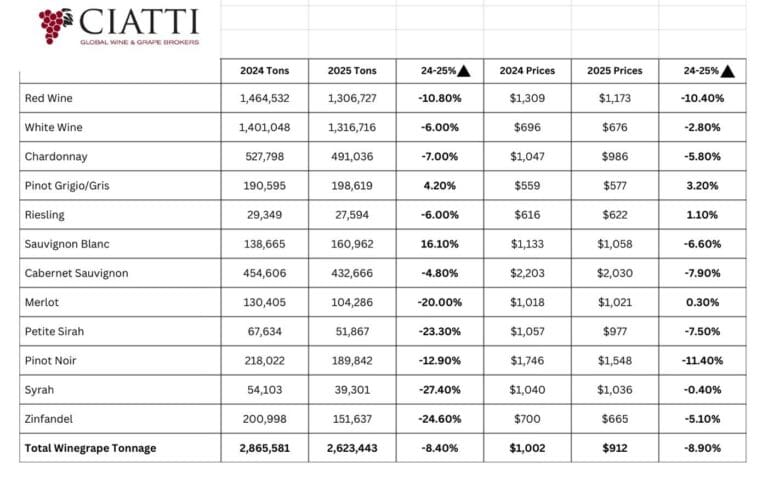 Image source - Ciatti
The smaller crop is a step in the right direction, but it does not resolve the underlying imbalance. The presence of unharvested fruit reinforces that demand remains constrained and that supply, in many segments, continues to exceed what buyers are prepared to absorb.
This distinction is critical.
A lower crush driven by reduced yields would suggest a tightening market. A lower crush influenced by demand limitations tells a different story. It suggests the system is still working through excess supply.
From a practical standpoint, the market remains soft. Bulk wine is still available, buyers remain selective, and pricing, particularly outside the premium segment, continues to face pressure.
For wineries, this means the window for opportunistic buying is not closing anytime soon. If anything, it may widen if supply does not contract more aggressively.
The Bigger Picture
To understand why this is happening, it is necessary to step back from a single vintage. Insights from the Silicon Valley Bank Wine Division consistently point to a structural issue rather than a short-term cycle.
U.S. wine consumption has plateaued and is likely declining in key segments. At the same time, the industry expanded production capacity during stronger demand years. The result is a system capable of producing more wine than the market now requires.
This imbalance takes time to correct.
Inventory built over multiple vintages must be worked through, and supply must remain below demand for a sustained period to restore balance. A single smaller crop, even one that is historically low, is not sufficient to achieve that on its own.
The tone coming out of the Unified Wine & Grape Symposium reinforces this reality. Vineyard removals are increasing, and there is growing recognition that the industry must adapt to a different demand environment. This is not a short-term adjustment; it is an ongoing realignment.
Why It’s Still Not Enough
Despite the progress reflected in the 2025 crush, several factors suggest it is not yet enough to bring the market into balance.
Inventories remain elevated, particularly in bulk wine, and continue to weigh on pricing and purchasing behavior. Demand has not stabilized, meaning supply reductions are working against a moving target. If consumption continues to soften, the level of production required for balance moves lower as well.
At the same time, supply adjustments are slow. Vineyard removals, replanting decisions, and contractual obligations all limit how quickly production can respond. There is also a degree of structural “stickiness”; once vineyards are farmed, the incremental decision to harvest becomes more justifiable, particularly if there is an opportunity to offset costs.
Finally, expectations themselves highlight the gap. Pre-harvest estimates across the industry generally pointed to a lower number, reflecting a broad understanding that deeper cuts were likely needed. The fact that the final crush came in higher suggests that, despite awareness of the issue, the system has not yet adjusted sufficiently.
Bottom Line
The 2025 crush is a step in the right direction.
But it is not a solution.
Production is declining, but supply still exceeds what current demand can sustainably absorb. The industry is in the middle of a multi-year correction, not at the end of one.
Until supply aligns more closely with demand and remains there for a sustained period, the market will continue to feel the effects of imbalance.
Protea works with wineries and select beverage businesses that want disciplined, dependable financial operations.
While our clients vary in size and structure, they share a common trait: they care about running better businesses and understand that accurate financial information is essential to achieving that goal.
Our goal is to help those who need and want better accounting make better decisions.
We typically support clients in one of three ways.
1. Full Accounting Department Support
For many wineries, we serve as the complete outsourced accounting function. We are their everything when it comes to accounting.
These businesses often:
Do not have internal accounting staff
Have outgrown informal bookkeeping
Realize they need reliable inventory costing and reporting
Want consistent financial visibility without building a full internal team
In these engagements, we manage everything from administrative support to day-to-day bookkeeping, inventory costing, financial reporting, and forward-looking financial insight. We operate as your accounting department, providing the structure and depth typically found in larger organizations.
This model is especially effective for growing wineries that need clarity and control but are not yet at a scale where hiring multiple in-house finance roles makes sense.
2. Integrated Role Within an Existing Finance Team
Some wineries already have an internal accounting resource but require additional depth.
In these situations, we may:
Fulfill the bookkeeper role, reporting to an internal controller
Serve as the controller overseeing an in-house bookkeeper
Provide financial management and reporting support that is not needed full-time
Assist with inventory costing and key close functionality
These clients are often more operationally mature but recognize that certain finance functions require specialized expertise. Rather than over-hiring or stretching internal staff beyond capacity, they partner with us to strengthen defined areas of their accounting structure.
3. Defined Function or Project-Based Support
For larger or more operationally established wineries, we may take on a clearly defined role within a broader finance team. We provide targeted support where capacity is constrained or where the business requires specialized expertise that does not justify a full-time hire.
This could include:
Accounts payable processing
Distributor billback capture
Payroll coordination
Specific reconciliations
Inventory costing
Financial reporting support
Many of these engagements begin as short-term coverage during staffing transitions—such as resignation, maternity leave, or unexpected absence- but often evolve into longer-term roles based on performance and fit.
We also support project-based work, including:
Accounting clean-up and reconciliations
Inventory costing corrections
Financial organization and support for due diligence
Assistance with sell-side transaction preparation
In each case, our role is clearly defined, structured, and aligned with the client’s broader finance function.
The Clients We Serve Best
Protea works best with wineries and select beverage businesses that are serious about strengthening their financial operations.
A partnership with Protea works best with owners and leadership teams who:
Value accurate, timely financial information
Want structured processes and consistent reporting
Are willing to engage and collaborate
View accounting as a strategic operational function, not just compliance
We are particularly effective with wineries navigating growth, operational complexity, staffing transitions, or increased financial scrutiny from lenders or stakeholders.
When We May Not Be the Right Fit
We may not be the right partner for businesses seeking:
The lowest-cost bookkeeping solution
Minimal communication or involvement
One-time transactional clean-ups without long-term structure
Our approach is disciplined and relationship-driven. We focus on building strong financial systems that support long-term success.
Protea Financial provides outsourced operational accounting for wineries and select beverage businesses. We support everyday operations and real-world challenges by functioning as an integrated accounting department, providing the depth of support typically found in larger internal teams, without requiring a winery to build one from scratch.
Our motivation is simple: to provide accurate, timely financial information so business owners can make confident, informed decisions. Everything we do supports that goal.
Everyone deserves better accounting, and we are here to help you meet that goal.
Full-Spectrum Operational Accounting
We are your full operational accounting team. We support a broad spectrum of services, from transactional accuracy to cost accounting, financial management and reporting, and forward-looking financial insight.
Core Accounting & Close
Strong reporting begins with disciplined execution.
We manage:
Transaction processing and bookkeeping
Accounts receivable processing
Accounts payable processing and payment coordination
Bank, credit card, sales, and inventory reconciliations
Month-end close
Balance sheet accuracy
This is the financial foundation. Without reliable day-to-day accounting, nothing else works. We take responsibility for ensuring the books are structured, reconciled, and dependable.
Inventory & Cost Accounting
Inventory and costing are central to winery performance and often the most complex.
We support:
Inventory reconciliations
Inventory costing and cost allocation
COGS accuracy
Margin visibility and analysis
We align your financial reporting with what is truly happening in the business so you can trust the numbers. With accurate inventory driving reliable margins, you can make confident pricing and marketing decisions based on strong data.
Cash Flow & Short-Term Financial Management
Clarity around cash is essential, especially when funds are short, a reality in the industry.
We assist with:
Short-term cash flow projections
Cash flow prioritization
Accounts receivable follow-up
Accounts payable management
We help you understand where you stand today and what actions are required. We work to identify patterns and strengthen systems so recurring pressure points are reduced over time.
Reporting, Budgeting & Financial Insight
We do not just produce reports; we make them usable.
Our support includes:
Monthly financial reporting
Budget vs. actual analysis
Variance explanation
Cash flow forecasting
Financial management reporting for owners, lenders, and stakeholders
We translate financial information into practical insight. Most winery owners aren’t accountants, and you shouldn’t feel like you need to be. You should not feel overwhelmed by your own numbers. We explain what’s happening, why it matters, and what it means for your business so you can move forward with clarity and confidence.
Systems, Controls & Process Improvement
Accurate accounting requires strong systems and clear controls.
We take time to understand each client’s processes and identify opportunities to improve:
Accounting workflows
Internal controls
Reporting visibility
Technology and system structure
Our goal is not only to resolve issues but also to prevent them from recurring. Structured systems create long-term stability.
Embedded Partnership
Protea operates as a remote, dedicated accounting team comprising professionals across our U.S. headquarters and South African office. Each client engagement is supported by a structured team with clear ownership and accountability.
We can:
Serve as your full outsourced accounting department
Supplement an internal accountant or controller
Provide targeted support for specific accounting functions
Over time, we become deeply integrated into our clients’ operations. We understand how your business works, how your inventory flows, and how your financial cycles move. Our role is not transactional; we are an operational asset to the success of the wineries we support.
Our focus on wineries is intentional. The wine industry presents unique operational and financial complexities, and we remain actively engaged to stay informed and connected to the realities our clients face.
We are committed to strengthening financial systems within the wine community and supporting owners who want disciplined, dependable accounting support.
Protea exists to help wineries operate with stronger financial systems, clearer insight, and greater confidence. Through structured processes, thoughtful analysis, and dependable partnerships, we provide operational accounting support that allows you to focus on running and growing your business
Protea Financial is an outsourced operational accounting partner built specifically for wineries and select beverage businesses. Our team is driven by a simple but powerful motivation: to provide accurate, timely financial information that helps business owners make better decisions and build stronger, more sustainable businesses.
We believe accounting exists to serve the business owner, not the other way around. When financial information is delayed, incomplete, or unclear, decision-making suffers. Winery owners deserve to understand their numbers, not question them. Accurate bookkeeping, timely reporting, and proactive inventory management allow wineries to operate with confidence, avoid unforeseen costs, and plan for the future.
At our core, we are a team that values clarity, accountability, and consistency. We take responsibility for the financial foundation of the wineries we support, ensuring that the day-to-day accounting, inventory alignment, and reporting are accurate and dependable. This work provides owners with visibility into their business so they can focus on running and growing their winery rather than worrying about whether the numbers can be trusted.
Technology plays a central role in how we operate. Accounting has evolved from manual recordkeeping into fully integrated, cloud-based financial systems. Today, accounting is not just about recording transactions; it is about building structured systems where financial data flows reliably, reports are available when needed, and business owners have access to timely information. Our team embraces modern accounting technology to create efficient, dependable financial systems that improve accuracy, transparency, and access.
We are also deeply team-driven. Protea Financial is built around a group of professionals who share a commitment to doing the work well and supporting one another. We collaborate closely, follow consistent processes, and continuously improve how we operate so that our clients benefit from reliable, structured accounting support. This team-based approach ensures continuity, accountability, and consistency over time.
Our focus on wineries is intentional. The wine industry is complex, with inventory, production cycles, compliance requirements, and capital constraints that make accounting uniquely challenging. We understand these realities because we work with them every day. Our experience also extends to select beverage businesses with similar operational and inventory complexity, but wineries remain at the center of our work.
Ultimately, Protea exists to bring stability and insight through dependable accounting support in an industry where clarity matters. We recognize that most winery owners are not accountants, and they should not have to feel overwhelmed or uncertain when reviewing their financials. Our role is not only to produce accurate reports, but to ensure owners understand what the numbers mean and how they can use them. We simplify complexity, translate financial information into practical insight, and help business owners move forward with confidence, backed by accurate numbers, strong financial systems, and a team committed to their success.
The 2026 State of the Industry session at Unified was cautiously optimistic but did delivered a clear message: the wine industry is not in a temporary downturn, it is undergoing a structural reset. We are deep into this adjustment but there is still work to be done.
Declining consumption, excess supply, margin pressure, and changing consumer behavior are no longer emerging risks; they are now realities. They are now the operating reality.
What made this year different was the alignment between market data, producer behavior, and financial results. The conclusions echoed the themes in the most recent SVB State of the Wine Industry Report: slower demand, elevated inventories, capital constraints, and the need for sharper business discipline.
A Global Market Under Pressure
As Mike Veseth, The Wine Economist, noted, wine is now a global commodity. Approximately 45% of all wine crosses at least one international border. While global trade continues to grow, overall consumption is declining. This mismatch is intensifying competition, particularly for U.S. producers. The gloabl wine market is trying to adjust to the same dynamics the U.S. wine market is face with, the only difference is exporting to the U.S. is a lever they are able to pull.
Currency and trade policy now play a larger role in winery economics. A strong U.S. dollar increases import pressure, while tariffs largely pass costs to consumers rather than improving domestic competitiveness. This is not a quality problem—the industry is producing exceptional wine. It is a structural and pricing problem.
Supply Is Correcting, But Inventory Still Drives Behavior
California vineyard acreage is finally contracting. Allied Grape Growers reported that standing acres fell from 515,615 in 2024 to approximately 477,475 in 2025, with projections near 437,000 by 2026. While meaningful, this reduction has not yet restored balance.
Finished wine inventory remains the primary driver of decisions. When supply exceeds 20 months, the market becomes defensive. Estimates for 2025 are near 19 months, an improvement, but not an equilibrium. As a result, further production restraint is likely through 2026.
Bulk Wine Remains in Excess
The bulk wine market is still oversupplied. Buyers are focused almost exclusively on recent vintages, while a significant portion of inventory is older. Demand and pricing remain under pressure, and many traditional buyers have exited. While the market is correcting, the adjustment will take time.
The Consumer Has Changed
According to the Wine Market Council, only 29% of U.S. adults currently drink wine. The primary reasons are not negative perceptions of wine itself, but lifestyle shifts: fewer occasions, health considerations, cost sensitivity, and confusion at the point of purchase.
Generational changes are accelerating these trends. Millennials have likely reached peak consumption, Gen X drinks less but remains engaged, and Gen Z is gravitating toward sparkling, RTDs, cocktails, and non-alcoholic alternatives.
Price Sensitivity and Competitive Pressure
Danny Brager of Azur Associates emphasized that wine is competing in a rapidly expanding alcohol category. Consumer choice has exploded, loyalty is limited, and wine is highly price sensitive. Higher-priced wines may show growth, but volume remains in the lower tiers. DTC growth is concentrated at the high end, creating challenges for mid-tier producers and limiting opportunities for ramp-on wines to bring in new consumers.
A Concentrated Growth Environment
Only 25% of the Top 100 wineries grew last year. Growth is no longer broad-based. It is concentrated among brands that are disciplined, differentiated, and operationally efficient.
The Path Forward
The industry is not broken, but it must adapt. Success will come from aligning supply with demand, simplifying offerings, managing inventory, and meeting consumers where they are. This is not a short cycle. It is a new operating environment.
The next two years will reward wineries that treat this moment as a strategic reset, not a temporary disruption.
The 2026 State of the U.S. Wine Industry Report, published by Silicon Valley Bank and authored by Rob McMillan, provides a comprehensive, data-driven assessment of current conditions in the U.S. wine market. Built on more than 25 years of industry research, the report combines results from SVB’s annual winery survey, its Direct-to-Consumer (DTC) survey, demographic and cohort consumption modeling, and a wide range of third-party wholesale, retail, and population datasets.
The conclusion is clear: while the industry continues to face structural headwinds, wineries are not experiencing these conditions equally. A widening performance gap has emerged between those adapting to changing demand and those struggling to do so.
2025 Performance: A Difficult Year for Many
By nearly every measure, 2025 was a challenging year for the U.S. wine industry. Roughly half of the surveyed wineries rated the year negatively, citing slowing demand, rising costs, margin pressure, and inventory challenges. Net sentiment declined further across most categories, including consumer demand, sales channels, labor, and capital availability.
At the same time, a notable minority of wineries reported strong or improving results. The share of respondents describing 2025 as “one of our better years” or even “the best year in our history” increased slightly, underscoring the growing divergence within the industry.
A Bifurcated Market
The most consistent theme in the report is bifurcation. Top-quartile wineries reported positive sales growth, stronger operating margins, and better control over inventory and working capital. The bottom-quartile wineries experienced declining revenue, higher inventory levels, margin erosion, and increased reliance on discounting and debt. While middle-quartile wineries generally reported flat to slightly negative performance.
Notably, the report emphasizes that this divide is not driven by region, winery size, or external market exposure alone. Instead, it reflects differences in strategic behavior. These wineries demonstrate stronger performance and discipline in customer engagement, inventory management, pricing, and, importantly, financial management.
The End of Passive Demand
A central finding of the report is that the era of passive demand has ended. Historically reliable drivers such as tasting room walk-ins, distributor pull, and automatic wine club growth are no longer sufficient to sustain performance. Successful wineries are actively cultivating demand through focused hospitality strategies, clearer brand positioning, and disciplined customer retention efforts.
Direct-to-consumer channels remain the economic engine of the premium wine business, accounting for approximately 53% of average winery revenue and as much as 75% or more in certain regions. However, the report stresses that DTC success is increasingly tied to loyalty, personalization, and brand clarity rather than volume-driven tactics.
Consumer Shifts and Demographic Pressure
This year's report reinforces that long-term demand is being reshaped by demographic change. Baby Boomers are aging out of peak consumption years, while Millennials and Gen Z are not replacing volume at the same rate. Younger consumers drink less overall, spread consumption across more beverage categories, and engage with wine differently than prior generations.
Consumption has not disappeared. Consumption is just very different. It is now more occasion-driven, value-sensitive, and less predictable. All of these shifts are influencing wine club performance, tasting room conversion, and overall demand elasticity.
Inventory, Pricing, and Financial Discipline
Inventory discipline and financial management emerge as critical differentiators between the best performers and the rest. Excess inventory, SKU proliferation, and misaligned production continue to pressure weaker operators. While discounting is widespread across the industry, the report finds that it is rarely strategic among lower-performing wineries and often erodes long-term brand equity. Reactive management creates short-term wins but does not set wineries up for long-term success.
Top performers tend to be more selective with pricing adjustments, more disciplined in cost recovery, and more focused on aligning production with realistic demand expectations. Good planning and discipline are key to their success.
Outlook for 2026 and Beyond
The report suggests that the steepest part of the demand correction may be moderating, with continued pressure in 2026 and a potential bottom forming in 2027–2028. However, this stabilization does not imply a return to historical growth patterns. Oversupply, vineyard contraction in certain regions, increased winery exits, and ongoing channel disruption are expected to persist.
The report is explicit that waiting for a return to “normal” is not a viable strategy. The next phase of the industry will reward wineries that adapt to evolving consumer behavior, invest in clarity and discipline, and use data to guide decision-making.
Source: Silicon Valley Bank, State of the U.S. Wine Industry Report 2026.
Additional insight: The State of the U.S. Wine Industry: What the 2026 SVB Report Tells Us-and What Comes Next
 For wineries, year-end is not simply an accounting exercise. It is the point at which financial discipline either shows up or years of small compromises finally catch up.
Too many wineries treat year-end close as a compliance task: get the books to the tax preparer, have them file the returns, move on. That mindset is increasingly risky, given that you are operating in a challenging market. Margins are under pressure, inventory is expensive to carry, cash flow is tight, and lenders and partners expect better visibility than ever before.
A clean, accurate year-end close is no longer optional. It is the foundation for survival and strategic decision-making in today’s wine market.
Start Where Most Problems Begin: The Balance Sheet
If your balance sheet is not clean, nothing else matters.
At year-end, every winery should have:
Fully reconciled bank and credit card accounts
A realistic assessment of accounts receivable (what will actually be collected)
Accounts payable that reflect true obligations, not duplicates or stale items
Loans properly split between principal and interest
This is not busywork. An unreconciled balance sheet produces misleading margins, distorted cash flow, and false confidence. We routinely see wineries making pricing, staffing, and inventory decisions based on inaccurate data.
Inventory: The Biggest Asset—and the Biggest Risk
For most wineries, inventory is the single largest line item on the balance sheet. It is also the most common source of financial misstatement.
A proper year-end inventory process includes:
A physical inventory count
Reconciliation to the production and accounting systems
Identification of obsolete, unsellable, or slow-moving inventory
Correct capitalization of production costs
If not done correctly, this is when the risk comes in. When inventory is misstated, margins are misstated as well. When margins are incorrect, pricing and sales strategies fail because it is nearly impossible to make sound decisions. This is where many wineries unknowingly erode profitability year after year.
Fixed Assets and Depreciation
It is crucial that capital improvements, equipment purchases, and vineyard investments are accurately accounted for.
At year-end, wineries should review:
Whether large expenditures were capitalized or expensed appropriately
Whether new assets were added correctly
Whether retired or sold, assets were removed
Whether depreciation was processed correctly
Accurate asset records provide a cleaner balance sheet and a cleaner profit and loss statement, which gives you clearer insight into your performance in 2025.
Payroll, Compliance, and Sales Tax Exposure
Payroll errors, missing W-9s, incorrect bonuses, and overlooked sales tax nexus issues often surface in January, by which time it is already too late.
For wineries selling direct-to-consumer across state lines, sales tax exposure is a growing risk. Year-end is the time to assess your nexus, registration, and system configuration.
Ignoring this does not make it go away. It compounds.
Why Most Wineries Should Not Do This Alone
Here is the hard truth: year-end financial cleanup for a winery is not generic bookkeeping. If it is not done correctly, it can lead to poor decisions and potentially incorrect tax returns. Both can cost your business significantly.
Year-end close is easier when you have strong accounting all year round, especially when an accountant works with industry-specific knowledge of inventory costing, compliance, production workflows, and financial reporting.
This is exactly where specialized outsourced accounting adds value.
At Protea Financial, we work exclusively with wineries and beverage businesses. We handle all your accounting, including the year-end close, inventory reconciliation, cost accounting, compliance coordination, and reporting, so winery owners can stop guessing and start operating with clarity.
If your goal is to “get through” year-end, there are cheaper options, or you can go it alone.
If your goal is to protect margins, improve cash flow, and make better decisions in a challenging market, specialization matters.
For a more detailed checklist, you can reference Protea Financial’s Ultimate Year-End Financial Checklist for Wineries and Small Businesses. But if you want the work done correctly—not just read about—this is the moment to bring in experts who live in your industry.
The wine industry is going through major market changes. Some wineries are posting growth, while others are facing flat or declining sales and increased financial pressure. The difference is not luck. It is strategy, financial clarity, and disciplined execution. As the market corrects, the operators who invest intentionally in their numbers, align their teams, and sell with purpose are the ones maintaining momentum.
Recently at WinExpo, Zane had the privilege of moderating a panel of industry experts to discuss how wineries can future-proof their businesses and focus on long-term success. From those discussions came five practical takeaways that winery owners and leaders can apply immediately to strengthen resilience and performance, and we would like to share them with you.
1. Know Your Numbers
Financial clarity is critical. It is the foundation of resilience. Understanding gross margin per SKU, contribution margin, and cash flow timing enables operators to make smart decisions rather than reactive ones. It reduces decisions based on instinct or habit, and in a tightening market, instinct alone becomes risky.
When you know which products drive profit and which quietly erode margin, you can price more accurately, manage inventory intentionally, and avoid costly blind spots. Knowing your numbers gives you power. It leads to better decisions, better outcomes, and greater stability, and, hopefully, growth.
2. Align Your Team Around Financial Insight
Profitability is not created in QuickBooks. It is created on the floor, in the vineyard, in the tasting room, and inside every decision your team makes. Financial reports simply reflect that behavior.
Every staff member influences revenue, conversion, spend per visitor, and the overall guest experience, yet many teams are never shown how their actions connect to financial results. When people understand what success looks like and how their choices move the numbers, they act with purpose.
Build a culture where financial understanding is shared. Empower people with information. Give them context so they can make decisions that support the business and its long-term vision.
3. Build Pull Through Relationship Driven Sales
There is panic in the market, and panic often leads to reactive decisions. Discounting and transactional selling can generate short-term wins, but they rarely build lasting value. Sustainable growth comes from connection and relationship-driven engagement.
This includes thoughtful club communication, intentional events, personalized outreach, and authentic storytelling that resonates with real customers. When your brand builds pull instead of pushing product, wholesale becomes easier, DTC becomes stickier, and your marketing dollars work harder.
A marketing plan is no longer optional. In this environment, it is survival. Being intentional is the key to success.
4. Enter Wholesale With Strategy
Wholesale can be a powerful growth channel, but only when approached with intention and a clear strategy. Before stepping into distribution, wineries should ask themselves:
• Do we truly need wholesale to meet our goals?
• Are margins strong enough to support it?
• Do we have the systems, time, and inventory to execute well?
If the answer is yes, distributor selection matters more than reach. Choose partners based on alignment, portfolio fit, and shared expectations. Strong distributor relationships are earned by brands that invest in pull, not simply push volume. Selecting where to sell matters, but selecting the right partner matters more.
One important note: excess inventory is not a strategy. Poor planning should not drive channel decisions. Wholesale should support the business, not rescue it.
5. Operate With Discipline and Focus on What Works
In this market, success favors focus. Invest more in what is working and pull back where it is not. If a SKU is performing, lean in. If inventory is aging, move it strategically. If operating expenses are heavy, correct them thoughtfully.
Forecasting is essential. Look ahead 3 months, 12 months, and even 36 months. Be proactive in managing debt. Align production with sales goals. Communicate early with stakeholders to prevent small issues from becoming financial stress. Operational discipline is not restrictive. It creates freedom.
The future will reward wineries that operate with clarity and intention. Success is no longer about size. It is about agility, decision quality, and understanding where value is truly created. With financial insight, aligned teams, intentional sales strategy, and thoughtful channel decisions, wineries can not only navigate this market — they can come out stronger.
Future-proofing starts with understanding your financial reality, and you do not need to take that on alone. Protea Financial partners with wineries to build financial clarity, improve reporting, and provide insight that empowers leadership to make strong decisions with confidence.
If you are ready to move from reacting to leading, connect with us and build the clarity your winery deserves.
The Wine Industry Financial Symposium 2025 and its speakers made one thing abundantly clear: the wineries that will succeed in this current market and into the future will look fundamentally different from the wineries that dominated in the past. The industry is undergoing a structural reset. Shaped by shifting consumer behavior, oversupply, rising costs, evolving demographics, and a fiercely competitive landscape.
Yet within this challenging environment lies an enormous opportunity. The sessions throughout the conference consistently revealed the same profile of a successful, future-ready winery. It is not the winery with the most acreage or the flashiest tasting room. It is the winery that is disciplined, adaptable, and deeply tuned into the consumer.
Across all sessions, the profile of the successful winery became clear:
Create a lean operation
Efficiency is not cost-cutting; it’s clarity. Lean wineries eliminate waste, streamline processes, leverage automation, and ensure every dollar spent moves the business forward. Inefficiency is now a competitive disadvantage. ROI and intentional spending should be the focus.
Build strong financial discipline
Winners know their numbers! Profitability by SKU, true wine costs, cash flow timing, inventory carrying costs, and department-level performance are all critical. They forecast continuously and use financial clarity to make smarter, faster decisions. Invest in a great accounting team as a strategic advantage for the future.
Focus on building deep consumer understanding
Consumer expectations are shifting rapidly. Listening! To! your! Customers! Engaging through surveys, data, feedback loops, and frontline staff is essential. The wineries that understand their audience at a granular level will earn loyalty as preferences evolve. Listen, digest, action, repeat.
Invest in authentic storytelling
Quality is no longer the differentiator. Everyone makes good wine! Story, identity, transparency, and emotional connection drive engagement. Consumers want to buy from brands that feel human, relatable, and meaningful. If you are disingenuous, they will sniff you and reject you.
Strive for continuous innovation
The most dangerous mindset is “this is how we’ve always done it.” Whether in packaging, experiences, digital engagement, hospitality formats, pricing models, or club structures, a willingness to experiment will define future growth. The consumer is different. Adapt or die.
Build flexible, personalized experiences
Rigid wine clubs and one-size-fits-all hospitality no longer meet consumer needs. Flexibility, choice, and tailored journeys are what keep customers engaged, not just great wine. This is what they grew up on, and this is what they expect. You need to cater to a broader audience. This is how you get them in the door and have them fall in love with your brand!
Commit to data-driven decision-making
Assumptions and nostalgia are liabilities. Operators must rely on data, operational, financial, consumer, and market, to cut through emotion and avoid reactive decisions. The wineries that follow the facts will outperform those that follow the noise. Gut instinct has value, but instinct backed by data wins.
Invest in empowered, engaged teams
Culture, communication, and accountability matter. The future belongs to wineries where employees feel valued, trained, trusted, and aligned behind clear goals. Engagement is a competitive advantage. Build a team that believes in the vision.
Build and implement a long-term strategic plan
Resilience requires direction. A strategic plan keeps teams focused, guides investment decisions, clarifies priorities, and provides stability during volatility. It turns reactive organizations into proactive ones. When you know where you’re going, getting there becomes far more achievable.
The path forward is clear, but it requires courage.
The wineries that rise in this environment will embrace a mindset shift: away from tradition for tradition’s sake, and toward a modern, disciplined, consumer-first approach. They will operate lean, tell compelling stories, invest in people, and make decisions based on evidence rather than sentiment.
The challenges facing the wine industry are real, but they are absolutely solvable. The wineries that take action now, not next year, will be the ones that lead this new era. They will succeed because they operate with financial clarity, build disciplined systems, understand their consumers deeply, and make data-driven decisions rather than assumptions. This is precisely where Protea Financial helps wineries gain an advantage.
Our team specializes in modernizing financial operations for the wine industry. We provide the structure, insight, and discipline needed to navigate today’s volatility. SKU-level profitability, true cost accounting, cash flow forecasting, budgeting, inventory management, and ongoing financial reporting that leadership teams can actually rely on. We understand the complexities of wine because we’ve been dedicated to this industry since 2014.
If your priority is to build a leaner, more resilient winery backed by a long-term strategic plan, we can guide that transformation. Protea integrates directly into your operations as a trusted partner, giving you the clarity and confidence to focus on what matters most: your brand, your customers, and your future growth.
If you’re ready to strengthen your financial foundation, streamline your operations, and build the winery of tomorrow, Protea is ready to support you. Let’s move your business forward, together.
In today's fast-moving wine sector, wineries need more than accounting; they need a partner who truly understands the vine-to-bottle journey.
Protea Financial stands head and shoulders above alternatives with industry-tailored financial excellence and strategic clarity.
1. Built Exclusively for Wine
Since 2014, Protea Financial has offered exclusively wine?focused accounting expertise. We get the cash flow quirks of harvest, the complexity of TTB compliance, multi-vintage cost accounting, and SKU profitability. Our niche focus gives us unmatched precision.
2. Precision Is Our Baseline
We treat each financial report as a critical stakeholder deliverable, with multi-tiered reviews and audit-ready accuracy. Errors aren't just costly, they're unacceptable. By delivering pinpoint-reliable data, we make financial trust effortless.
3. Flexible Outsourced Accounting Tailored to Your Growth
Seasonal cycles, SKU changes, or expansion into new channels, your needs change fast, and Protea's team adapts instantly. We provide scalable outsourced support so you never over- or under-resource your accounting function.
4. Strategic Financial Insight Beyond Bookkeeping
We go far beyond ledgers. Our team delivers:
- SKU- and vintage-level margin analysis
- Inventory valuation tied to harvest cycles
- Bank-ready reporting aligned to board?level reporting
- Cash-flow forecasting built for agricultural seasonality
- Our clients use financials not just to report on the past, but to guide future growth.
5. Service That Feels In-House
Protea clients often say our team "feels like sitting in the office next door." With proactive communication, seamless integration, and deeply personal support, we operate as trusted advisors, not distant vendors.
Bottom Line: Why Protea Financial Stands Above the Rest
While others try to fit themselves into the wine world retroactively, Protea Financial was founded for it. Our systems, team, and services are crafted for complex winery finances with precision, scalability, and strategic depth. We have built a team and processes to allow us to succeed and help you succeed!
If you're seeking a finance partner that speaks your language, understands your challenges, and helps you grow with clarity, Protea Financial is your strategic advantage.
Ready to Elevate Your Winery's Financial Game?
🔹 Visit proteafinancial.com
🔹 Schedule your complimentary consultation
🔹 Experience why focused expertise transforms outcomes