.jpg)
In the wine business, presence matters. We show up for tastings, walk vineyards, meet buyers, pour samples, and have informed conversations. We know relationships are built through visibility, consistency, and credibility.
LinkedIn is the digital extension of that same principle. It functions like a trade show floor that never closes.
Buyers, distributors, importers, media, and potential partners are forming impressions there every day, whether a winery is actively participating or not.
Most wineries maintain a company page. You share releases, awards, job postings, and announcements. All necessary.
But in today’s B2B wine landscape, credibility is built less by brands alone and more by the people behind them. People don't use social media to talk to brands; they use it to talk to humans.
Trust in the wine industry lives with leadership.
Buyers and journalists want to understand who is behind the winery and how they think about the issues shaping the business. Increasingly, LinkedIn is where they look first.
When trade media evaluate sources, or buyers assess potential partners, they are often asking two questions: Is this person engaged in the industry, and do they demonstrate informed thinking?
Credentials alone are no longer enough. Perspective matters.
The company page sets the stage. Leadership creates the signal.
A winery principal reflecting on harvest conditions, sustainability pressures, or export realities does more than post. They demonstrate fluency.
A sales or export lead commenting on on-premise recovery, pricing pressure, or distribution shifts shows relevance.
These posts are not about mass reach. In wine, relevance consistently outweighs volume. A few hundred views may include exactly the right people looking.
In a competitive and transparent marketplace, LinkedIn creates a visible track record of how a winery thinks. That quiet consistency can be the differentiator buyers and media remember when it matters most.
Town Hall Brands handles LinkedIn profiles for clients.
By Leeann Froese, Town Hall Brands
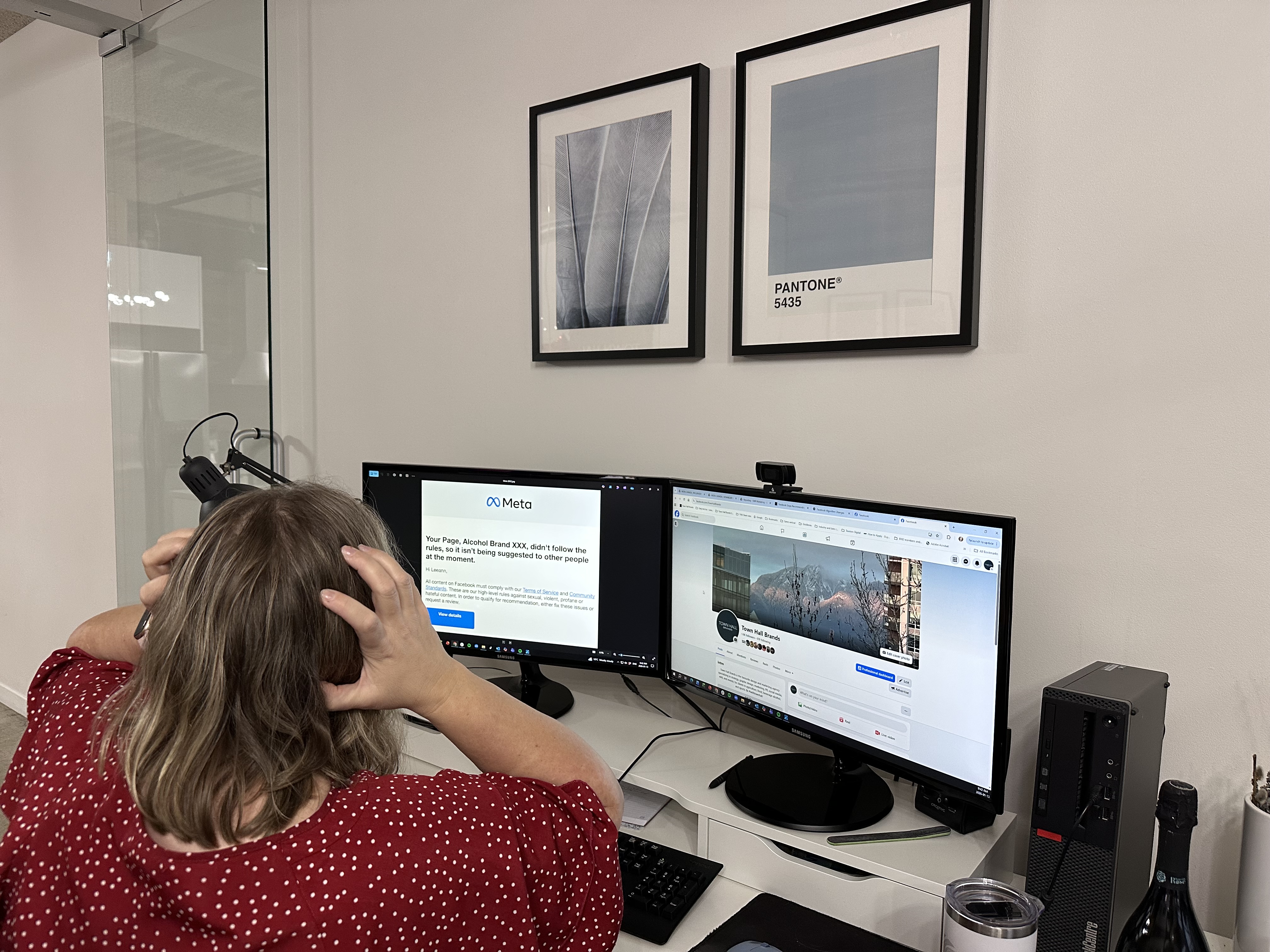
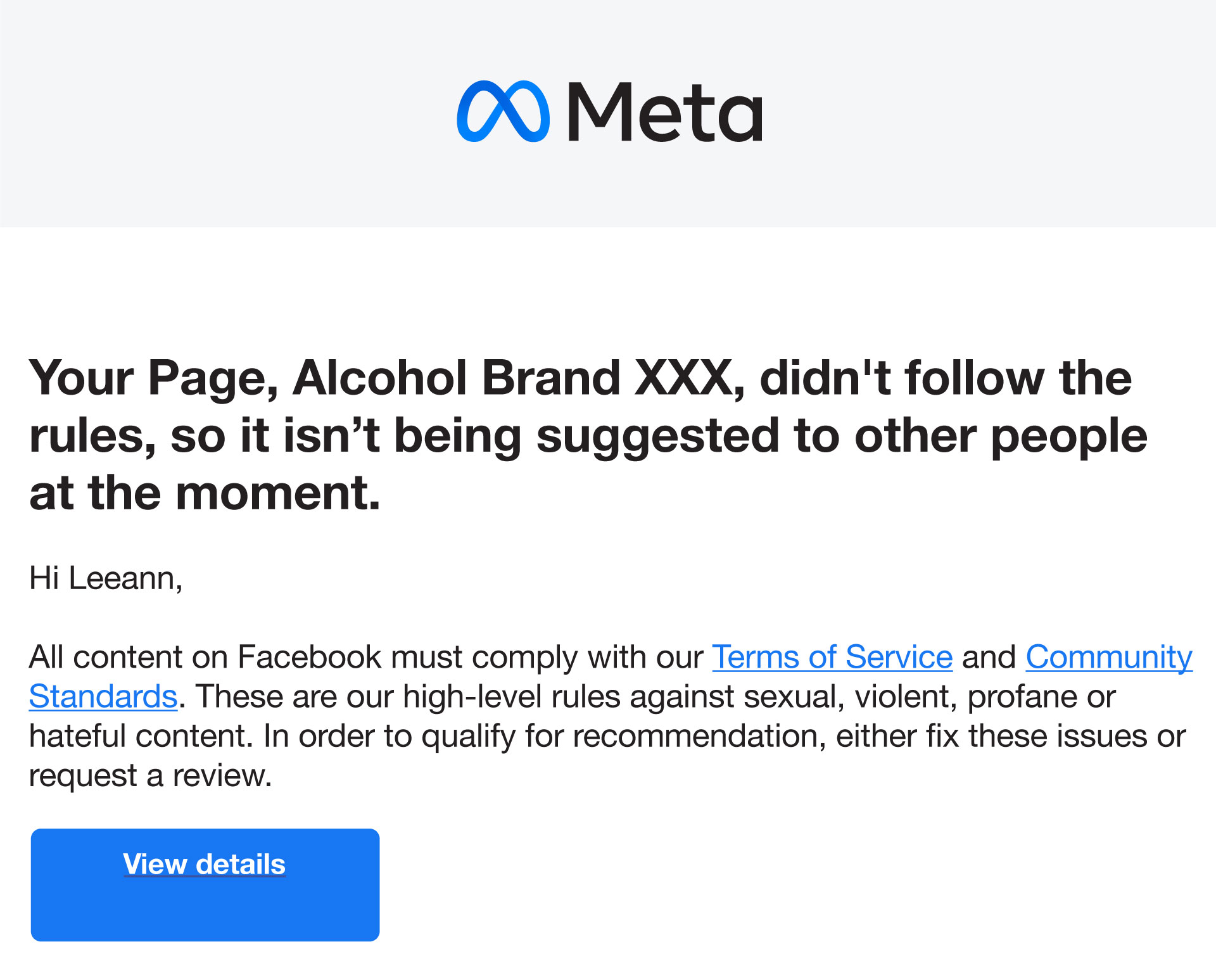
Over the past few months, wineries across North America have begun receiving a vague but unsettling notification from Facebook stating that their Page is “not being suggested to other people at the moment.” In many cases, there are no visible violations, no content removals, and no clear explanation.
Pages remain live. Accounts remain in good standing. But organic discovery has narrowed.
This is not a glitch, and it is not necessarily a punishment. It is a platform decision, and it has real implications for how wineries should approach marketing in 2026.
This is not a compliance failure
Most wineries encountering this issue are fully compliant with Facebook’s Community Standards. Their content is allowed to exist on the platform. What has changed is recommendation and amplification, which Facebook controls separately under its Terms of Service.
In other words, a Page can follow every rule and still be excluded from algorithmic discovery.
This distinction is important because it explains why Facebook’s notice feels so vague. Recommendation eligibility is driven largely by automated systems, pattern recognition, and risk management — not by a single identifiable post that can easily be “fixed.”
Why Facebook doesn’t tell you what’s wrong
For regulated categories like alcohol, Facebook applies a more conservative approach to amplification. Signals that can affect recommendation eligibility include:
- Language that implies overconsumption or partying
- Imagery that suggests excessive drinking or unclear age context
- Sexualized or suggestive copy, even if subtle or humorous
- Historical content patterns, not just recent posts
- Unmoderated comments from followers
In many cases, there is no single violation to point to. This is intentional. Platforms do not disclose exact triggers because doing so would allow the system to be gamed.
What wineries can do if they receive this notice
While there is no guaranteed fix, wineries should take a measured and practical approach:
- Audit both recent and historical posts for borderline language or imagery
- Archive or remove content that relies on innuendo, party framing, or exaggerated consumption cues
- Review Facebook Page category, business description, and age restrictions for accuracy
- Moderate comments more actively, as user comments count as Facebook Page content
Only request a review once anything questionable has been cleaned up
Even after review, recommendation may not be restored. That outcome is increasingly common and does not indicate wrongdoing.
The bigger issue: you do not own social media
At Town Hall Brands, we have long advised that the most important assets a winery can build are its website and its email list.
Social platforms are powerful tools, but they are “rented” spaces and in the case of Facebook, Meta is the landlord. Algorithms change. Policies tighten. Categories like alcohol are treated conservatively. Pages can lose visibility overnight with little explanation and limited recourse.
If a Meta account were to disappear tomorrow, a winery with a strong website, a healthy email list, and an established media footprint would still be standing. A winery that built its entire audience inside a platform would not.
That reality has not changed. What has changed is how clearly it is now being demonstrated.
What this means for winery marketing in 2026
These platform changes intersect with broader shifts already underway across the wine industry:
Storytelling must move forward.
Audiences are fatigued by narratives of struggle. The messaging that cuts through now is confident, optimistic, and focused on quality, place, and momentum. These stories travel better through media, newsletters, and owned channels than through algorithms.
Digital presence means conversion, not aesthetics.
A strong website that captures email, hosts earned media, and converts interest into action matters more than a perfectly curated feed. Social should drive traffic off platform, not act as the destination.
Smaller experiences travel further.
Micro experiences, seasonal offerings, and flexible add-ons are easier to share, easier to pitch, and easier to repeat than large-format events. They also perform better in PR and partnerships.
Collaboration is a growth strategy.
As individual Page discovery weakens, regional and collective storytelling strengthens. Media, tourism platforms, and consumers respond to cohesion.
Planning cannot be reactive.
The wineries best positioned for 2026 are using this planning window to rebalance their channel mix, strengthen owned assets, and reduce dependence on any single platform.
The renewed role of PR and earned media
One of the clearest implications of Meta’s shift is the renewed importance of earned media.
PR is not subject to algorithmic throttling. Coverage is searchable, permanent, and compounding. It supports SEO, feeds generative AI discovery, and builds credibility in ways platforms cannot suppress.
As social discovery becomes less predictable for alcohol brands, earned media once again becomes a primary visibility channel, not a secondary one.
A strategic reset, not a setback
This is not a signal to abandon social media. It is a signal to stop building businesses as if social media were guaranteed.
Platforms will continue to change. Policies will continue to tighten. Wineries that invest in owned channels, earned media, and intentional planning will be the ones that remain visible, resilient, and competitive in 2026 and beyond.
Does reading this give you anxiety and overwhelm? We are here to help. We have been marketing in beverage alcohol for more than two decades, and we have a team that can help you navigate all levels of media needs.
Consumers are drinking differently. Smart wineries are packaging differently.
The wine industry is entering a moment where packaging innovation is no longer a nice-to-have.
It is becoming essential. As consumer habits shift, wineries need to look seriously at how they will integrate new formats and sizes into their production plans. Smaller formats, single-serves, multi-packs, pouches, and other alternative packaging have all seen steady, quiet growth. This is not a fad. It is a response to how people actually want to drink wine today.
Consumers are exploring more, committing less, and looking for ways to enjoy wine that fit their real lives. They want options that support moderation, convenience, sustainability, and trial.
A four-pack of 250 mL cans allows someone to try a winery without buying a full bottle. A lightweight pouch is ideal for hiking or concerts. A half-bottle makes a midweek glass feel approachable rather than indulgent.
When wineries resist these changes, they risk missing a growing audience that is actively seeking them out.
The producers who move quickly will be the ones who capture demand first.
Integrating alternative formats takes planning, capital, and openness to change. But the payoff is meaningful: better alignment with today’s wine drinker, more points of entry for a brand, and new opportunities to drive loyalty through flexibility and choice.
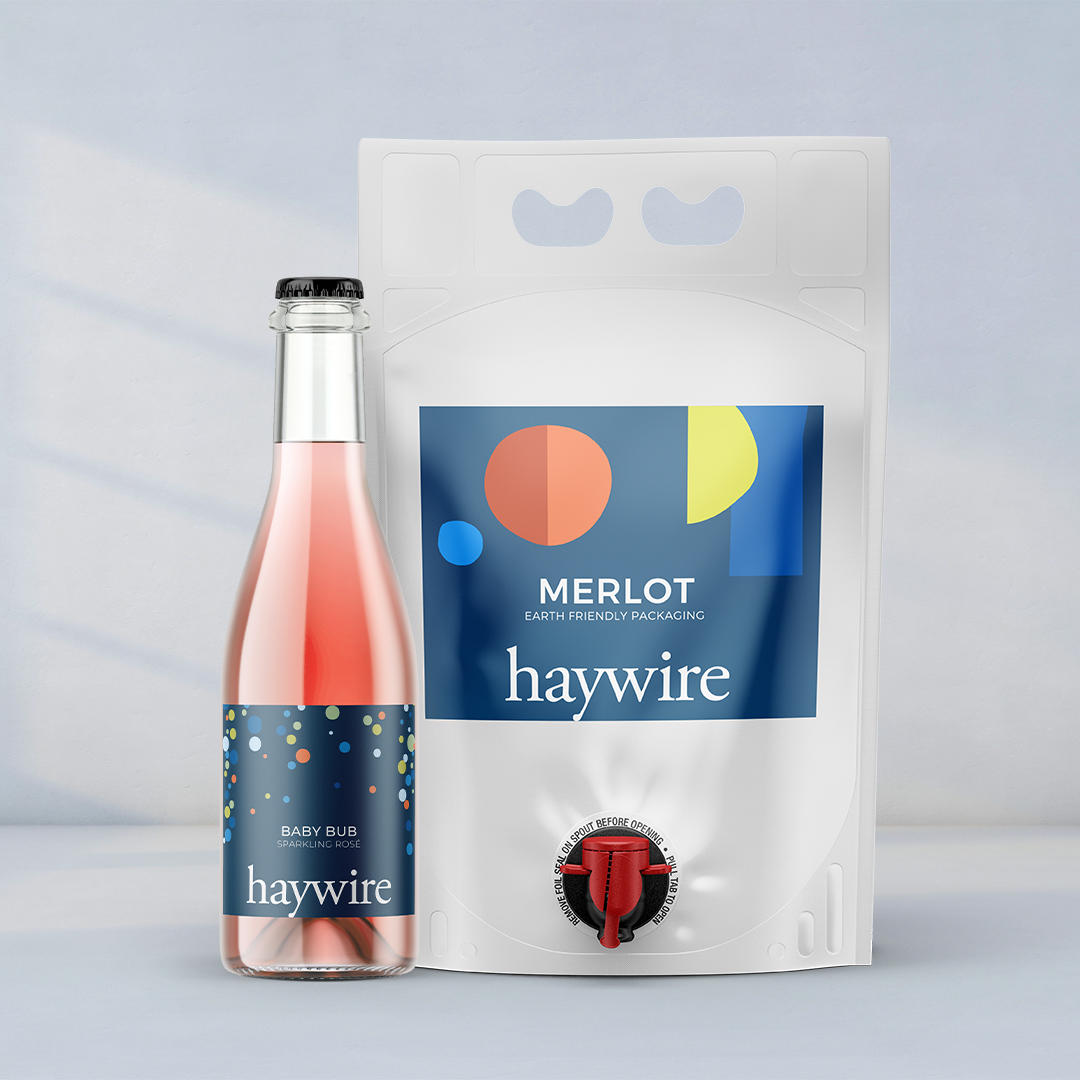 Haywire Winery's 375ml and 1.5L packages
Town Hall Brands helps wineries evolve, differentiate, and grow through brand strategy, design, packaging, and communications.
 Savour Quality from Europe: Tuscany’s Wine and Olive Oil Icons Find New Fans in Canada
October 2025 [Vancouver, BC] Canadians are falling in love with the real taste of Tuscany as testimonial of the European quality. This year, two of the most respected European producer groups, the Consorzio Vino Nobile di Montepulciano and the Associazione Produttori Olivicoli Toscani (APOT), are sharing their story through the European Union–funded campaign Savor Quality from Europe.
The campaign celebrates craftsmanship, authenticity, and sustainability by connecting Canadians with the winemakers and olive growers who represent the heart of European culture.
Why Canada’s Falling for European Products
Canada is becoming one of the most exciting destinations for premium European food and wine. Consumers here want products that tell a story: where they come from, who makes them, and why they matter. The Consorzio Vino Nobile di Montepulciano and APOT see that as a perfect match for the way they’ve always worked: with respect for land, tradition, and craftsmanship.
Earlier this year, the two organizations hosted seminars and walk-around tastings in Toronto and Montreal, giving Canadian trade and media an up-close look at what makes these products special.
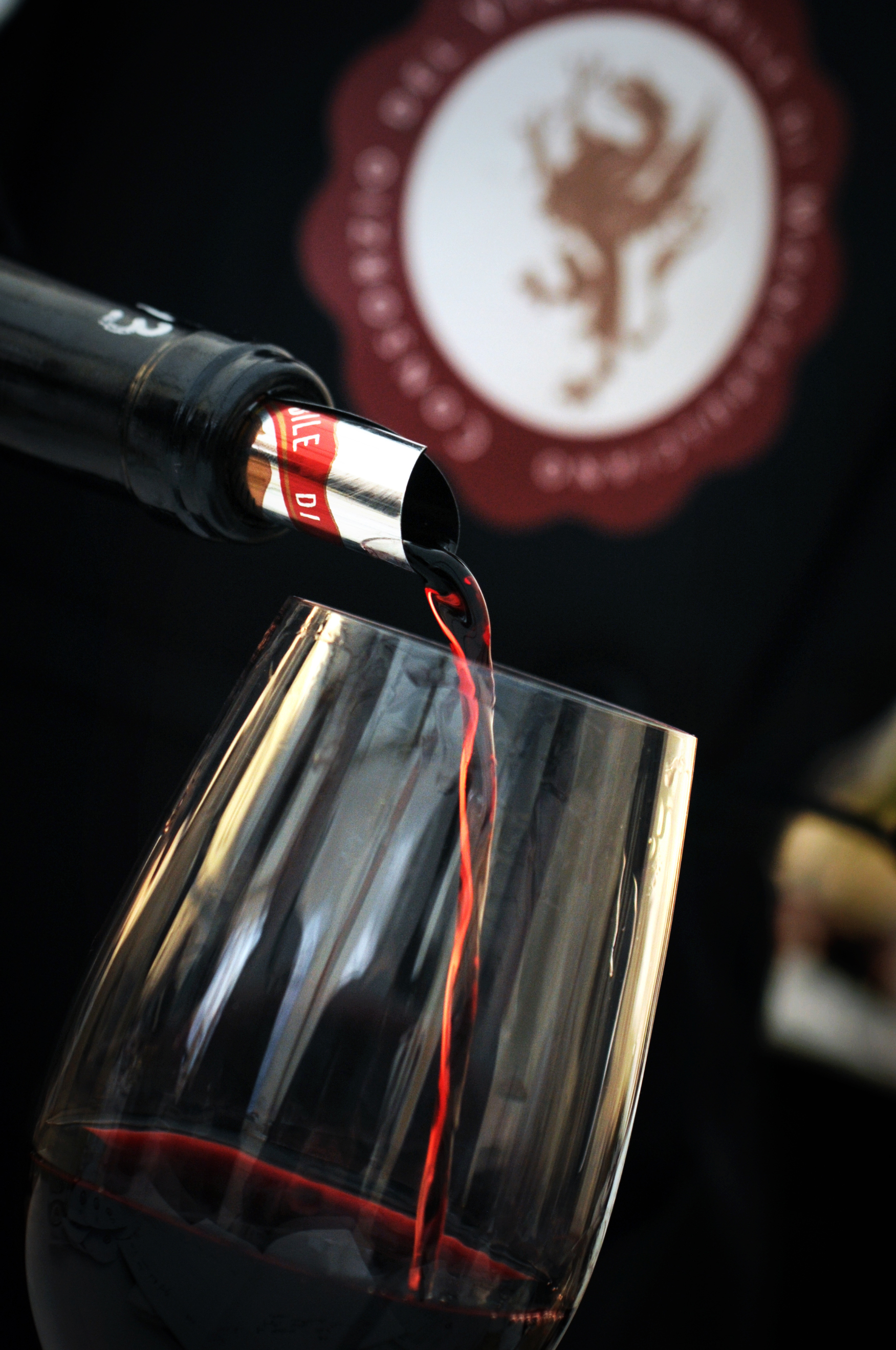
Meet Tuscany’s Noble Wine Collective
Few wines express place and history like Vino Nobile di Montepulciano. The Consorzio Vino Nobile di Montepulciano was founded in 1965 and represents producers of Vino Nobile di Montepulciano DOCG, Rosso di Montepulciano DOC, and Vin Santo di Montepulciano DOC.
Vino Nobile is made mostly from the Sangiovese grape (known locally as Prugnolo Gentile), grown on the sun-kissed hills of Montepulciano in southern Tuscany. The vineyards sit between 250 and 600 metres above sea level, where sandy and clay soils help create wines known for depth, balance, and longevity.
In 1980, Vino Nobile became the first Italian wine to earn DOCG status, Italy’s top quality designation. Today, the Consorzio continues to lead the way in sustainability. The entire Montepulciano denomination is certified under Equalitas, an internationally recognized standard that measures environmental and social responsibility across the region.
The newest chapter in the Vino Nobile story is the Pieve classification, officially recognized in 2025. The first vintage, from the 2021 harvest, marks a new level of quality that celebrates the diversity of Montepulciano’s vineyards. The classification highlights twelve historical zones, each linked to an ancient parish area. To qualify, vines must be at least 15 years old and wines must contain at least 85 per cent Sangiovese. Each Pieve bottling reflects the unique soils, exposure, and heritage of its parish, giving wine lovers a true taste of place.
The Keepers of Tuscany’s Liquid Gold
The Associazione Produttori Olivicoli Toscani (APOT) unites Tuscan producers who craft some of the world’s most sought-after extra virgin olive oils. Its members grow and press olives under European Union protections such as PGI Toscano and PDO Terre di Siena, Lucca, Seggiano, and Chianti Classico.
These designations guarantee more than just geography. They ensure that every bottle meets strict production and tasting standards, offering consumers traceability and confidence. APOT’s producers focus on early harvesting, gentle milling, and full transparency, preserving the bright, peppery character that defines authentic Tuscan oil.
For Canadians, these certifications help separate true extra virgin olive oil from generic imports, and they reinforce the connection between quality and origin.
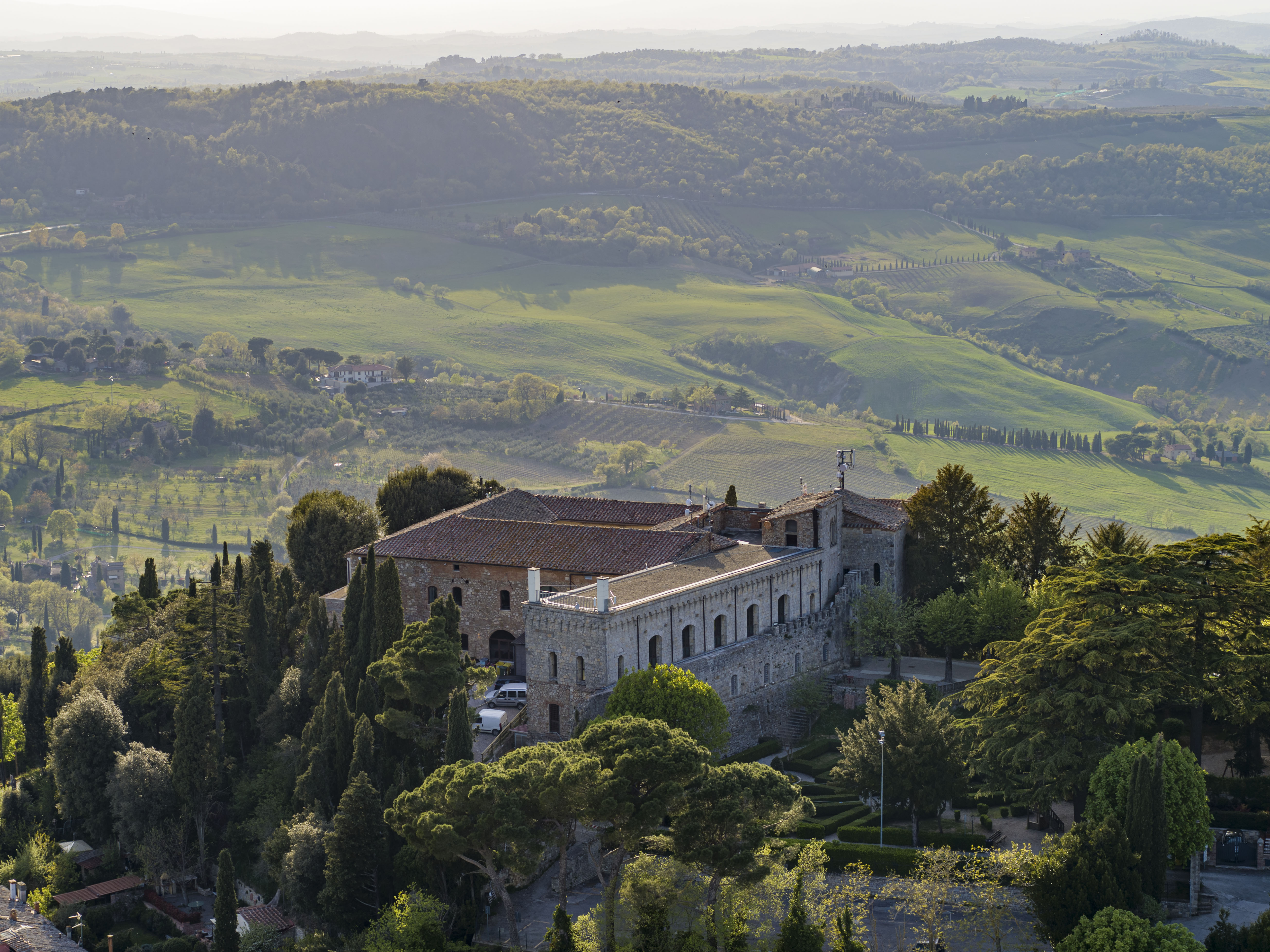
Pour, Drizzle, Repeat: Bringing Europe Home
The “Savor Quality from Europe” campaign is about more than introducing products. It is about celebrating the values that Canadians and Europeans share, such as sustainability, craftsmanship, and curiosity about the world.
As autumn unfolds across the country, Canadians are invited to bring a taste of Europe to their tables. A glass of Vino Nobile di Montepulciano and a drizzle of Tuscan olive oil can transform any meal into something memorable.
About the Campaign
Savor Quality from Europe is an educational and promotional program co-funded by the European Union to highlight the excellence of European agri-food products. The campaign focuses on origin, quality, and sustainability while encouraging consumers to connect with authentic European flavours.
For more information about the project, visit www.savorqualityfromeurope.eu/

Logos are a visual symbol used to represent your brand, often a relatively simple graphic but don’t underestimate its importance. We are sharing our best practices for logo usage to preserve this important piece of brand recognition.
LOGO FILE TYPES
There are multiple file types used for logos, each with their own benefits and ideal uses. Selecting the file type that best matches the application will ensure your logo is looking its best.
At Town Hall Brands we work with logos in three formats: JPEG, PNG and Vector
JPEG is the image file extension that you may be most familiar with as it is commonly used for photographs. The benefits of this file type are compressed files that load quickly with web applications. The drawback when using a JPEG logo is the solid background, when placed over a photo or colorful background a JPEG logo will have a white background preventing the logo from integrating with the larger design.
When to use: website and digital formats where small or compressed files sizes are needed.
PNG is ideal for logos as they can have transparent backgrounds, this allows your logo to be placed into a design or over a photo without a background or border around the logo.
When to use: websites, social media icons, small scale print jobs
Vector unlike the previous two formats is a category rather than a file extension. A vector file is comprised of mathematical points rather than pixels, this allows vector files to be scaled indefinitely without any loss of quality. Types of vector files can include EPS, SVG and Ai (Adobe Illustrator).
When to use: printing, branded products and large-scale applications such as signage
LOGO RULES AND GUIDELINES
Consistency is key when it comes to logos as this is how consumers will identify your brand. Limit the number of logo variations and avoid making alterations to keep your logo easily recognizable. See our logo dos and don’ts:
DO
- Have full color and black and white versions of your logo for different purposes
- Use the full color version of your logo whenever possible
- Use the best file type for each logo application
- Include a safe space around your logo so it stands out and doesn’t get lost among other elements in a design
DON'T
- Rotate the logo
- Stretch the logo
- Change the font in the logo
- Change the color of the logo
- Change the scale of certain elements
- Place the logo on a busy background
- Make the logo so small that details are lost or the text is no longer legible
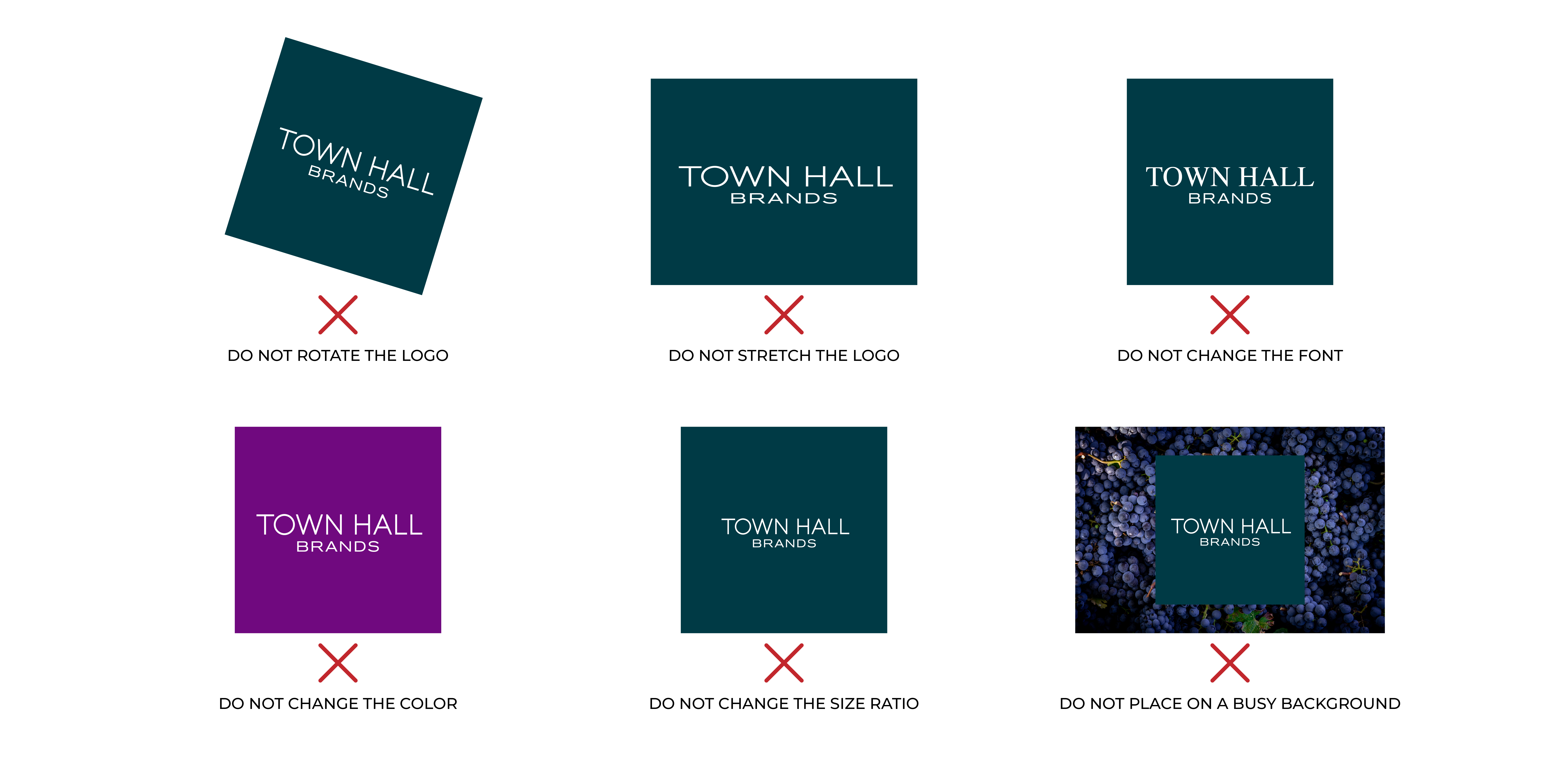
When sharing your logo with third parties ensure that you provide high quality files that are compatible with how they will be using your logo and share your logo rules.
Your logo is a valuable piece of your brand, don’t overlook the importance of logo usage in putting your best foot forward.
Have logo questions or need help designing your logo, email info@townhallbrands.com
It’s hot outside, summer is in full swing, and the fruit is growing. The farthest thing from many minds is the holiday season but planning now will make sure that you are not panicking in the fall.
Now is the time to prepare for stock and inventory requirements, secure in-store stacks and displays with retailers, and prepare to have adequate merchandise and marketing materials on hand for the heavy sales push of October, November and December (OND).
Will you be making a special offer? If so, what kind of materials will you need? Do you need long lead ads created, or a campaign developed? Or do you need special packaging? Maybe you want to create a library release, or a box set? Starting the design process now allows time for new materials and campaigns to be fully created and ready to go when consumers turn their focus to holiday shopping in the fall.
Feel like you are always scrambling to get design assets done? Town Hall Brands has created a guide, so you won’t miss another design deadline.
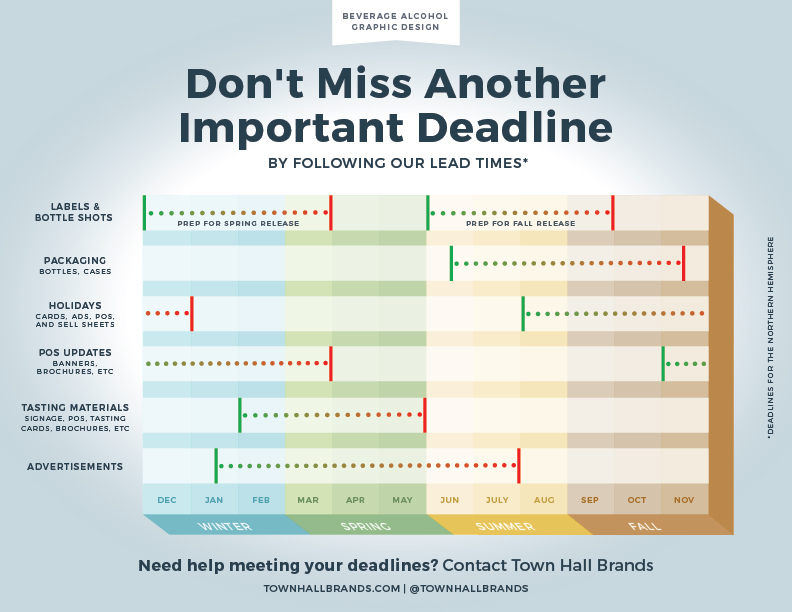
WINTER (DECEMBER, JANUARY, FEBRUARY)
- Advertisements: You should have your advertisement budget planned for the year. Now’s the time to get those campaigns and ads created. Keep in mind print, broadcast, digital, and influencer collaborations.
- Labels & Bottle Shot Images: Whether you are refreshing your labels, updating the vintages and back labels, or designing a whole new label – it’s time to start this process to prepare for your spring release.
- Prepare updated press materials for media queries.
- Tasting materials: Below are some materials you may need for your tasting room opening:
o Highway signage for visitors
o Shelf talkers
o Portfolio list
o Signage for winery (tasting fees, etc)
o Tasting cards
o Neck tags
o Shelf tags
SPRING (MARCH, APRIL, MAY)
- This is the time to make sure all your labels are done in time for your spring bottling and release.
- Bottle Shot Images: With the labels finalized, this is the time to get bottle shot images done. They can be used in your sell sheets, online store, advertisements, or to fulfill media requests.
- Is your press information kit up to date?
- With the tasting season coming up, is your retail shop ready for visitors?
SUMMER (JUNE, JULY, AUGUST)
- Wine & Cider Labels & Bottle Shot Images: Whether you are refreshing your labels, updating the vintages and back labels, or designing a whole new label – it’s time to start this process to prepare for your fall release.
- Packaging: Wine cases, bottle cap enclosures, prep for bottling
- Holidays: It’s not too early to think about your holiday offerings, and this is actually the best time to do it! Below are some materials you may need, for your clients and for your sales team.
o Shelf talkers
o Technical sheets
o Portfolio booklets
o Holiday offerings sell sheets
o Wine club offers sell sheets
o Advertisements
o Holiday cards – printed or ecards
o Tasting cards
FALL (SEPTEMBER, OCTOBER, NOVEMBER)
- Holidays: Finalize your holiday pieces to make the most of your year-end sales
- Point-of-sale materials: Need updates to your current marketing materials?
o Business cards
o Rack cards
o Brochures
o Banners
NEED HELP WITH THIS?
The Town Hall Brands team is here for your graphic design, branding and marketing needs. Shoot us an email info@townhallbrands.com and we will create a custom plan for you to make sure your deadlines are met.
Are you and your importer/distributor both eager to tell your story in a way that translates into sales? Consider equipping your sales team with consistent and professional materials (a sales tool kit) that tell your authentic story.
A sales tool kit is a toolbox, containing the items that make it easier for your customer to understand your wine, and make room for it on their shelves.
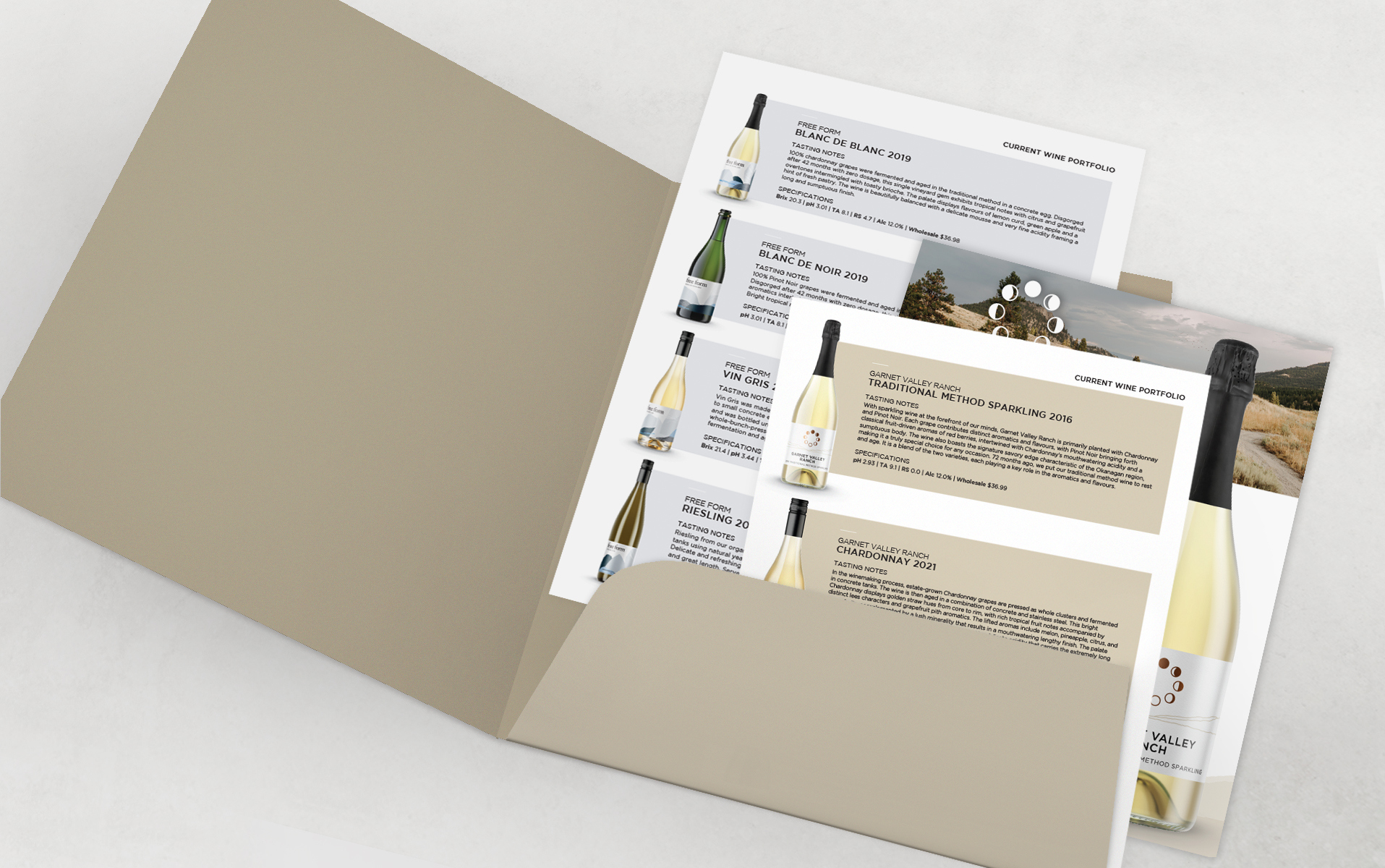
What’s in a sales tool kit? At the minimum it should include a portfolio sheet listing all of your wines, but a great sales tool kit will include several items that make it easier for the buyer to sell your wine to consumers.
Sales Tool Kit Checklist:
- Portfolio Sheet/Booklet
- Technical Information Sheets
- Sell Sheets
- Shelf Talkers
- Neck Tags
- Business Cards
- Tasting Cards
So, how can you create a sales tool kit? Here’s the process we go through to create one:
Strategy
The first step is to have a strategy and determine which pieces of information will be used where (such as what accolades or reviews you’ll want to use and if you want them on shelf talkers or neck tags). This will help inform which items you will need to make.
Gather
The next step is to gather the content you’ll need to create the tools: your brand story, wine technical info (pH, RS, TA, alc%), harvesting information, awards/reviews, and product photos (bottle shots).
Create
The last step is to create the materials. Portfolio sheets, tech sheets, and sell sheets, shelf talkers, business cards, and tasting cards.
Creating these materials in a professional, consistent and compelling way will help your brand stand out and make it easier on your sales reps and retailers to sell your wine.
Are you stuck in the steps to create your own kit? Maybe you don’t have all the content you need, like a compelling brand story, or you lack professional bottle shots. Or maybe you need help creating professional looking tech sheets and shelf talkers. Let us help un-stick you, and help you create a really successful sales tool kit.
You spent time, money, and energy building a brand that people recognize. It looks good. It sounds right. People are finally starting to get it. So why are you letting it fall apart?
Your brand is a reputation, not just a logo. Inconsistent fonts, weird colors, off-brand photos, and tone-deaf captions are the start of a slow slide into brand chaos.
Here’s how brands get muddled:
- No rules, just vibes: You hand your logo to a sign maker or a friend who “knows Photoshop” and hope for the best. Without a brand standard, they’re guessing. And that guess might be Comic Sans.
- Template traps: Canva and AI tools are great. While these programs open a new set of opportunities it is important to use them in a way that honors your brand identity. When using pre-made templates take the time to change the fonts and colors to the ones that match your brand and use your original photos when possible, to preserve brand recognition. If you're using pre-made templates without updating fonts, colors, and imagery to match your brand, congratulations—you just became generic.
- Death by a thousand tweaks: Adding a new font here, changing a color there, updating a label “just this once.” It all adds up. You’re too close to notice, but your audience isn’t. They can feel when something’s off.
Everyone has a different aesthetic and having strong brand standards ensures that your brand look is consistent regardless of who is working on it.
The Fix: A Brand Standard
What are ‘brand standards’? A brand standards document provides a ‘how-to’ to implement your brand consistently and uniformly in design and communications. Sometimes called a ‘brand usage guide’, the document becomes a tool for you to share with those who are going to bring your brand to life after it has been created.
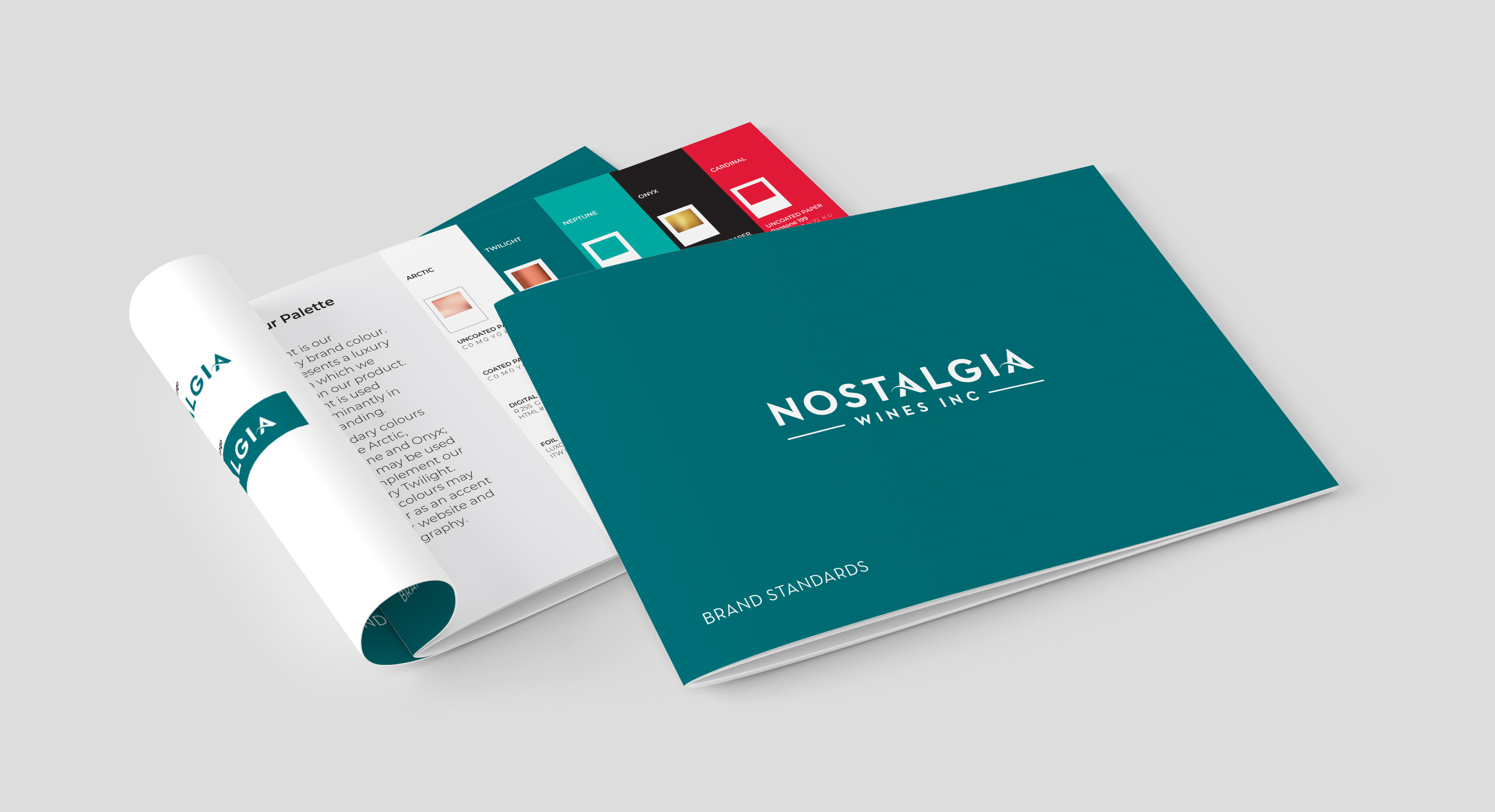
It’s the “how-to” guide for using your logo, colors, fonts, and voice—so your brand always shows up looking sharp and sounding like itself. Whether it's a one-sheet or a 40-page book, it keeps everyone (including your future self) on the same page.
The basics of a brand guide covers the brand’s visual identity, the logo, color palette and typography. This can be expanded to include a photography guide and sample design layouts.
At its simplest, a brand guide covers:
- Your logo (and how not to stretch it)
- Colors (with the right codes, not just “blue-ish”)
- Fonts (consistency is sexier than creativity here)
- Visual guidelines (like photography style and sample layouts)
- Voice and tone (what your brand says and how it says it)
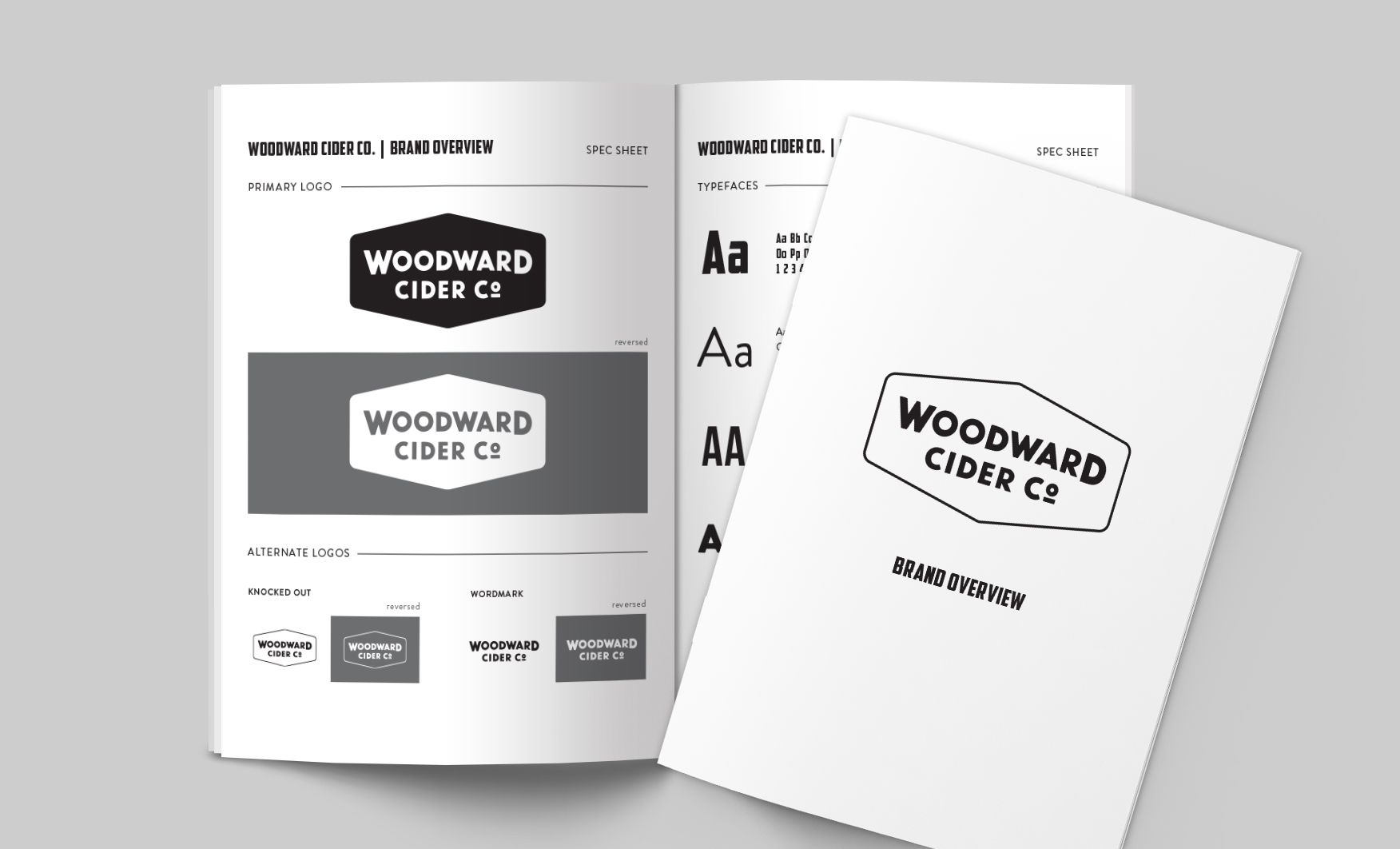
Want to go deeper? A more comprehensive brand package can be developed to include the corporate mission statement, brand promise and personality. These can set the tone for your brand’s editorial voice, including examples of the appropriate tone of voice and language to use when talking about your brand. These help anyone writing, designing, or promoting your brand to nail it every time.
At Town Hall Brands, we don’t just create brands—we protect them. As a full-service agency, our company has a design team that creates brands, logos and packaging from scratch. However, our design team is also responsible for taking a brand we didn’t create and making promotional materials from it. This includes items like a restaurant promotion or an ad that needs to fit within an existing brand.
With or without a standards guide, we’ve seen what happens when there are no guardrails. Spoiler: it’s not pretty.
Bottom Line
If you’ve gone through the effort of building a brand, do yourself a favor: protect it. Create a brand standard. Use it. Share it. Enforce it. Your brand is only as strong as its weakest execution.
Don’t f*ck it up.
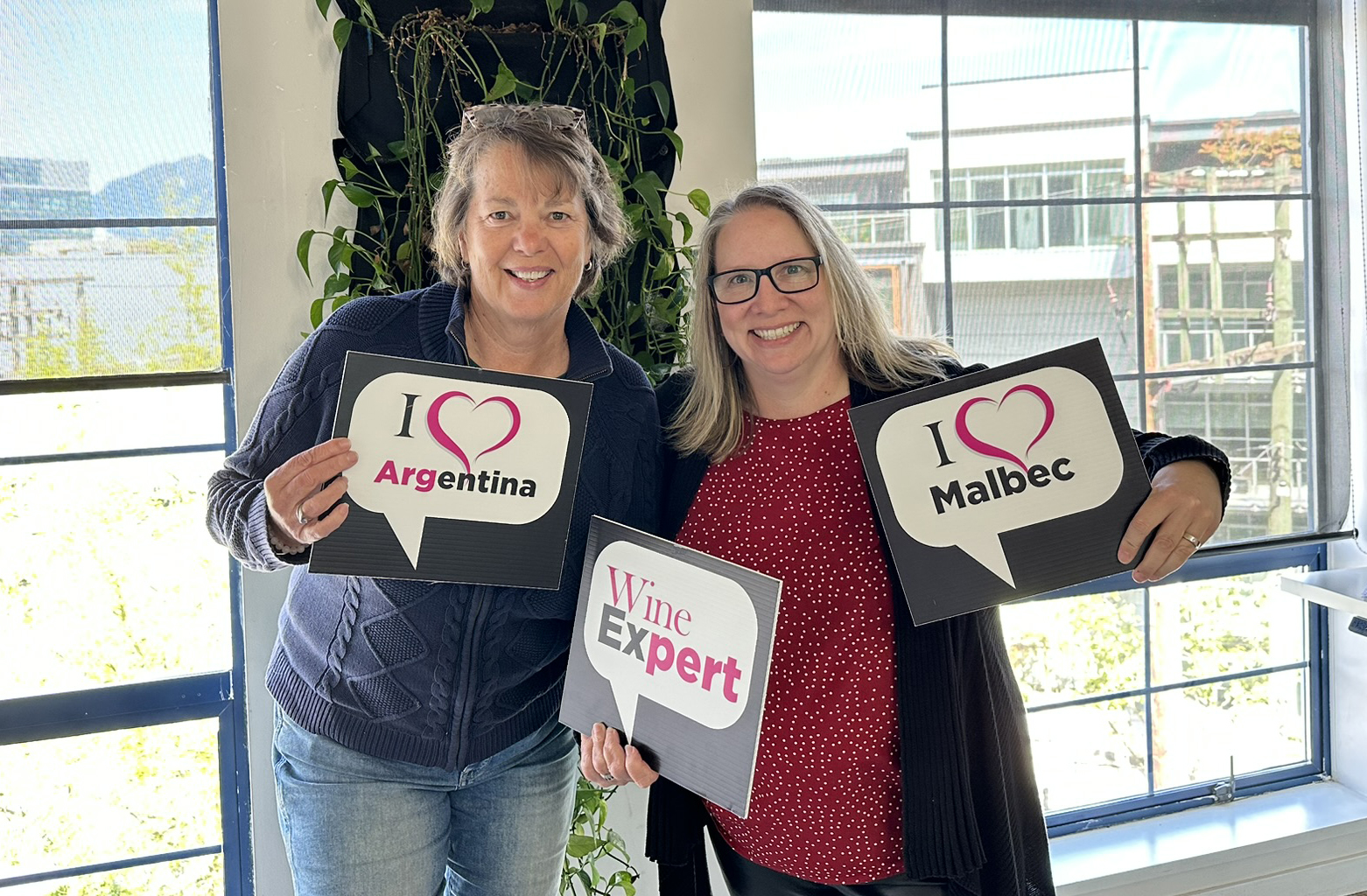
We are proud to share that, as of June 1, 2025, Town Hall Brands has been appointed to represent Wines of Argentina in Western Canada.
This opportunity follows nearly two decades of outstanding stewardship by Dana Lee Consulting Ltd. We extend our sincere thanks to Dana and her team for the strong foundation they built for Argentine wines in this market.
We are honoured to continue this legacy with renewed energy and focus. Judith Arcand, who has worked closely with us on wine industry projects since 2020, will lead the program across BC, Alberta, Saskatchewan, and Manitoba.
Town Hall Brands will be responsible for projects involving trade marketing, media relations, and promotional initiatives to support Wines of Argentina in Western Canada. With deep experience in wine communications and industry engagement, we look forward to elevating awareness and appreciation for Argentina’s incredible wine regions and producers.
For inquiries, please reach out to Leeann Froese at leeann@townhallbrands.com.
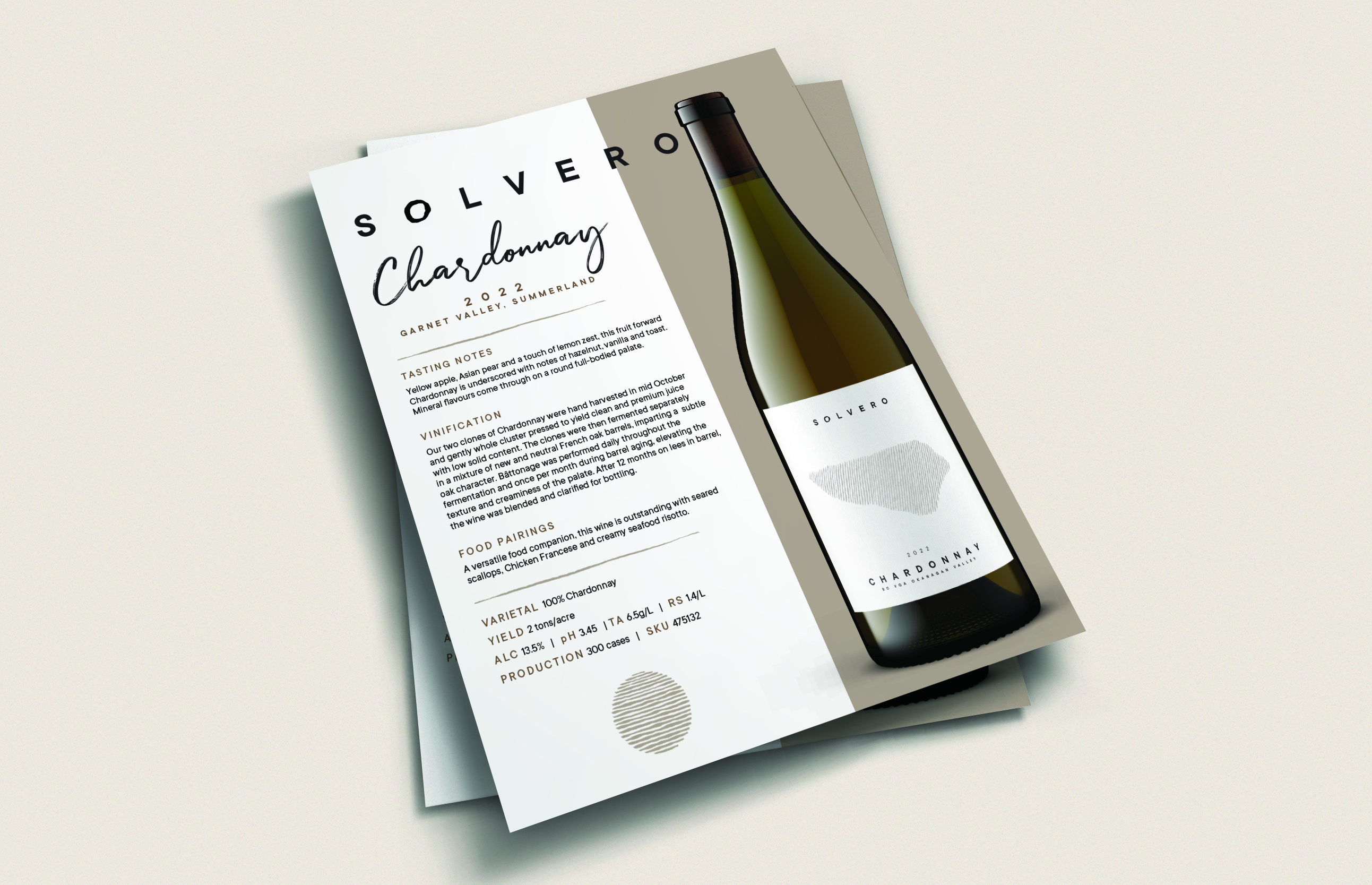
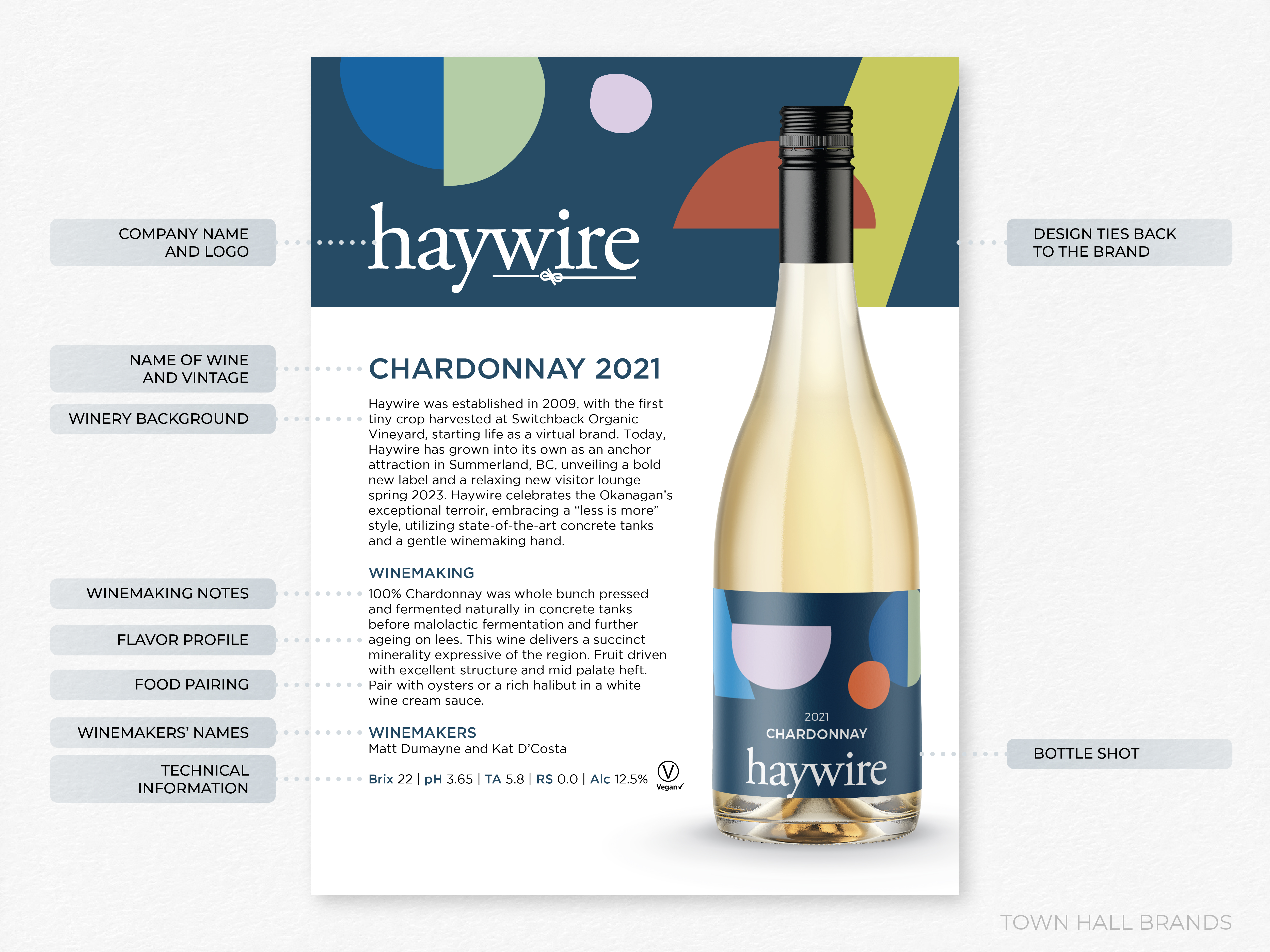
Each wine has a story to tell but the details of the flavor profiles, food pairing and technical information doesn’t always fit on the label. This is where the technical sheet comes in, all the details in one place makes it easy to share with your sales team and consumers.
The most standard information on these sheets include:
- Company name and logo
- Name of wine
- Vintage of wine
- Bottle shot image
- Flavor profiles
- Food pairings
- Alcohol percentage
- pH
- TA
- RS
- SKU
- Price
- Website and social handles
- Company contact information
Additional information to bring your technical sheets to the next level could include:
- Accolades
- Awards
- Viticulture and Composition
- Winemaker’s Notes
- Bottling date
- Production in cases
Having a professionally-made technical sheet can give your company polish, legitimacy, and make your brand more reliable. For more information on technical sheets, how they can work to help you sell wine, or to get some created, contact us today at info@townhallbrands.com.