

Two years ago, I wrote an article on AI in the vineyard for WBM. Feel free to read that article here…if you want. Otherwise, my basic argument was that although AI will eventually play a role in how we farm grapes, it’s a long way off compared to other industries and even other crops. We who grow grapes are the last ones to see such innovation.
And since then, AI has grown exponentially. If two years ago you were playing around with Chat GPT to create bizarrely distorted images and learn about tax loopholes, you can now go onto the likes of Claude and have it just create a website for you from a single prompt. Chatbots like this have essentially eliminated the need for entry-level coders.
However Claude is a computer, so it makes sense that it’s gotten very good at writing code for other computers. Similarly Chat GPT has digested the entire internet, and curates any answer for you by plucking it from its vast network of information. Sometimes its correct, and other times … less correct.
Vines aren’t computers…that’s right. I went to college.
And that’s where my argument on AI in the vineyard remains unchanged. We need a lot of data to train machine learning models and we don’t have that in viticulture. Now my previous examples are generative AI’s, i.e. bots that build things. But they are a bellwether for the state of technology as a whole, which has also improved considerably. You can’t make up for a lack of information though.
Many other industries, the ones we see significantly altered in recent years, have this plethora of data. Let’s say you want to come up with a model that, for instance, maps the behavior of people in an airport. Any given airport on any given day produces millions of data points tracked via sales information, inventory, flight schedules, etc. If you wanted to target specific groups or even specific individuals most likely to buy a certain product, the footprint we leave constantly informs these models.
But in viticulture, you might have a dirty notebook somewhere or a few random excel files on cluster counts from blocks that were subdivided years ago. Even if we as an industry were better organized, gathering data in vines is hard. Seasons are variable. Blocks are variable. Measurements are time-consuming in a job where timing is everything.
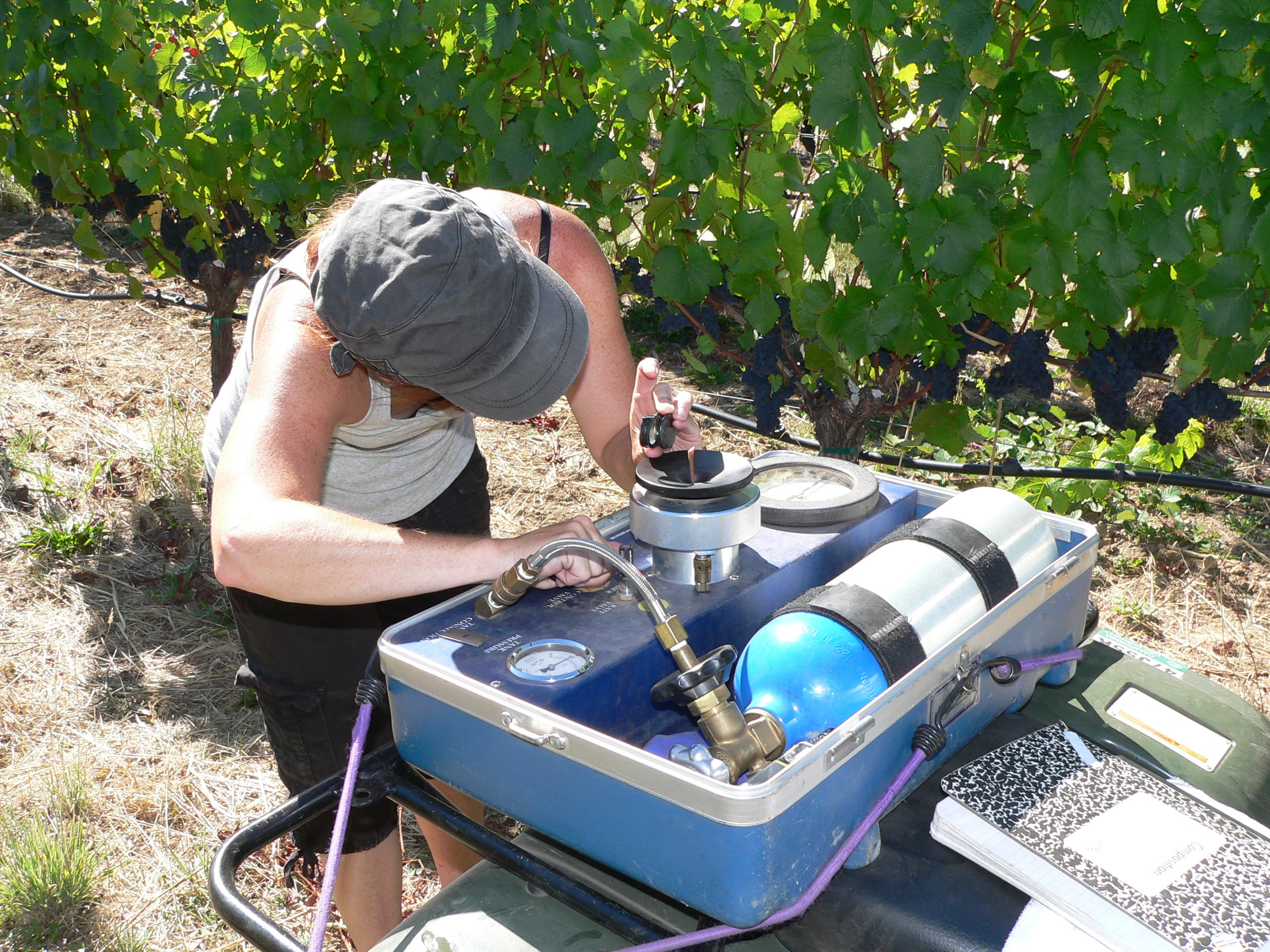 Gathering data in viticulture is an arduous task. So is keeping records of it.
Gathering data for data’s sake
If I’ve seen anything take off since I last wrote on the topic, it’s companies offering to track yield and infrastructure using AI models. The method is simple (but not easy): they put a camera on your tractor and gather data while you go about your normal operations. Then they use machine learning to count clusters in addition to giving you a count of missing vines, virused vines, emitters, and broken posts. A robot that does yield estimate is arguably pretty cool…but at what cost?
When I first heard of this, the ROI seemed fairly straight forward. Yield estimation is super important but notoriously inaccurate. Random sampling in a big block in July and August is hard even for experienced vit techs and samples are often taken and multiplied over inaccurate vine counts that don’t account for missing vines. Having an exact count of clusters alone is something worth paying for and the pricetag I would put on it is, well, probably a little more than what I would pay an intern to do it for me. I am paying for better data afterall. Then, if I want to, I can correlate that data with my actual yield and improve my predictions going forward. That’s worth something but not everything. As one grower I spoke to said, “Yield estimation is a problem, but it’s definitely not the only problem.”
As for the ability to monitor virus spread, I don’t see the advantage of having precise incidence numbers. Most growers don’t rip out individual virused vines, they rip out blocks and if a block is 25% infected, it probably pays to remove rather than farm. Do I care if that number is 27% or 32%? The decision to rip out depends on what the wineries are telling you anyway. If a block shows consistently declining quality and can’t compete in what is a cutthroat market right now, you’re going to pull it out no matter what the virus incidence is.
When it comes to vine counts, I still think a good old flyover similar to what a company like Vine View offers, is adequate enough to understand how many vines are missing. Unless you are an enormous company, having those precise numbers from an on-ground camera scan isn’t going be worth what they’re charging, at least not yet. Besides, when you put an order in for replants, you do so a year in advance. Growers are already adding in a fudge factor to their orders should anything die or weaken over the course of the season.
I think that AI used in this way is a cure in search of a disease, akin to how many people wanted to work with drones when they became affordable a decade ago. It turns out driving out to a vineyard to launch a drone is way more expensive than a fixed-wing plan flying out of an airport in Sacramento. A plane can capture thousands of acres in a single flight and isn’t limited by roads or battery life. The most I’ve seen come out of drone technology are pretty videos for the tasting room and website.
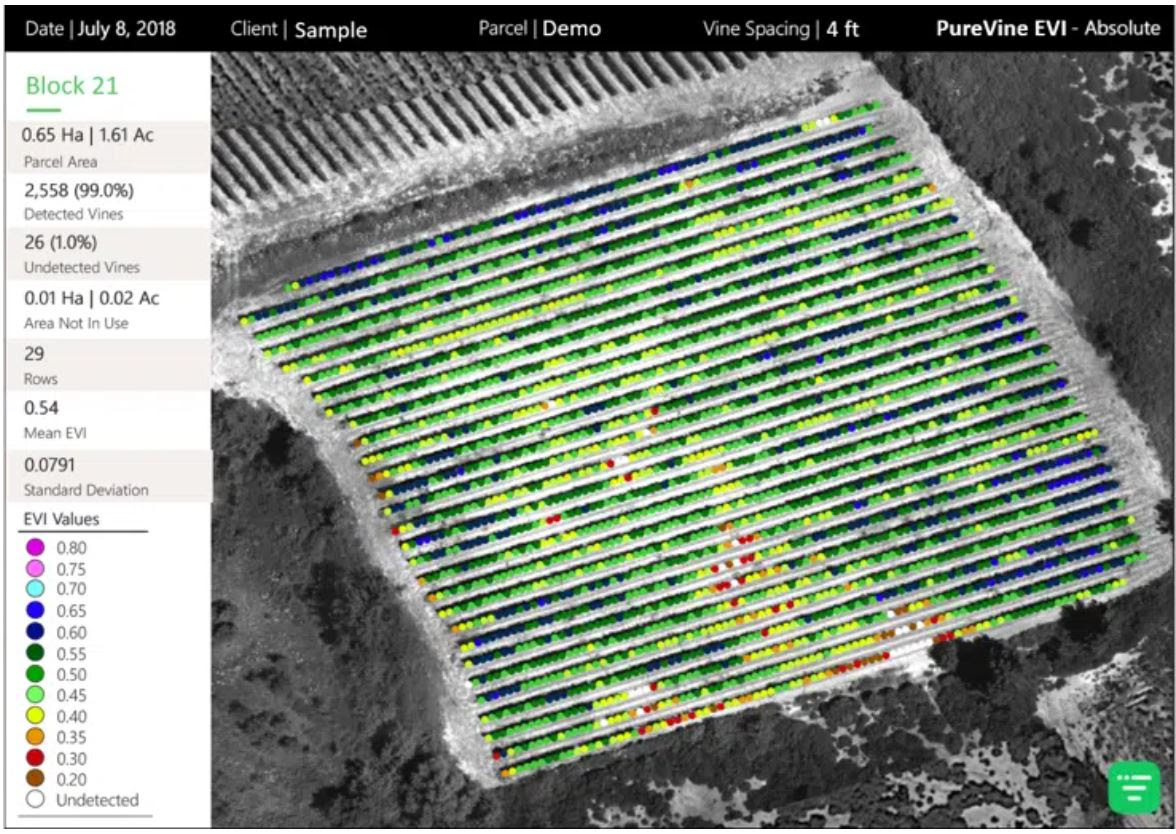 Vine View offers services such as vine counts and virus detection for much less than camera-based data collection companies.
Gathering the right data
As a viticulturist, I’m much more interested in informing the decisions you actually make in the vineyard. I think AI can eventually help growers do that in the near term. But it needs to be based on the right data, not just data in general. That’s why I recommend investing in sensor technology first.
One of the biggest problems facing growers in California is water. Having a grasp of how much water you use is vital. Companies such as Lumo allow you to monitor how much water goes into each block. This alone can help you track pressure discrepancies and leaks. It gives you information you can use. If Lumo’s out of reach for you, I would recommend adding a datalogger to your flowmeter because let’s be honest, no one is ever going to check the meter, jot it down, and put it in the speadsheet. Similarly adding a pressure transducer to your irrigation line can be done for a few hundred dollars. Knowing that you are experiencing low pressure throughout the duration of the irrigation already lets you know you should water fewer blocks at a time…or that your booster is failing. That’s something I’d rather spend money on than a precise count of bent T-posts.
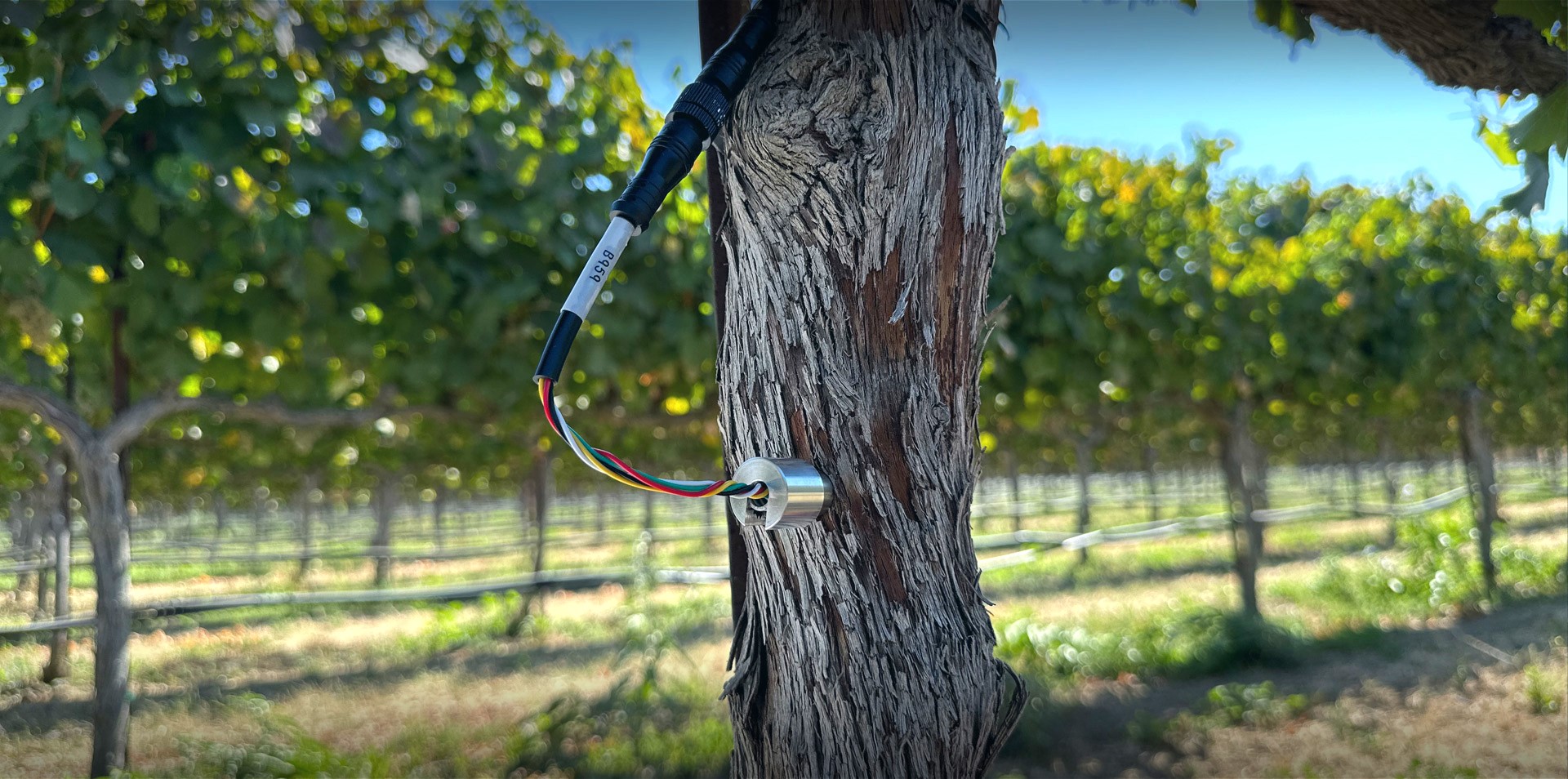
There is very little that is truly “new” that comes out in Agtech, except for those rare times when it does. I’m still surprised by how under-the-radar Florapulse micro-tensiometer plant stress sensors are especially since the alternative is a pressure bomb…which sucks. We’ve been using these sensors for four years now in lieu of taking manual measurements of leaf water potential. Having a reading every 15 minutes as opposed to once every week has been a gamechanger. I can track how a vine responds to weather, how sensitive vines are to irrigations, and exactly when we reach desired stress levels at any given point in the season. One thing we can do here at AV is loop together your plant stress levels and your lab data to track what practices and seasonal conditions have historically produced the best wine. That could be used to build models eventually, but even just seeing the information graphed together allows growers to see similarities with their own eyes and make decisions accordingly.
When I first wrote about this in 2024 Li-Cor had just released their Li-710, a scaled down version of their research-grade Eddy Covariance system. While many companies claim to offer a “real” measurement of evapotranspiration(ET) or crop water use, these are all estimated in some way or another. The Li-Cor 710 actually measures your ET by measuring water vapor flux directly. Mark Greenspan has been working diligently with this sensor over the last two years and has created an exact water balance model that allows you to water back exactly what your vines are using. In the end, machine learning can’t make up for experience…so many years of experience right, Mark? He’s also found that the crop coefficient we’ve been using for grapevines (and probably other crop coefficients as well) is exaggerated almost by a factor of two.
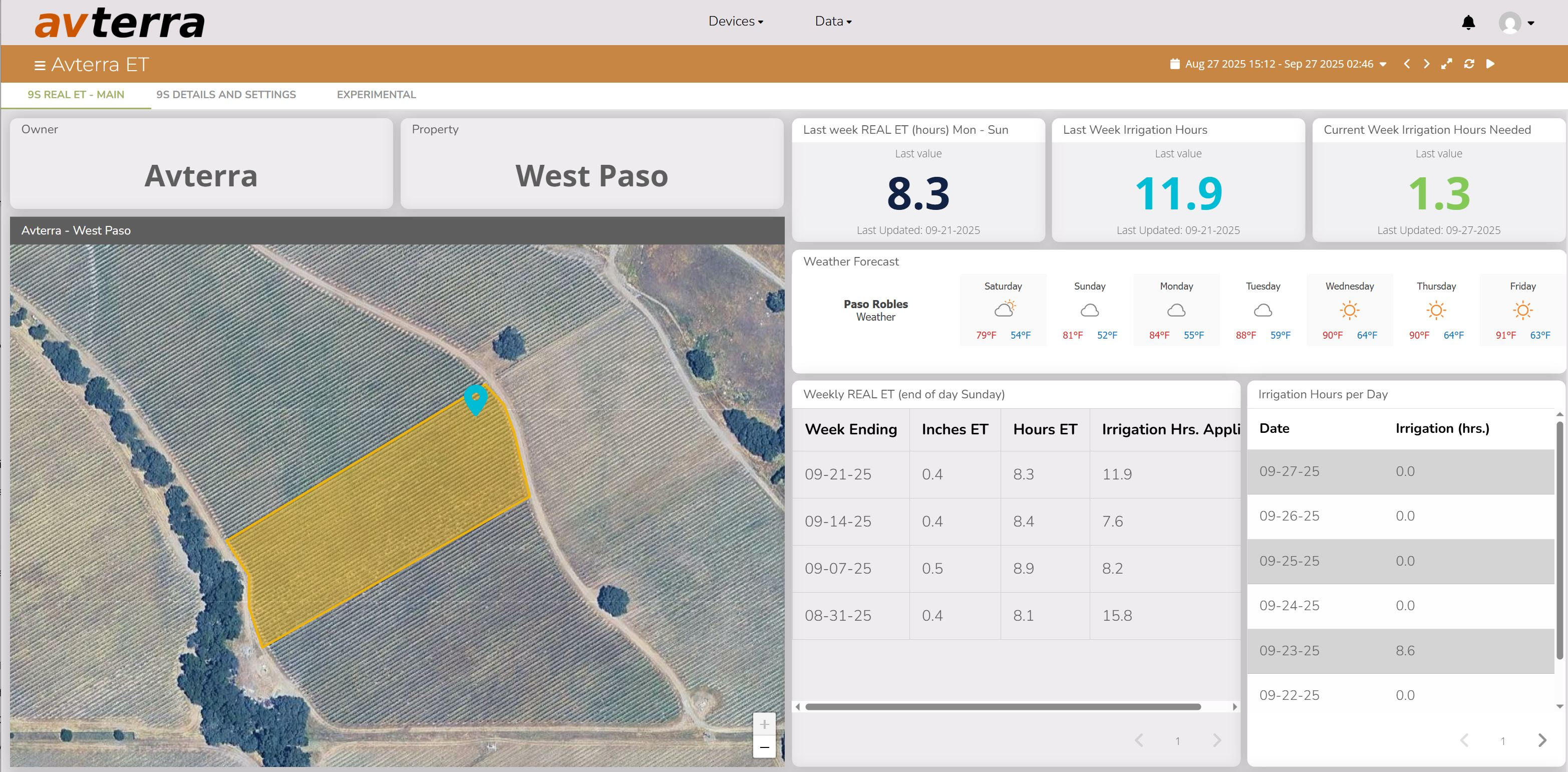 Over the last two years, Mark Greenspan has engineered an exact water balance model based on the Licor-710, the only tool capable of measuring actual ET for under $50k. No AI, just experience and collecting usable data about crop water use.
Read the rest of the article here to find out more.
How should I be irrigating?
Water is scarce and labor is expensive. Installing a soil moisture probe can show you when to irrigate, how much to water, and how often. Know where your water is and how long it stays in the rootzone.
Soil moisture probes can be integrated with any existing telemetry device or we at AV can provide inexpensive dataloggers for you.
Reach out anytime to loni@advancedvit.com for more information.
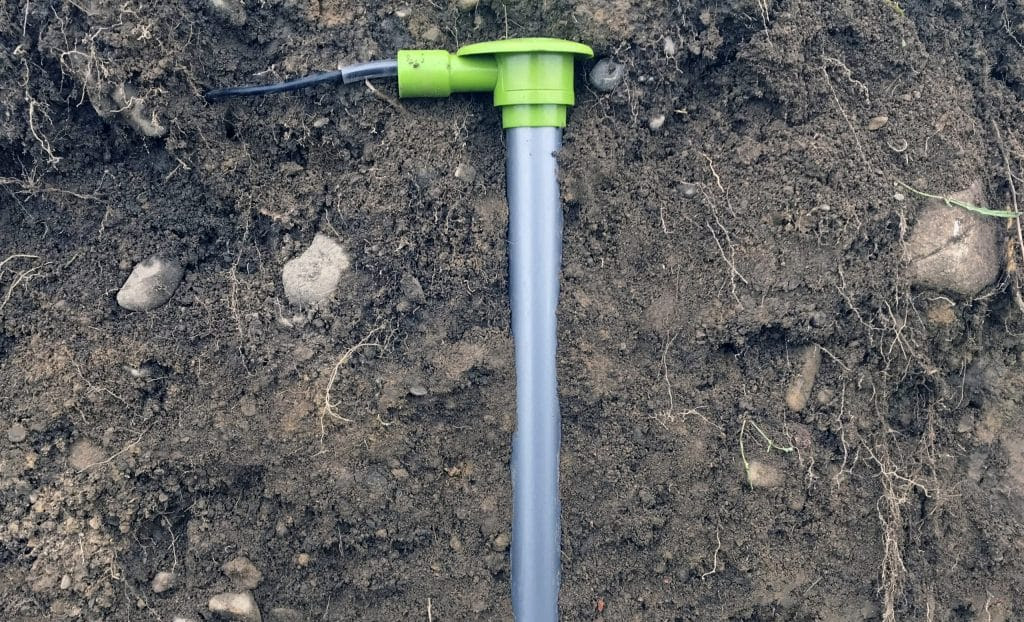 Aquacheck soil moisture probes measure soil moisture at 8" intervals down to 48". Know where roots are actively taking up water and time your irrigations to perfection.
Harvest has wrapped. It's raining. And the only thing on your calendar is that pesky meeting to finalize your budget for next year. Here are some things Advanced Viticulture can help you out with:
- Soil moisture probes: see how deeply irrigations percolate and how quickly water gets depleted.
- Florapulse plant stress sensors: track water stress and maximize wine quality, sans pressure bomb.
- Weather stations: don't just talk about your terroir, quantify it
- Frost monitoring: monitor temperatures and set alerts for dangerous frost events.
- Valve automation: stop sending someone to that far-flung vineyard just to turn a valve.
- Flow/pressure monitoring: Keep track of your irrigation efficiency and see just how much water you're actually using.
- Tank/reservoir/well depth monitoring: how much water are you working with? Know what's available to you whenever and wherever.
Did your fruit get rejected this year? How about leveling up your game with Advanced Viticulture Consulting. The market is competitive. We can help you improve grape quality and save resources...like money.
Reach out to loni@advancedvit.com for more information.
Want your own 2025 year in review?
If you liked out last article on the 2025 vintage, why not have us run the same analysis on your vineyard(s)? Let the folks at AV illustrate just how your vineyard compares to different sites and/or regions across the years.
Show those winemakers why your grapes are worth paying top dollar for. Get in touch with loni@advancedvit.com for more information.
Come see us at WIN Expo 2025!


Introducing Avterra, AV’s vineyard technology hub and irrigation guidance system. Avterra is an integrated data portal that links a multitude of sensor and telemetry providers into one cohesive dashboard.
Based in advanced crop science, our guidance system is thoroughly nerdy yet is easy to use. Our goal is to make vineyard technology uncomplicated so it can best support your decisions as a grower.
Integrating our data streams into a single portal makes interpretation easier and decisions straightforward and repeatable. Dashboards can be fully customized to suit the customer's needs. Create a personalized user interface for your team. Streamline field notes, lab results, and sensor data to view trends as they unfold.
Not merely a collection of charts and tables, Avterra includes data interpretations and recommendations. Remove the guesswork by embedding Advanced Viticulture's decades of experience. We make sense out of those squiggly lines.
How do we optimize irrigation you ask?
Avterra uses Real ET (evapotranspiration) combined with soil moisture, vine water stress, and weather forecasts to determine the optimum irrigation application rates and timing.
Turn data into decisions with Avterra.
To learn more, visit AV at WIN Expo booth 431 on December 4 at the Sonoma County Fairgrounds.
Register for a free trade show floor pass with promo code: ADV431
Hear me out
Up and down the California Coast, we got some rain last week. Up North, places got around 1.3” with up to 2” closer to the ocean. Down south in Paso Robles, we’re looking similar numbers of between 1.5” and 2”. So, one would naturally think that if we were irrigating post-harvest (as we highly recommend), we can stop now. As you may have suspected by the title of this article, that may or may not be the case.
Profile Picture
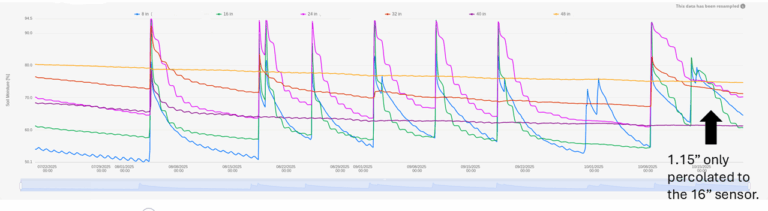
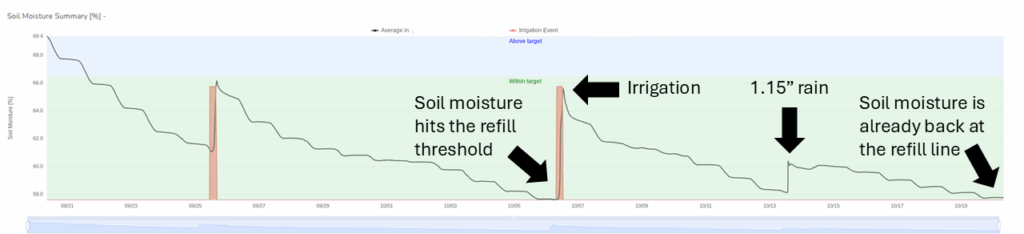
Here at AV, we love looking at soil moisture charts. However, in the case of rainfall, it can be misleading. Looking at the graph below, you can see that irrigations produce a clear spike indicating how deeply water percolated and how long it took to be completely depleted by plant roots. Rain doesn’t deliver the same concentrated volume you’re used to getting with a drip emitter. Therefore it doesn’t infiltrate the soil in the same way. You may see shallower percolation from the inch plus of rain we got, but that doesn’t mean the rain was insignificant since it wets a much larger surface area than drip irrigation.
Soil moisture probes do a good job of showing your soil’s water holding capacity. That’s what I put more stock in rather than comparing a rain storm to irrigations. In the graph below, we see that the average soil moisture (average of moisture at all sensor depths from 8” to 48”) is slower to deplete when compared to the previous irrigations, where water was rapidly drawn up. This isn’t always the case.
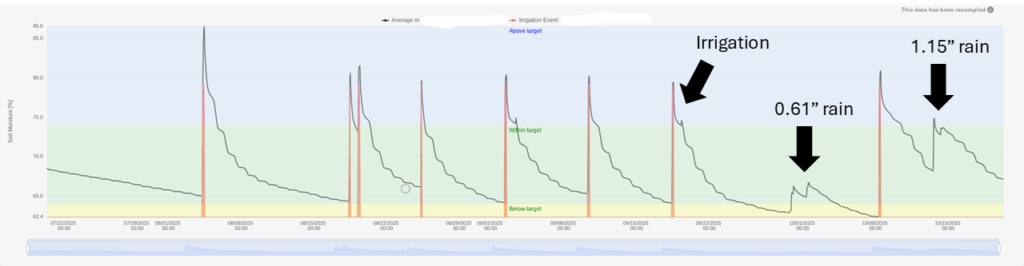
In this graph for however, we see that after the recent rainfall, average soil moisture is right back to where it was prior to the rain. Assuming vines haven’t entered dormancy, this site should continue to be irrigated.
What about plant stress?
We don’t water just for the sake of the soil. We care about what a lack of water does to the vine’s physiology. And right now, we want vines nice and happy…not so happy they start putting out new growth, but that’s hard to do. An unstressed vine has a functioning canopy that can produce sugar. With the fruit gone, that sugar gets stored in the woody permanent parts of the vine and used the following season to grow leaves and shoots. Eventually, the canopy will start earning its keep but before then the canopy relies on these stores from the wood.
Vine stress (water potential) is not just a function of water availability. Its also a function of vapor pressure deficit…and salinity…but that’s another article. Vapor pressure deficit is the discrepancy between how much moisture the air could hold and how much it’s actually holding. When temperatures are hot, the air can hold a lot more water in suspension than when it’s cold. That’s why things are dewy in the morning. Water potential, which is essentially just the tension of water moving through the plant’s body, responds to this atmospheric pull of moisture.
When it rains, VPD is very low because humidity is 100%. Vines aren’t just unstressed because there’s plenty of water available. They’re also unstressed because the atmosphere isn’t pulling water out of their tissues.
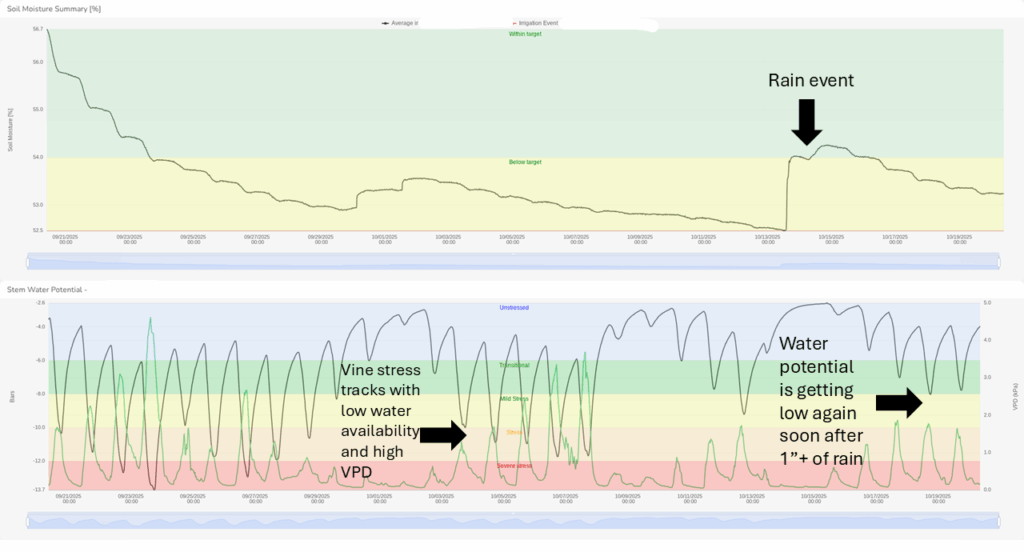
Even if a rainstorm fails to deliver much water, vines are unstressed. It doesn’t mean it will stay this way though. Late season heat happens here in California and if you stopped watering completely because you assumed the soil profile is full, think again. If the profile is back to being dry and we get some heat, your vines can easily get stressed again.
Get your macros in, bro
One of the main reasons to keep irrigating is to apply some fertilizer. Harvested fruit removes roughly 3 lbs nitrogen and 11 lbs potassium per ton. Applying an N-P-K fertilizer through the drip post-harvest puts some of these removed nutrients back into the system. Later, cool years like this one make getting in this final application difficult, but if you can squeeze it in, it makes a big difference when it comes to early canopy establishment the following season.
Conclusion
Should you irrigate or not? Ideally, you get yourself some soil moisture probes and find out. Otherwise, my general advice is if you’re on a lighter soil or one with poor percolation, I wouldn’t take the rain as a sign that your work here is done. Keep irrigating regularly until leaf fall is the best way to ensure maximize recovery and set yourself up for success next season.
If this year is defined by a singular emotion, it’s anxiety. That’s nothing new in farming, however I’m talking about anxiety over the abysmal grape market rather than any natural phenomenon. Many of us were so busy scrambling for buyers, we may have forgotten to notice just how great the weather has been. Why wouldn’t we get handed a great year when most of us can’t sell any grapes?
Let’s look at some numbers
My gut feeling was that 2025 was similar to 2023 with a few big differences. 2023 saw some record high rainfall in the winter and early spring throughout California. Even the Paso Robles area got around 21” of rain from July 1st 2022 to July 1st 2023, up from a whopping 6.5” the year prior. That amounted to lots of nice canopy development early in the year and some good yield potential, provided you didn’t get shatter during the chilly springtime. This year however, the Central Coast was back to a measly <7” of rain while the North Coast got upwards of 40”. This made for a more “typical” vintage from the outset with Central Coast growers having to water much earlier in the season than their northern counterparts.
And now let’s look at some graphs
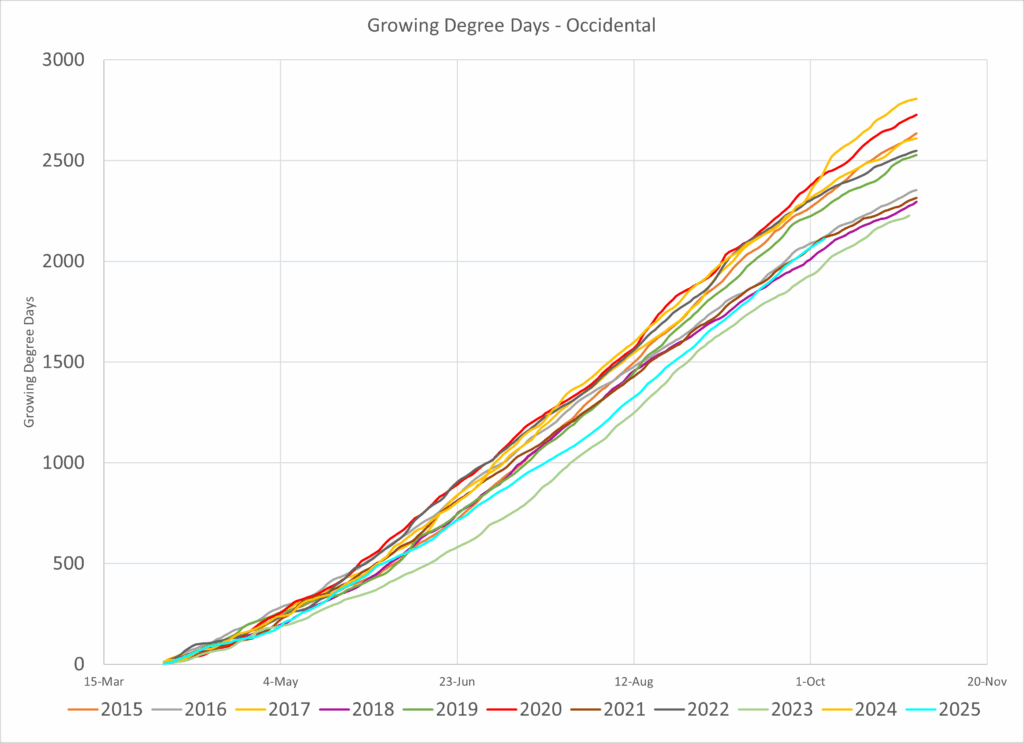
I like looking at how heat accumulates over the course of the season to better understand how one season stacks up against another. The Winkler Growing Degree Day formula allows us to compare different seasons using the same metric. Growing Degree Days (GDD) are calculated by subtracting the grapevines threshold temperature (50°) from the daily mean temperature.
Below are a few graphs from Sonoma County
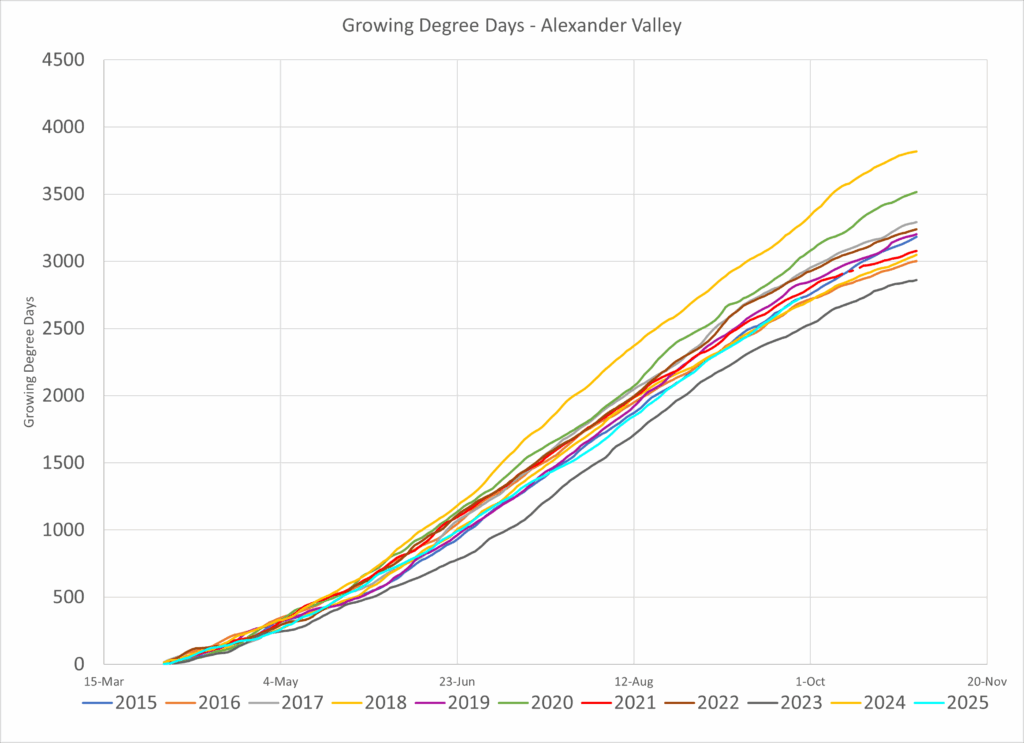 For the Alexander Valley 2025 (in cyan) comes in just below the previous 11 years except for 2023
Occidental shows a similar situation. 2025 (cyan) was slower to accumulate heat than most years but was warmer during the spring compared to 2023.
Let’s look at how the season played out in Napa.
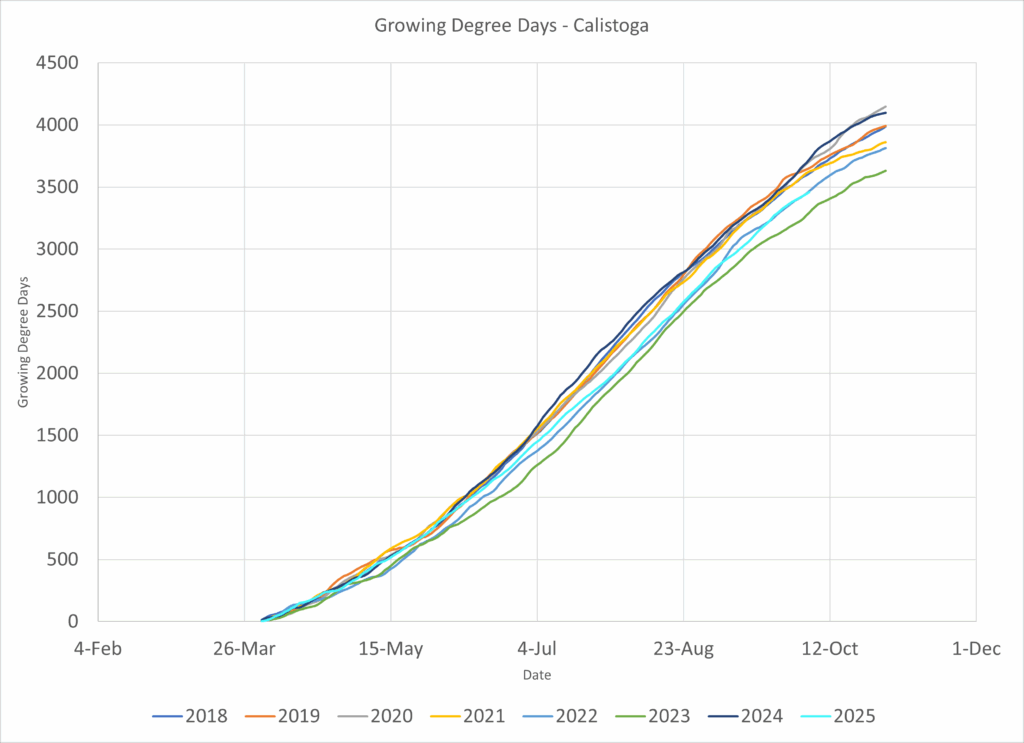 Calistoga, in the northern part of the valley, saw slowly accumulating heat akin to 2018.
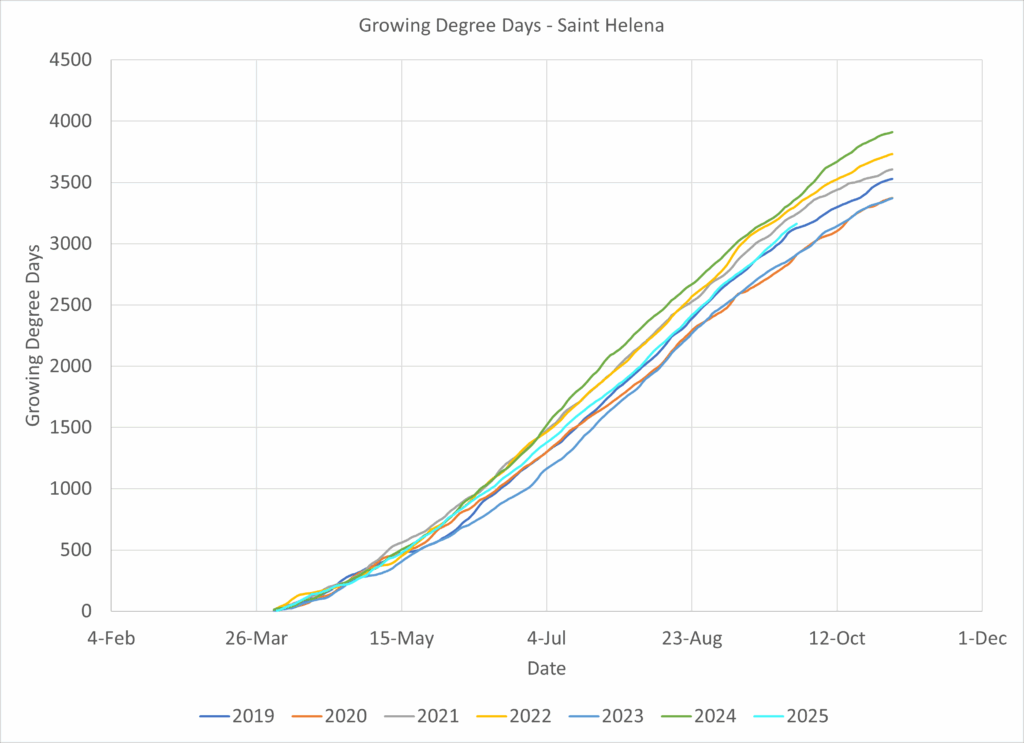 2025 in Saint Helena was right in the middle and seemed to track almost perfectly with 2019.
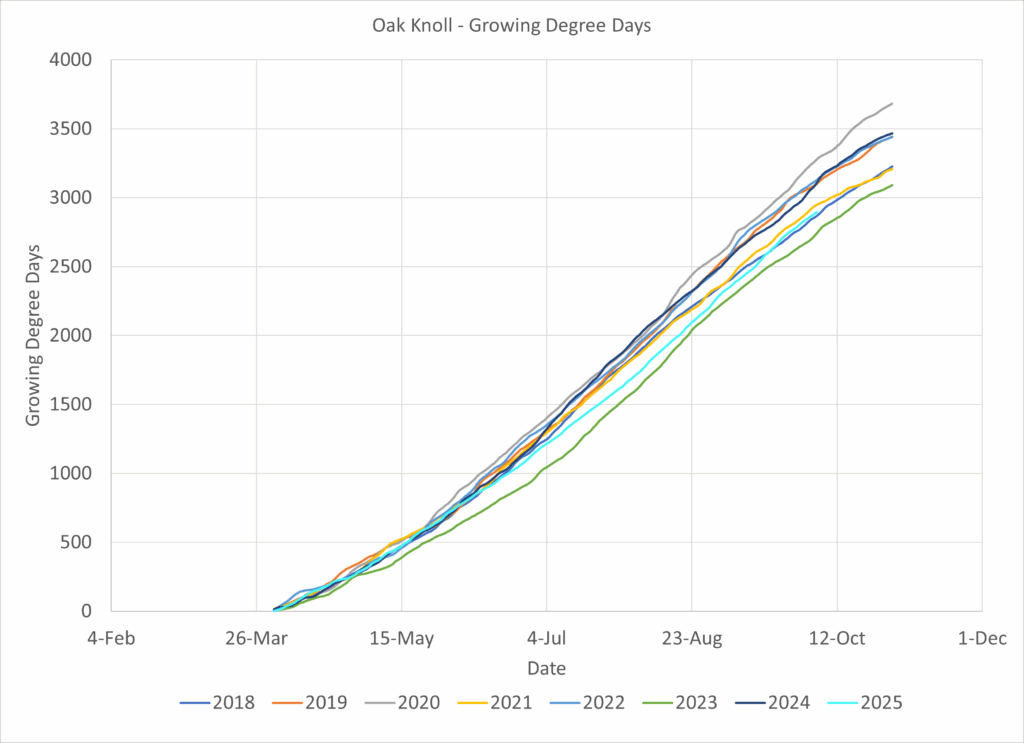 Oak Knoll, which is typically cooler than other parts of the valley, saw 2025 coming in just above 2023 but with a warmer spring.
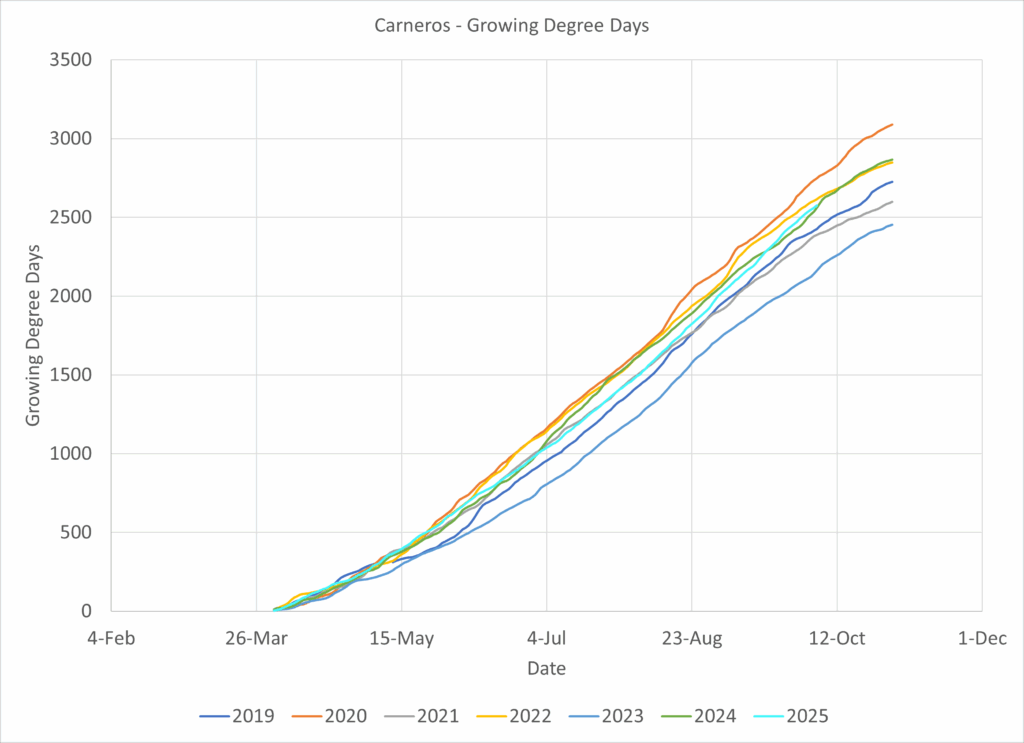 2025 in Carneros was right in the middle of the last 7 years.
Let’s look at some places in the Central Coast.
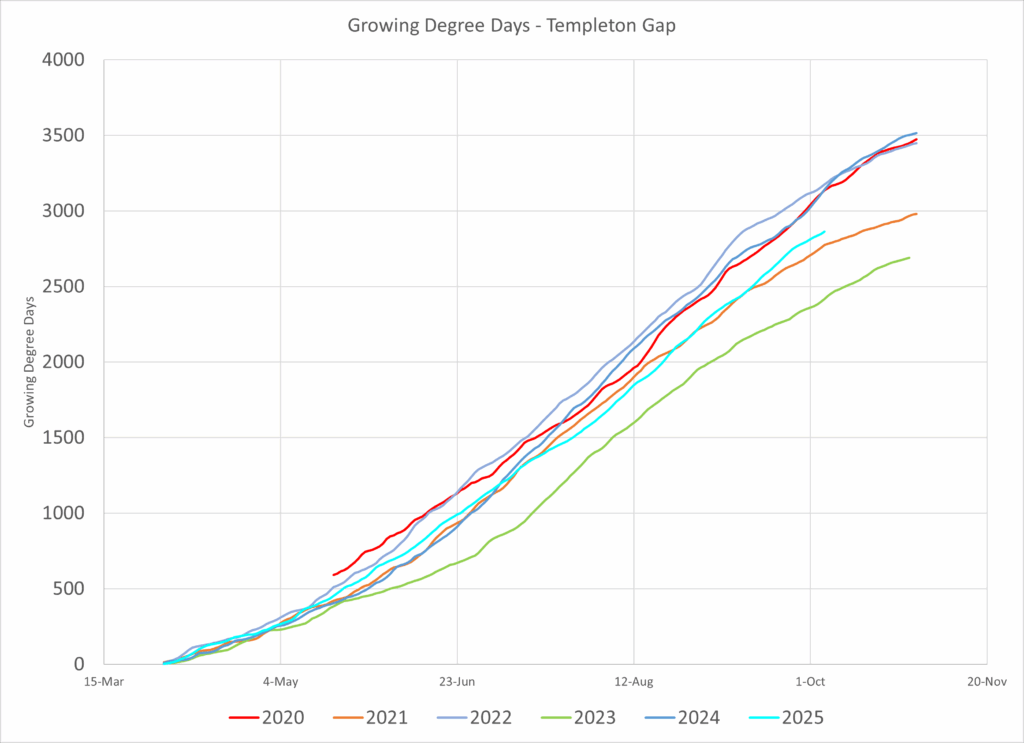 In Templeton, a fairly cool zone with influences from the ocean, 2025 was a much more typical year with respect to 2023 and tracked with 2021.
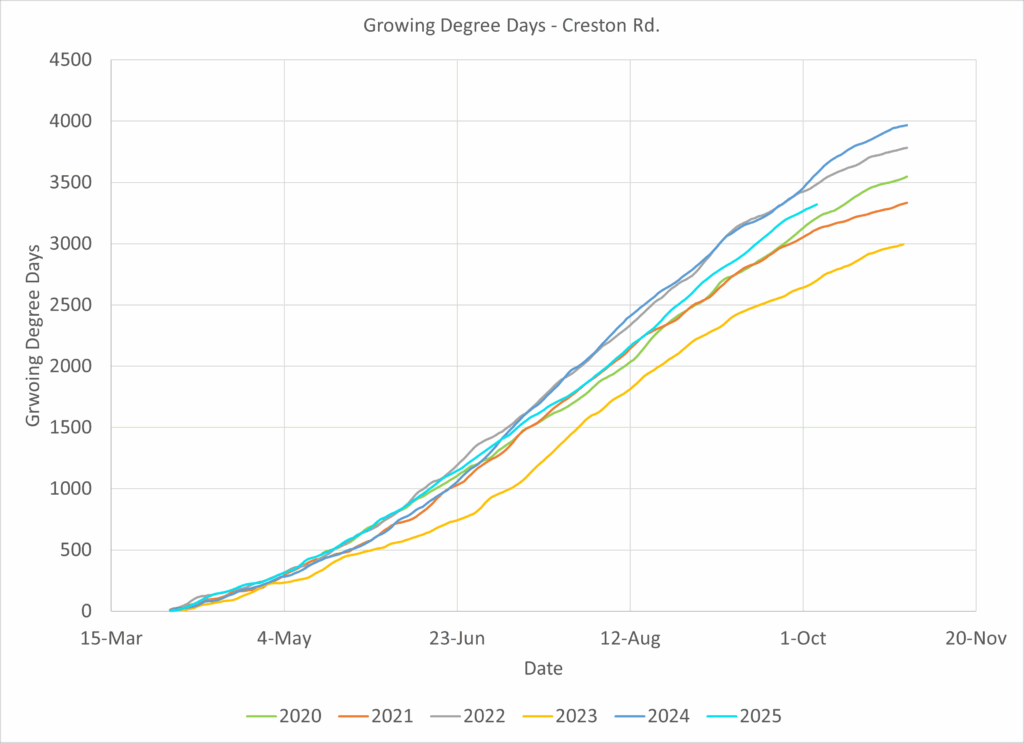 East Paso also seems to have had an average year as well.
Most notable about these graphs is that the cool spring temperatures that caused a long drawn out bloom period in 2023 was absent. Most growers were able to set some fruit. We didn’t get an early heat wave that got things started just in time to get frosted. That’s nice.
Moderate temperatures, however make for a nasty mildew season. If there’s anything to gripe about…in terms of weather anyway…it was pest pressure. Mildew secondary infection is a function of temperatures and can be charted using the Gubler Thomas mildew model. The image below shows the mildew widget from the AV’s own Avterra portal. Mildew pressure was high throughout the season.
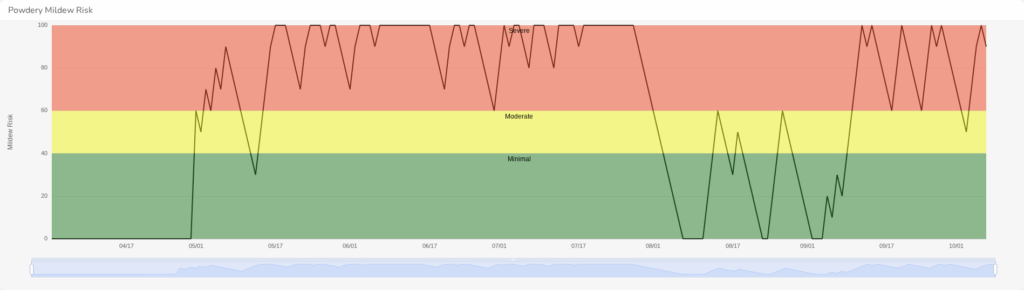 The Avterra data portal tracks mildew risk over time. Risk was high most of the season.
Similar to 2023, what made this year great was the lack of damaging heat waves. This was more noticeable in areas that typically struggle with excessive heat. We did get some warm days, but nothing compared to the hot July of 2024 or the horrendous September of 2022 the latter of which effectively destroyed the vintage for many growers.
The charts below show how summed heat events compare across the last 6 vintages. Here’s the Alexander Valley. While there were a few warm days, there were none above 105°, which is the threshold at which severe damage to vine tissue can occur.
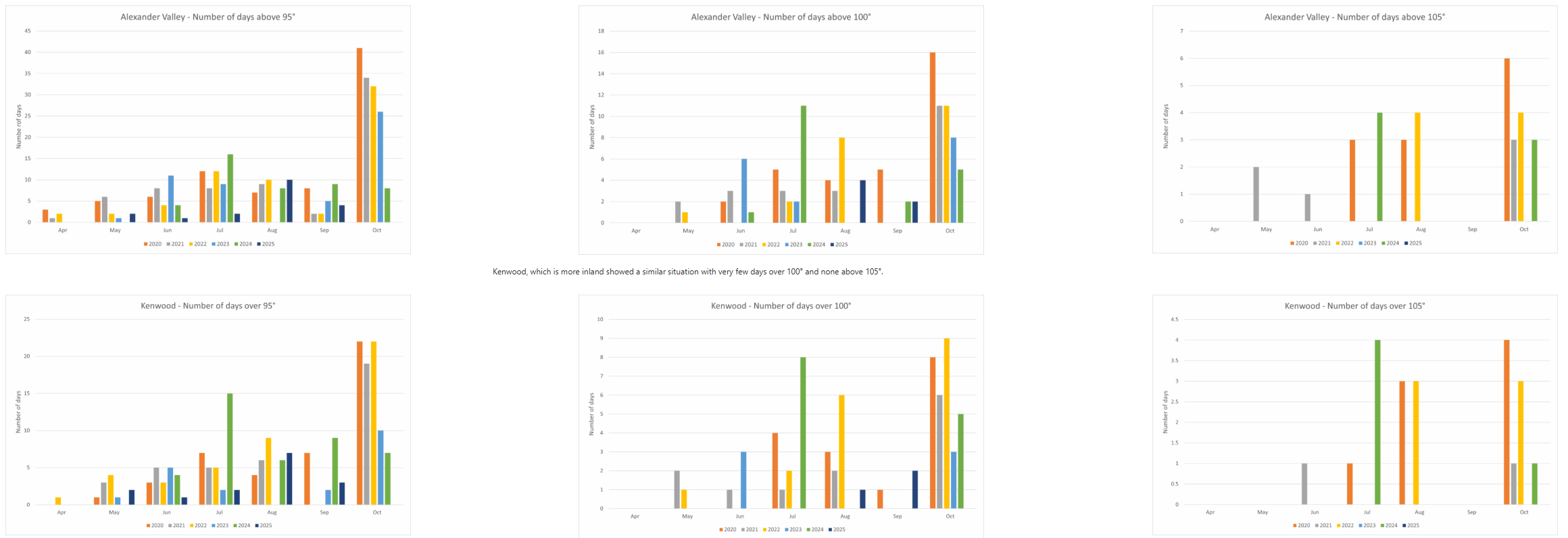 Click image for larger view
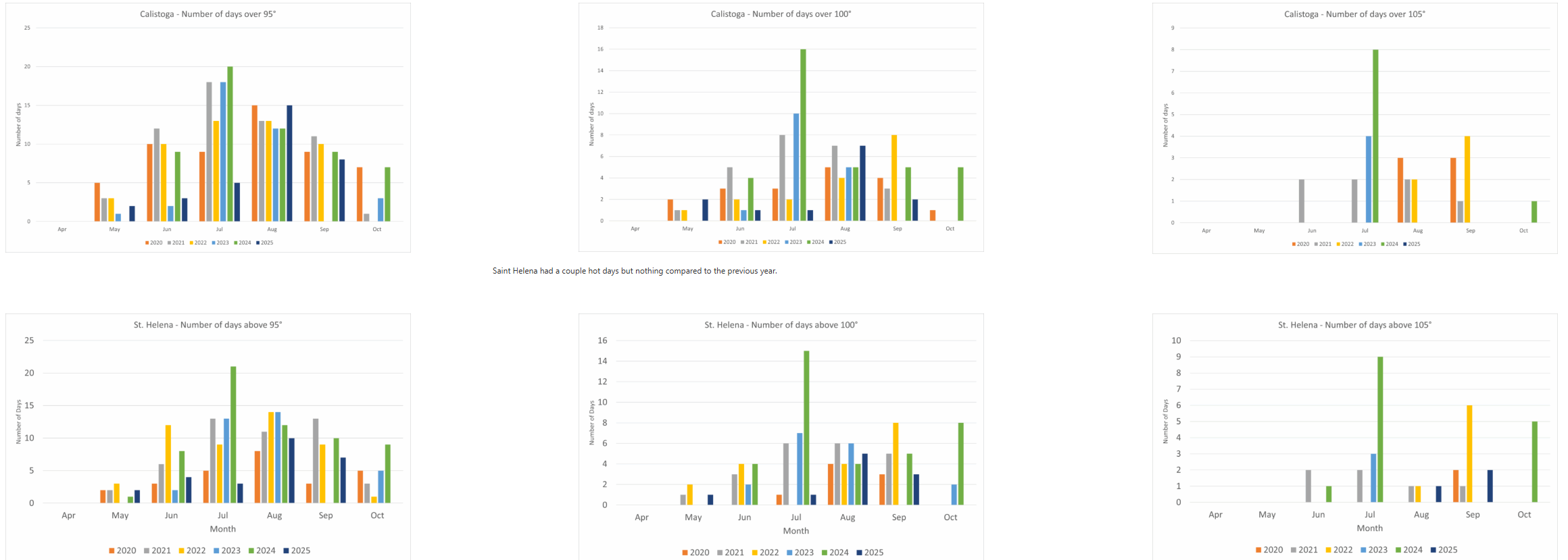 Click image for larger view
It’s worth noting that these years are considered spectacular in areas where heat events prove year after year to be a big problem. In a place like Carneros, which is typically cooler, a year without heat waves is less anomalous. We didn’t register any days over 100° this year. For other cooler regions such as west Sonoma County and the Templeton Gap in Paso Robles, severe heat events are less of a concern. Unlike 2023, these areas had enough warmth to ripen fruit without having to hang it out until Christmas.
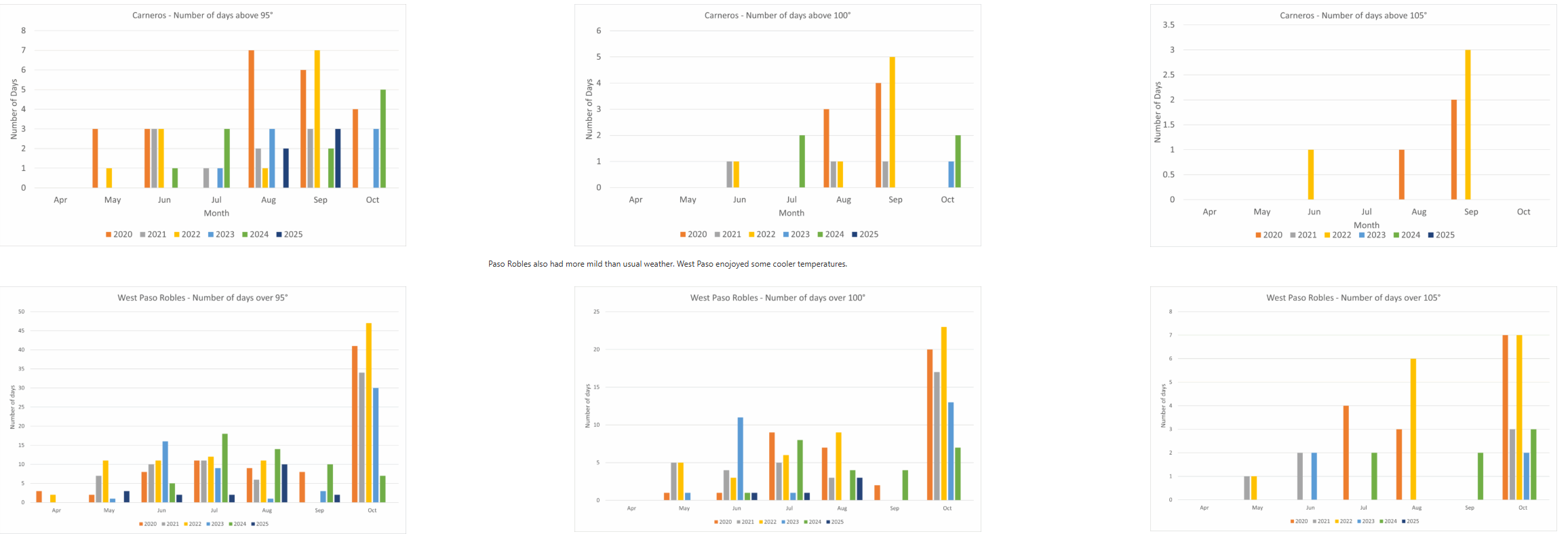
 Click image for larger view
Fire on the mountain
Looking at some of the growing degree day accumulation charts, 2025 is looking a little like 2020 but without the devastating Glass Fire that took out most of the vintage in the North Coast. We did get a couple fires that may pose a problem for some parts of California. However, the effect is more localized than in previous years.
Extra innings
While the Pinot and Chardonnay are in the tank, some red growers are still waiting to pull the trigger. 2023 was so markedly cold that some late season varietals didn’t even get ripe. This year however, these grapes are well on their way to ripening and cool weather (with even a little rain!) means less dehydration and less late season shrivel.
Does the innings analogy work? …sports.
In sum
High disease pressure with great wine that no one wants to drink? I feel like I’m back in Europe. For many reasons, this is a vintage to lay down and open up during what we hope will be better times.
All data in this article is from the Western Weather Group.
Let’s look at some maps
Last week I was in the middle of writing a post about how great this year was turning out. I thought, just as long as growers can avoid something disastrous, this could be a great vintage. Within 24 hours, the Pickett fire grew from a small blaze north of Calistoga to a towering wildfire that has since consumed 6000 acres.
Of course, this comes on the heels of the Gifford fire in San Luis Obispo, which has taken out over 100k acres the week before. For some growers in Napa and Edna valley, harvest may be over before it starts. While the definitive kibosh will come from lab analysis, knowing how smokey it got and when is useful for metering expectations and determining the next step.
And there are some super useful tools out there! The EPA has a wide network of air quality sensors throughout the country with varying degrees of concentration. The map below shows just how many of these stations are publicly available, so you can see where air quality is suffering the most.
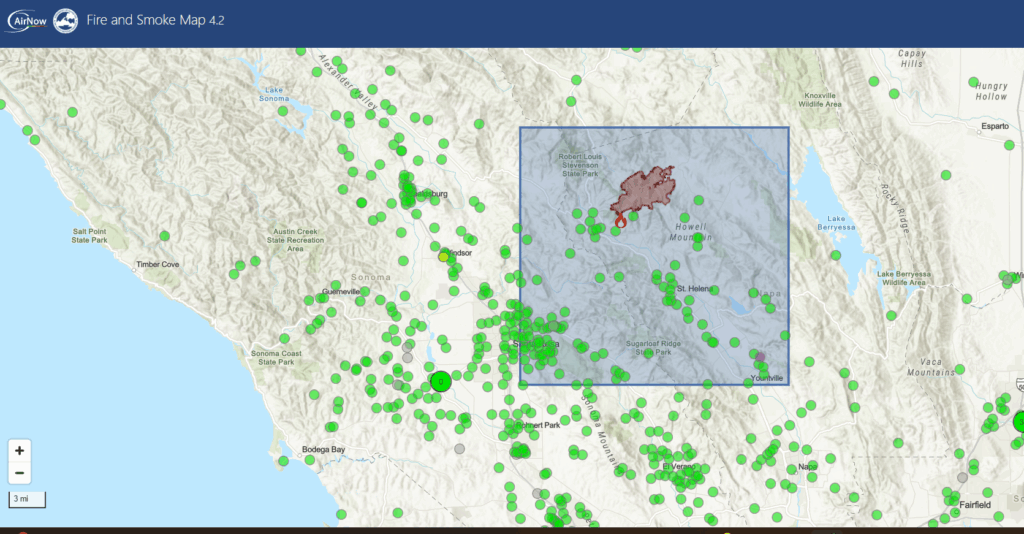 A map of reference AQ stations in the North Coast. The Pickett Fire is outlined in red.
So what is AQI?
The immediate snapshot this resource gives you is the Air Quality Index. This is an index released by the EPA that takes into account several key pollutants:
- Ground level Ozone: primary component of smog
- PM2.5: inhalable fine particles that are 2.5 micrometers in diameter or less.
- PM10: inhalable coarse particles that are 10 micrometers in diameter or less.
- Carbon monoxide: Product of combustion of fossil fuels from vehicles or industry.
- Sulfur dioxide: Reactive gas from combustion of fossil fuels, namely power plants.
- Nitrous dioxide: Another reactive gas from combustion of fossil fuels.
The scale goes from 0 to 500, with anything above 100 considered unhealthy for sensitive groups such as those with asthma. Anything above 150 is classified as unhealthy for everyone.
What we consider when it comes to smoke taint however, is primarily PM2.5, that is, very fine particles. Did your vineyard experience a spike in PM2.5? You are more likely to find smoke taint if you did.
As I write this blogpost at 10pm on a Thursday night, all the dots you see are green, meaning that the AQI is between 0 and 50. Having better AQI at night is pretty typical. We want to know the highs and lows during the day though. Luckily each of these dots gives you hourly and subhourly information on how AQI and PM2.5 have cycled over the last few days.
The EPA also releases this fire-specific information in map form.
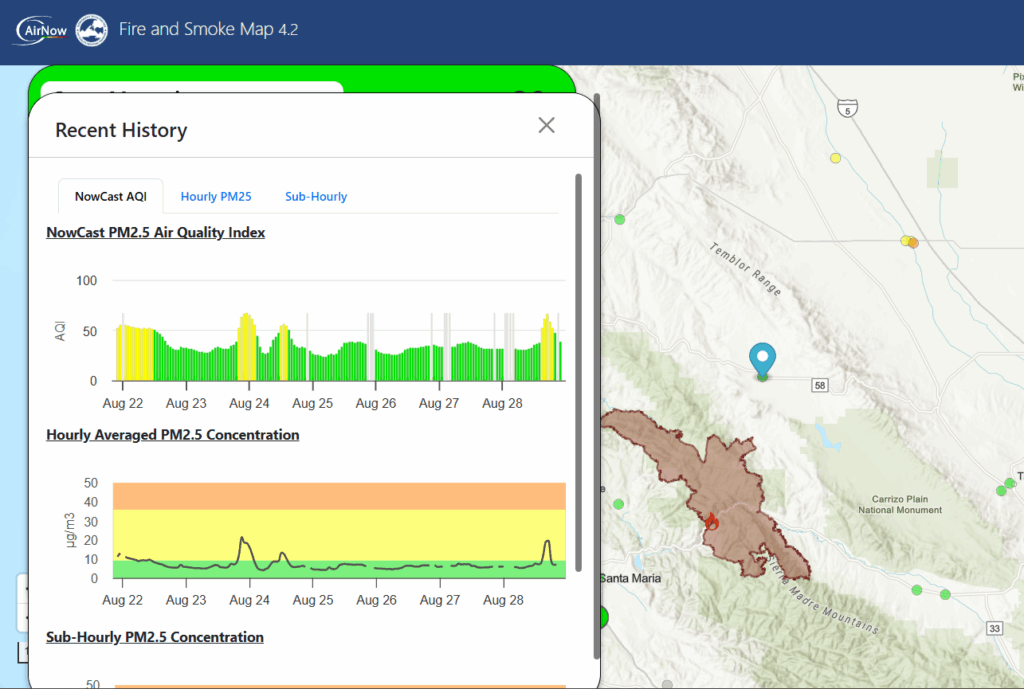
They also display information from the Interagency Wildland Fire Air Quality Response Program, which gives information specific to any given fire. Below we have the areas affected by the Pickett Fire in Calistoga, Deer Park, Angwin, and Pope Valley.
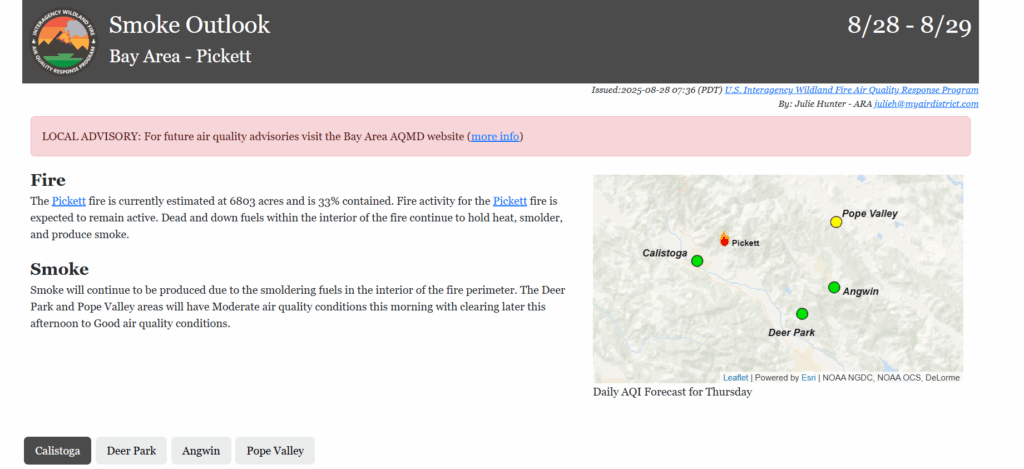
The EPA’s website gives you not just air quality but also charts ongoing AQI and PM2.5. The below information is from the reference station in Calistoga. This tracks air quality from the start of the fire onwards.
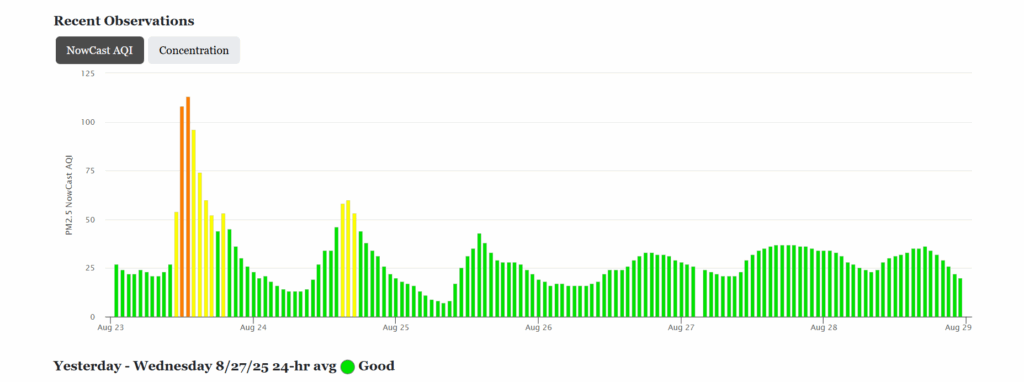 Air Quality (AQI) from the Calistoga Reference Station
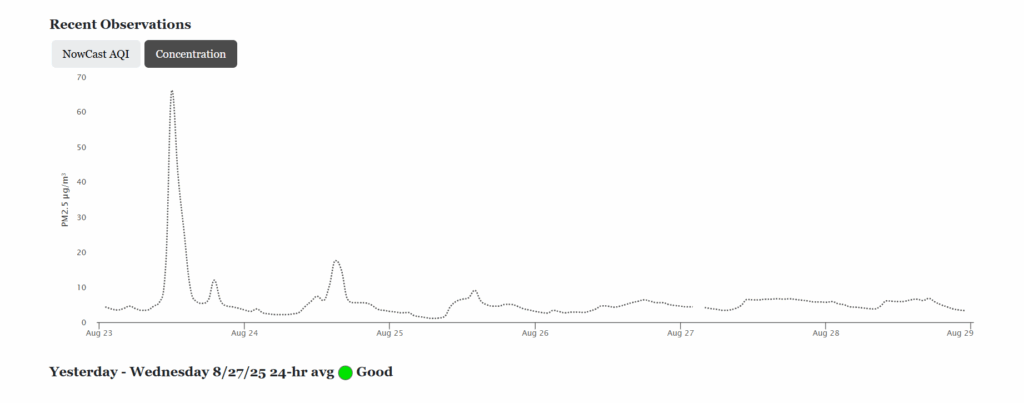 The same station in Calistoga showing concentrations of PM2.5, the pollutant that poses the biggest risk when it comes to smoke taint.
Reference stations are more common in some areas than others. The North Coast has hundreds of these stations available and fewer as you move south. The best way to track your own air quality is by getting your own sensor.
The EPA’s network is largely made up of Purple Air sensors, which are fairly inexpensive and allow you to share your information with the EPA for better monitoring and modeling. These start at just $139.
Alternatively, Davis Instruments offers the Airlink AQ sensor for just north of $200. This provides PM1 (1 micrometer and smaller), PM2.5, and PM10, in addition to AQI. This will display alongside your weather data if you happen to already have a Davis station.
As a caveat, these stations both require Wifi and AC power.
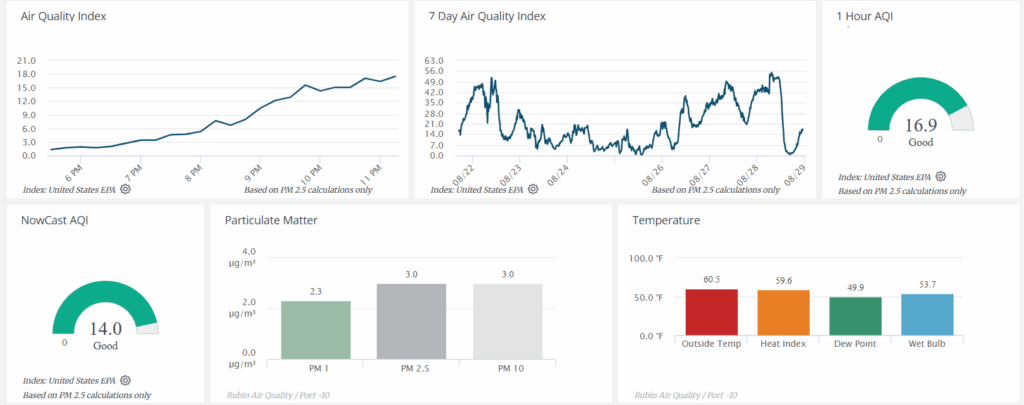 Here's a snapshot of all the information Davis Airlink can give you. This information is available on your phone app and on your weather station dashboard.
As things keep burning here on the West Coast, this is definitely a worthy investment. Otherwise, the publicly available information provides some fun resources to nerd out over as you await your lab results.
Happy picking! Or y’know, not.
The conversations I have about quality tend to focus on red wine. This is especially true in California, where Napa Cabs have historically garnered high prices, followed up by Coastal Pinot noirs and red Rhones. Honestly, in most places I’ve been where the climate allows for ripening red grapes, the reds are the main event with the whites being more of a warm-up act or even an afterthought. As a result, we know a lot about how to grow red grapes for quality – and less about how to grow whites.
Consumer tastes are shifting though, and the big reds of yore are taking a back seat. Drinkers want lower alcohol wines with a lighter style and wineries are taking fewer risks with wine they can turn around in under a year. As a result, white varieties are in hot demand. If you’re a grower who can’t sell your grapes, you may very well be considering grafting some of your reds over to white.
So how do you grow a good white? In many ways whites are harder than their red counterparts because there isn’t as much ripe fruit and tannin to hide behind. Let’s go over some practices that will help make the best of the current market and grow just as good white winegrapes as you do red.
Smelly smells that smell: Volatile Aromatic Compounds
Here at AV our summers are spent analyzing plant water potential, coaching growers on how to tiptoe right to the edge of the cliff before turning on the water. For Pinot, we aim for hitting around -13 bars for midday leaf water potential (LWP) during lag phase and through veraison. For Cabernet, we aim for -15 bars. This is because water stress imposed during lag phase upregulates the synthesis of many secondary metabolites associated with better color and mouthfeel amongst other attributes. The link between phenolics and water stress is well-established and in places where we irrigate, like the West Coast, we can manipulate our farming practices to beef up the tannins and color.
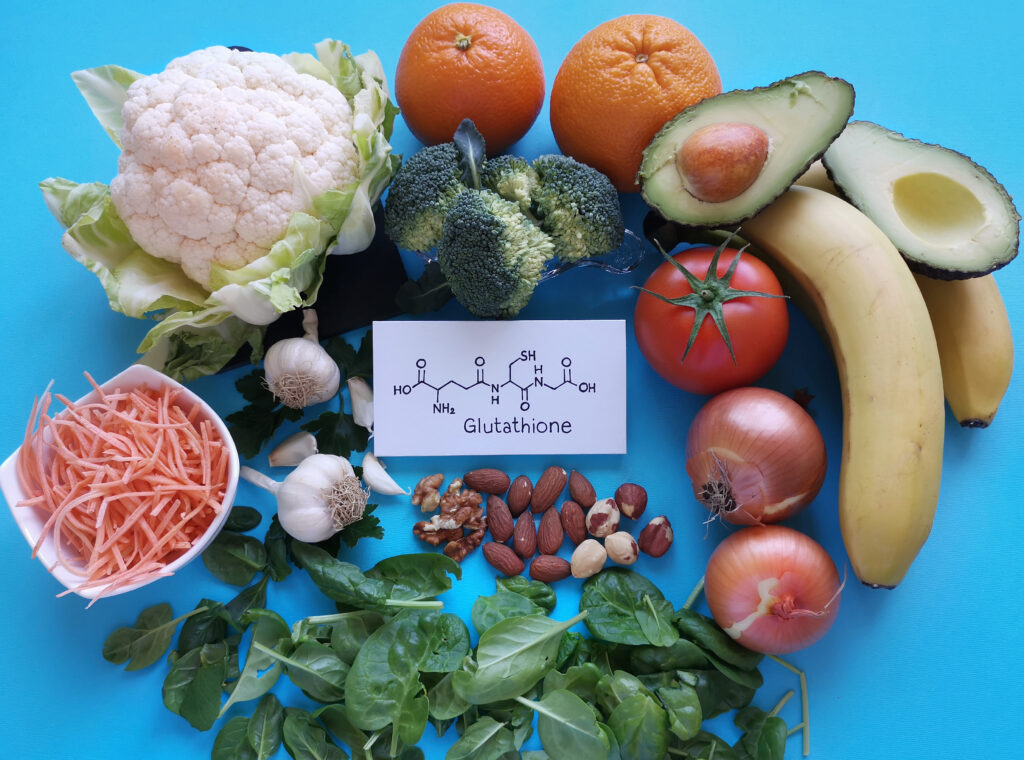
Other secondary metabolites have also been shown to accumulate more under conditions of water stress imposed pre-veraison, most notably the precursors leading to volatile aromatic compounds (VAC). One of the major groups of aromas found in wine are thiols or mercaptans: organic compounds containing sulfur. These are the compounds associated with passion fruit, guava, and grapefruit. The cat pee note you get in Sauvignon blanc for instance is from a volatile thiol. Thiols are derived from the degradation of cysteine-containing compounds, the most abundant being glutathione, an antioxidant found throughout the plant world.
Research out of Udine (Savoi et al., 2016) in Northern Italy has shown that the biochemical pathways responsible for terpenes and 13-Norisprenoids (derived from carotenoids) were upregulated by water stress between lag phase and veraison. These are the compounds associated with floral and earthy aromas. Both classes of molecules were present in higher concentrations in the vines stressed to minimum of -16 bars compared to -8 bars LWP.
This study also showed an upregulation of the phenylpropanoid pathway, which is responsible for the synthesis of phenolics in both red and white varieties, was also upregulated by water stress during pre-veraison. Phenolics in white grapes are different from red grapes, most notably in that white grapes don’t accumulate anthocyanin. However, white grapes do contain lower levels of flavonols, flavan-3-ols, and proanthocyanidins, which account for astringency in white wines. Some varieties, like Sauvignon Blanc, can tend towards bitter if over-stressed. A compromise could be to avoid over-pressing, which isn’t usually observed when the goal is quantity over quality.
I like this study because examining upregulation of genes offers a better window into actual plant response to water stress. The period from fruit set to veraison is a critical time for berry expansion and applying deficit irrigation at this time can limit berry size. A lot of studies that just look at final concentration provide practical knowledge, but I prefer to look at the cause and effect of a given stressor instead of how much it stunted fruit growth. Depending on what your goals are as a grower, you can find the middle ground between berry size and berry composition.
Another earlier study on Sauvignon Blanc (Storchi et al., 2005) confirms that many precursors to desirable aroma compounds were found to be elevated at higher stress levels (around -16 bars LWP). The aromatics tested for included monoterpenes, norisprenoids, benzoic compounds, and higher alcohols associated with aromatic esters. However, when the musts were subjected to a tasting panel, vines subjected to around -10 bars of LWP were preferred.
It’s important to know that this study maintained these high (i.e. low LWP) stress levels all the way to harvest, and that may have been why the wines with the highest aromatic potential didn’t score as high as expected. Similarly, one of the few papers that examined glutathione synthesis in water-stressed white grapes applied stress during the lead up to harvest, ultimately showing a higher concentration of the precursor in well-watered vines versus stressed ones (Cataldo et al., 2021). That might not be the best approach in practice, which leads me to my next point…
Keep your canopies active (especially post-veraison)
Aromatic compounds are produced in abundance during periods of abiotic stress because they help protect the plant from oxidation. If prolonged stress brings about these oxidative conditions, the compounds will be put to good use, thereby depleting your aromatic potential before anything is picked.
High temperatures can also bring about oxidative stress, so if you’ve stressed the vines to the point that basal leaves are yellowing (or falling off), you also risk depleting these aromatic precursors. I would also recommend avoiding extensive leaf removal, but I know plenty growers who struggle with mildew or botrytis in their white blocks. Pulling leaves is one of those gambles you take in farming and climate change is rapidly requiring things like shade cloth and microsprinklers to cool the fruiting zone in the event of a severe heat event.
Nitrogen fertilization is vital for aromatic potential. Glutathione, and more generally the amino acid cysteine, contains a lot of nitrogen. Chlorophyll contains plenty of nitrogen too. In instances of insufficient nitrogen the plant will produce fewer aromatics, be less functional photosynthetically, and be worse at protecting itself from oxidative stress. This last point is key. A white grape is inherently more vulnerable to degradation since it doesn’t have an arsenal of polyphenols protecting it.
In addition to nitrogen, winemakers tend to shoot themselves in the foot when it comes to potassium fertilization. Potassium is vitally important when it comes to the vine’s ability to manage stress and ripen fruit. Yes, it can form a precipitate with organic acids and cause a drop in total acidity. The risks of under-fertilization of K are significant though. If a lack of potassium, combined with water deficit stress, leads to premature senescence of the basal leaves, the potassium contained in the yellowing leaves will get exported to the plant and then imported directly into the fruit, leading to excessive potassium levels in the must. I’ve written a whole blogpost about potassium, so go ahead and check that out if you want to know more.
When photosynthesis falters due to nutrition, water, or temperature, the vine looks around for carbon skeletons with which to construct important amino acids. This leads to the dismantling of malic acid, which is vitally important for white wine quality (Lawlor and Cornic 2002, in Keller 2010). On a more general note, water stress inhibits the synthesis of malic acid in the first place. This is one reason why we tend to recommend less severe water stress for white grapes. Finding balance is key. However, if you overshoot your mark, I’m told malic and tartaric acids comes in bags…
Let’s talk about acidity
Why are we growing French varieties in California, when our climate is more similar to that of Italy and Greece? Chardonnay has had their niche areas in the Sonoma Coast and Carneros, but are the rest of us just stuck with Sauvignon blanc? There are many other varieties from the vast world of wine that we can turn to that contain high levels of tartaric acid, which is considerably more stable than malic when it comes to heat and water stress. I’m starting to see more interest in planting high-tartaric varieties like Vermentino and Assyrtiko, varieties that prevail from arid climates but manage to maintain their freshness. As far as marketing goes, I think consumers are more open to unknown whites than they are with unknown reds. They can’t like something that isn’t available to them. If you plant it, they will drink. Or y’know. Not. Don’t come for me if I’m wrong here, but I think it’s as good a time as any for exploration.
In sum – my wish list
Ultimately, the strategy for growing white varieties doesn’t differ that much from our approach to reds. However, there’s significantly less knowledge out there about white varieties and in many ways there are more opportunities to screw it up.
I’d like to see a study that delves into the optimal leaf water potential of white varieties during lag phase. The importance of building a canopy in early season and of maintaining leaf function into harvest is well established by the literature. Not doing so has obvious effects on yield, sugar accumulation, and acidity. Assuming that lag phase is the time to stress vines, I’d like to have a more precise answer when it comes to how much.
I’d also like to see more studies on finished wines. Many aromatic compounds are short-lived and degrade either by oxidation or don’t make it to bottling. Some are glycosylated (i.e. attached to a sugar molecule, usually glucose) which once cleaved off by yeast volatilize. Sometimes these compounds are imperceptible prior to fermentation. Other compounds such as the monoterpenes (nerol, geraniol, linalool) found in Muscat varieties are extremely ephemeral glycosides. One of the main reasons that Muscat is typically vinified as a sweet wine is to preserve these compounds for as long as possible. Fruity esters synthesized in the berry (not discussed) are another volatile compound that is usually present in must and very young wine. These disappear very rapidly. Enologists are usually more concerned with yeast-produced esters that result from the union of higher level alcohols and aldehydes, neither of which would register on a taste-test prior to fermentation and a little bit of time in the tank. My point is, a lovely must doesn’t always make for an interesting glass of wine. We all know someone who peaked in high school.
The shift we’re seeing the market preferences presents growers and winemakers with a chance to explore different varieties, finding those that are better suited for regions previously dedicated primarily to reds. Hopefully increased commercial interest will lead to an expanded knowledge base and allow us to make and produce better wines that people want to drink.
Citations
Ahmad, N., Malagoli, M., Wirtz, M. et al. Drought stress in maize causes differential acclimation responses of glutathione and sulfur metabolism in leaves and roots. BMC Plant Biol 16, 247 (2016).
Cataldo, E., Salvi, L., & Mattii, G. B. (2021). Effects of irrigation on ecophysiology, sugar content and thiol precursors (3-S-cysteinylhexan-1-ol and 3-S-glutathionylhexan-1-ol) on Vitis vinifera cv. Sauvignon Blanc. Plant Physiology and Biochemistry, 164, 247-259.
Keller, M. (2020). The science of grapevines. Academic press. pp. 283.
Labudda, Mateusz, and Fardous Mohammad Safiul Azam. “Glutathione-dependent responses of plants to drought: a review.” Acta Societatis Botanicorum Poloniae 83.1 (2014).
Savoi, S., Wong, D. C., Arapitsas, P., Miculan, M., Bucchetti, B., Peterlunger, E., … & Castellarin, S. D. (2016). Transcriptome and metabolite profiling reveals that prolonged drought modulates the phenylpropanoid and terpenoid pathway in white grapes (Vitis vinifera L.). BMC plant biology, 16(1), 67.
Storchi, P., Giorgessi, F., Valentini, P., Tarricone, L., Bonello, F., & Tamborra, P. (2005). Effect of irrigation on vegetative and reproductive behavior of ‘Sauvignon blanc’in Italy. Acta Hortic, 689, 349-356.
Who (or what) is this eddy you keep talking about?
Efficient water management has never been more critical for agriculture and specifically for viticulture. High-end viticulture needs to manage water to not only cut costs, but to keep quality high in a market of oversupply and buyers who hold the upper hand over the grower. High production viticulture may not need the water management finesse for quality that high-end viticulture does, but regulatory demands for groundwater protection as well as limitations on water deliveries push growers into making the most out of every gallon.
Here at AV, we’ve made use of impactful technologies to help growers irrigate efficiently and control vine stress to improve wine quality from their vineyards. Our primary tools have been the soil moisture probe and, more recently, the Florapulse microtensiometer. Both tools have been indispensable and even more so now that we have our own data portal to view and analyze these data streams. More recently, we’ve been working with a new tool, an eddy covariance device, for direct measurement of ET, which gives us another approach for irrigation management that we didn’t have before. Before I introduce this new tool, let me explain what direct measurement of ET is and how it differs from other ET measurements.
Eddy Covariance – who is this guy?
Eddy is not just your buddy down the road with whom you share a good laugh occasionally. Eddy or more meaningful, eddies, are swirls of turbulent air which we experience daily but don’t give a lot of thought. Unless you’re a micro-meteorologist like I am. Yes, I am one of those. I did my Ph.D. in micrometeorology of the vineyard environment so I know a thing or two about it. Let me give you the nickel tour of micrometeorology (let’s call it micromet for short), eddies, and how eddy covariance is used to measure ET.
Wind does not blow in a straight line. As air flows across the earth’s surface, or on a micromet-scale, the surface of a field, forest, desert, or whatever, it experiences friction from that surface. Air flow at the very surface of the earth is zero, because wind cannot penetrate the earth. So, as the wind blows across the surface, the portion closer to the ground experiences drag from the friction, which is enhanced by objects, such as buildings, trees, and of course grapevines. This friction causes a shear force in the air flow field, which creates the turbulent eddies. And these eddies swirl and interact with other masses of air, creating more eddies. These wind shear eddies are smaller than the primary eddies, and these smaller eddies interact with other packets of air, creating their own eddies. And so on and so on. So, indeed air does not flow in a straight line, with some exceptions like katabatic wind during the very still night when cold air sinks. Those flows are not turbulent, but during the day, you can count on turbulent eddies all over the place. You can see this if you look at smoke rising and then swirling: initially it rises quickly because of convection from the heat, but as it cools, it gets taken by the air and you can then see what the eddies look like.
So, now that you know what an eddy is, let’s discuss why It’s important to us, not only for agriculture, but as humans. Without air movement, everything that is generated at the earth’s surface (e.g. dust, CO2, farts, and yes water vapor) would have to rely on diffusion from high concentrations at the surface to lower concentrations in the atmosphere above. Thankfully, that is not the case. The wind, with its turbulent eddies, facilitates the movement of gases and suspended particles (called aerosols) from the surface to the sky.
In the case of water vapor, the water vapor concentration (when it is not raining) is higher within and just above a plant canopy than it is in the air above the canopy. Turbulent eddies mix the moister air below with the drier air above (Fig. 1). In the portion that is swirling upward, vapor is brought upward. In the portion that is swirling downward, drier air is brought downward.
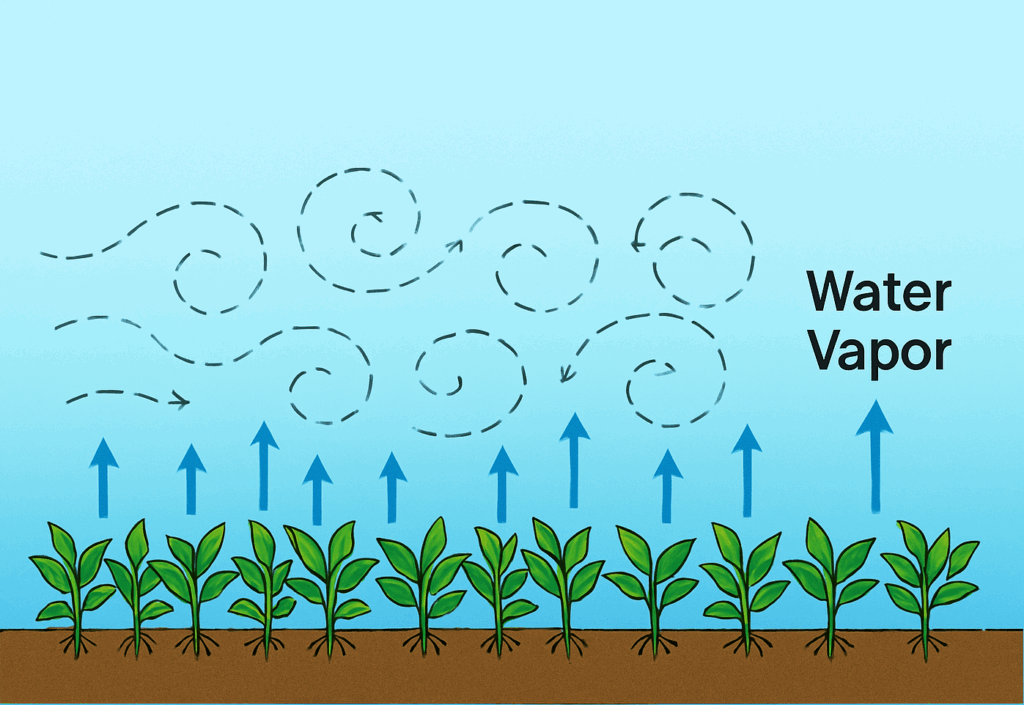
We can measure this! Eddies can be measured using high-speed anemometers. A sonic anemometer looks like a stethoscope, but it is really a pair of speakers and microphones. Several times per second the speakers emit an ultrasonic pulse, which is captured by the microphone on the other end. The time it takes for the sound wave to reach the microphone on the other end is measured and the difference in time between the two directions is a measurement of instantaneous wind speed. We can measure the turbulent air field this way and meteorologists can measure this in 3-D. For us, we only care about one axis – the vertical one. Because movement horizontally just moves vapor across the field and we only care about what is moved upward. So, the 1-dimensional sonic anemometer measures the fluctuations in vertical air movement. Over time, the net air movement is zero because the earth blocks vertical air movement. So, we only care about the fluctuations in the vertical direction.
We can also measure water vapor, or humidity, at the same high frequency. When air swirls upward, the moisture air registers an increase in humidity and when it swirls downward the drier air brought in registers a decrease in humidity. If we record the instantaneous vertical air velocity along with the instantaneous humidity, and take the covariance of the two over a time interval, we get a direct reading of water vapor flux. This is what eddy covariance is!
If it sounds complicated, you’re right it kind of is, but fortunately this is established technology and the covariance is computed on the fly by either the device itself or the equipment used to log the data. In my graduate research, and in my early professional career, I used eddy covariance equipment. The cost back then was about $30,000 in today’s dollars. You can find them now for that or much higher for use in micromet research. So, while eddy covariance equipment has long been the gold standard for ET measurements, its high cost has rendered it primarily a research tool, though developers of other ET methods have and are still using it as a standard to calibrate their approach.
 That’s nice, but the gold standard is too expensive to use to directly measure ET
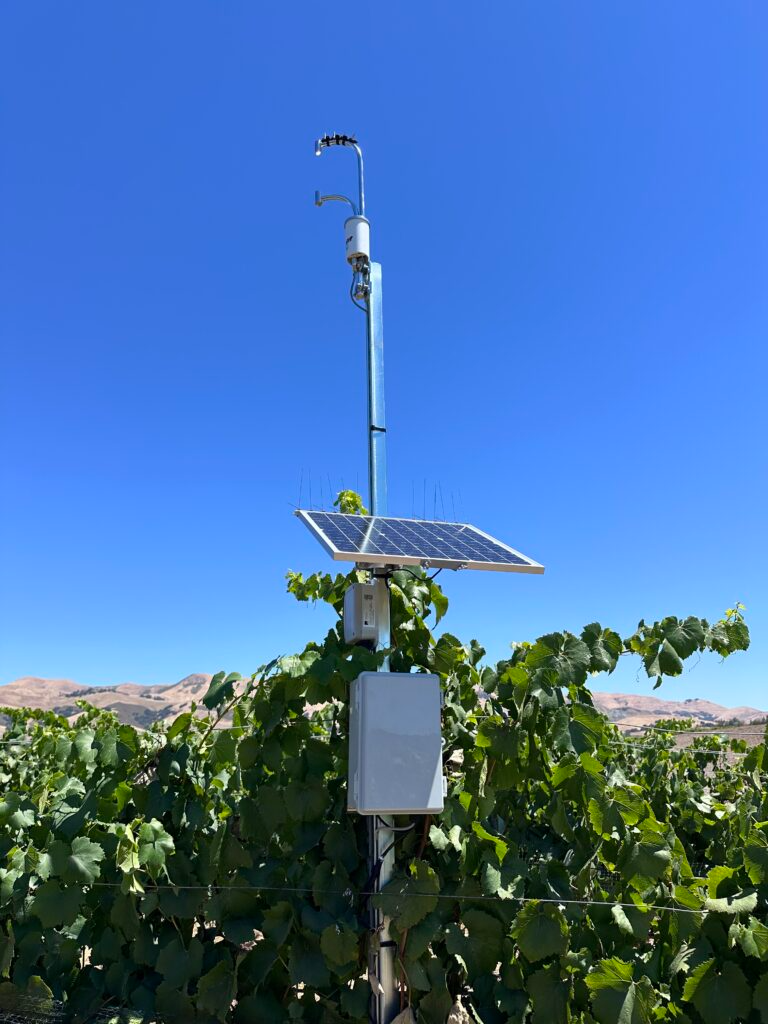
That’s right, equipment for eddy covariance has been just too costly to use as a source of daily ET measurements. Until recently, at least. Last year Li-COR, a company out of Nebraska who have been making plant and environmental research equipment for decades, released their LI-710 Evapotranspiration Sensor (Fig. 2), which is a simplified, but still effective, eddy covariance sensor in a small and rugged package. The best thing about it is the price tag, which is a fraction of the cost of a traditional eddy covariance system and puts it right into the cost-effective range for commercial agriculture. The device computes eddy covariance internally and communicates digitally to a datalogger.
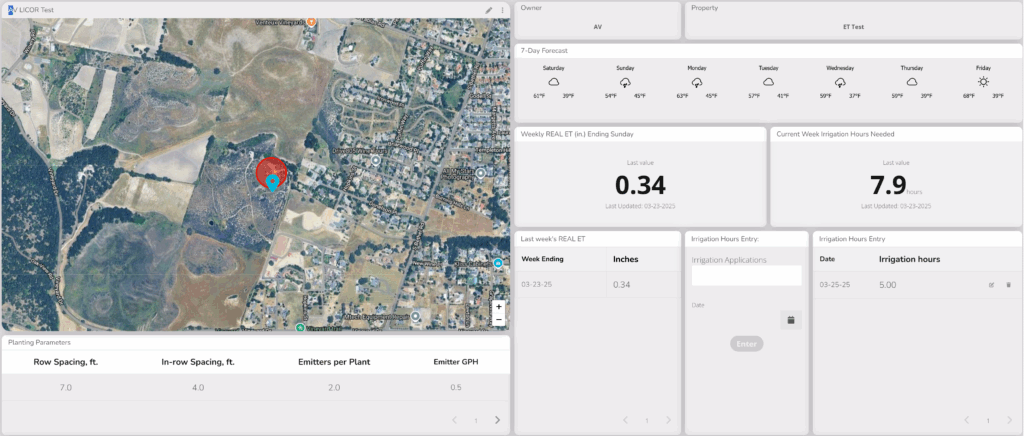
Last year, overjoyed with this new technology, we entered into a reseller agreement with Li-COR and purchased some units to get more familiar with and to do some design for the best data logging and telemetry solutions. We’ve made substantial progress and have also developed an app to track ET and to help growers make determinations of irrigation from the information (Fig. 3).
Why use this over other ET measurement methods?
Our motivation for this blog post is to announce this new technology and not to disparage other technologies out there, but we should at least briefly discuss why it is such an exciting development for us and for agriculture in general.
Probably the most common way to obtain ET measurements is by using weather stations and using that information to determine reference ET (ETo) using the modified Penman equation. Weather inputs of solar radiation, wind speed, temperature and humidity are used to determine Daily ETo. Almost all weather stations will provide values for ETo, as this is a standard and common method. That said, ETo itself has limited utility, as it is based on the theoretical ET of a hypothetical reference crop (a mixed grass mowed to a certain height) and does not indicate the ET of the crop (ETc). For many crops, including grape vineyards, ETc is a fraction of ETo.
To determine ETc, ETo is multiplied by a crop coefficient (Kc). These crop coefficients are basically a “fudge factor” to represent the fraction of ETo that the actual crop experiences. Kc values will vary during the growing season as the canopy develops and then senesces, usually peaking around veraison, holding steady and then dropping near or after harvest. Kc values have been computed and published by many researchers for many different crops, including grape vineyards. However, they are prone to error and we have found, using soil moisture as our guide, that we can irrigate far less than the amount ETo*Kc produced without long-term loss of soil moisture. So, actual Kc is likely substantially lower than published values of Kc are telling us based on our experience.
In fact, last year we ran some REAL ET eddy covariance measurements and compared them with ETo computed from nearby weather stations and found effective Kc values of around 0.35 for a full canopy in three vineyards, compared with published values of around 0.6. That’s a big difference!
Surface renewal has been a popular method of ET determination in recent years. While surface renewal is a valid micromet method, we should caution that it is not a direct ET measurement. Rather, it is based on a surface energy budget (Fig. 4). Let me explain. The energy budget of a field (or any other part of the Earth’s surface) is comprised of four basic flux components:
1) Net radiation flux, Rn, which is the amount of solar radiation that provides energy to the surface (downwelling radiation minus reflected radiation)
2) Ground heat flux, G, which is energy that warms the surface of the soil and penetrates into deeper levels
3) Sensible heat flux, H, which is energy dissipated into the air by heating of the air from soil and leaves and is transported into the ambient environment by turbulence, just like water vapor is
4) Latent heat of evaporation flux, LE, which is energy used to evaporate water from liquid into vapor, which is then transported into the ambient environment by turbulence, just like sensible heat is.
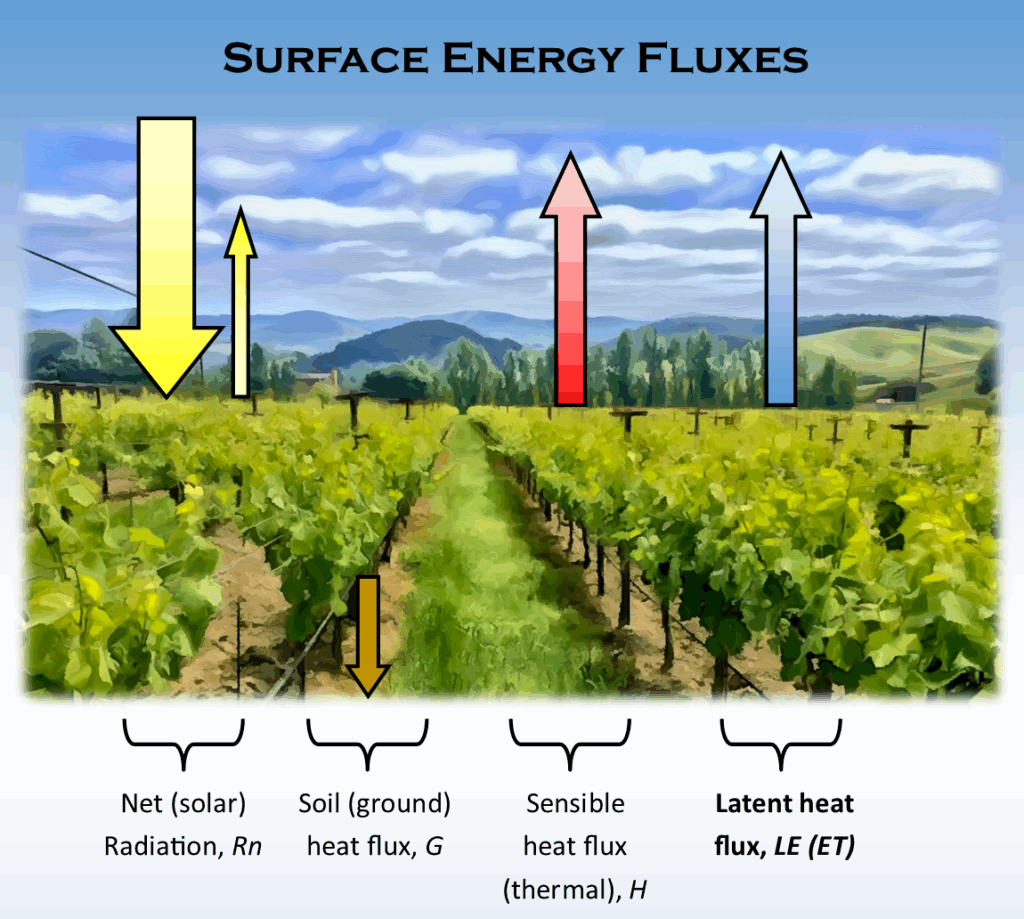
The surface renewal approach measures not latent heat flux or water vapor flux, but it measures sensible heat flux. To determine latent heat flux, and from that, evaporation flux, the energy budget is used to net out that term. Usually, the other two terms, Rn and G, are estimated, and whether or not estimated or measured, each term in the energy budget equation represents a source of potential error. The net of it is that surface renewal is prone to error, unlike eddy covariance, which is a direct measurement of water vapor movement and does not require any assumptions or models.
Are there any limitations on where eddy covariance can be used?
Yes, there are limitations, which are pretty much the same limitations that surface renewal has. The field needs to be a decent size – large enough to provide a few hundred feet of upwind fetch to the sensor. This is to allow the flow field to stabilize and avoid edge effects, like from roads and ponds. And while the field should ideally be flat, sloped fields can be used as long as the slope is relatively consistent. We tested the LI-710 over some uneven and sloped vineyards last year and got good readings from those, but site selection is important and tiny little “island” vineyards are simply not candidates. This is true for both surface renewal and eddy covariance sensing techniques.
That said, most commercial-scale vineyards will be able to use this new device and we look forward to rolling them out to early adopters in this and upcoming growing seasons!
It's not for the faint of heart
Going no-till certainly has been picking up steam in recent years, and overall it’s a good thing. When I first got involved in viticulture back in 2010 I was living in Italy. Like a lot of Mediterranean viticultural areas, there was a tendency to disc everything all the time. If you didn’t have a barren wasteland with vines poking out of it, you weren’t a good farmer. Anything you couldn’t get to with a tractor you sprayed with herbicide. One of my first vineyard jobs in Italy was spraying glyphosate out of a backpack sprayer all spring. I felt like I was in the final scene of the Godfather! Minus the dying part.
Herbicide: the new four-letter word
Mentalities have shifted since then both in Europe and here in the states. All in all it’s a good shift. We’ve all seen places that have gone on for years and years using herbicide to a point where you don’t even need to spray it anymore because that soil is so dead. The only thing that grows on it is that weird reddish moss.
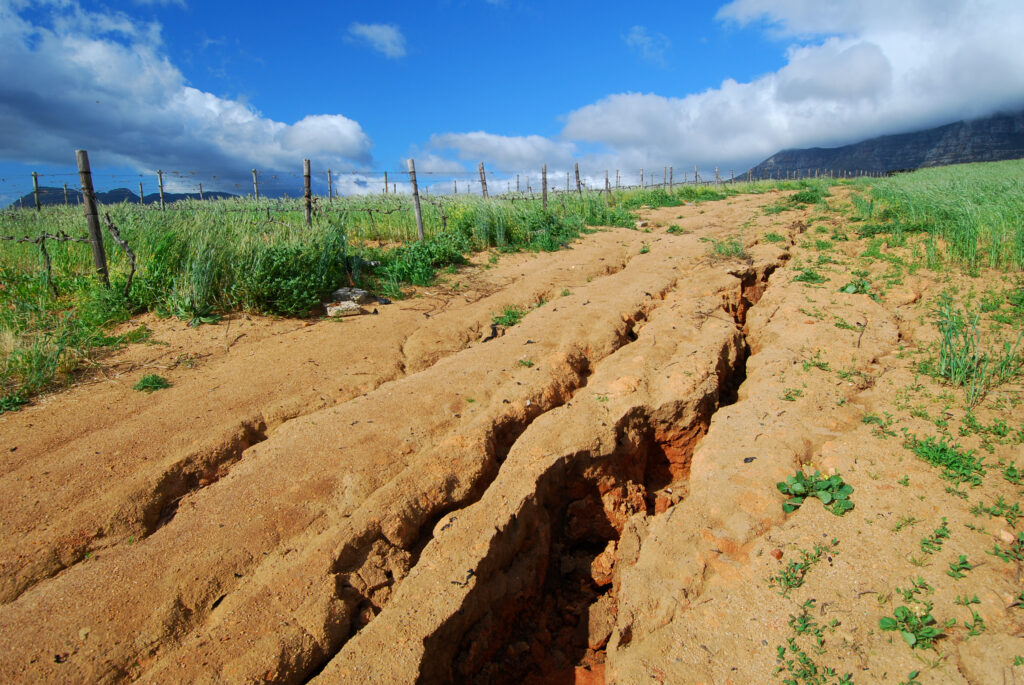
Percolation suffers. The soil forms a crust on top and water can’t infiltrate it. You’ll walk these vineyards and you see the water from the emitter just beads up and drips off the berm like Teflon. Then it pools in the tractor row. There is just no porosity to these soils and it makes irrigation almost impossible.
Aside from that, herbicides are gross. We’re lucky in vineyards to not use too many nasty chemicals but the ones that are nasty are all herbicides especially the pre-emergent ones.
Herbicides also have developed a bad rap among consumers especially roundup or glyphosate, which is ironic because it really isn’t that toxic compared to others. As an aside, there are a bunch of people out there who seem to think that glyphosate is the same thing as Agent Orange. For the record that is very not true. They are completely different chemicals. Commercial forms of glyphosate can be orangey in color. The resemblance ends there.
The trouble with tilling
Conventional tillage can also be problematic. Frequent tilling destroys soil structure. If you break a chunk of undisturbed soil apart, you’ll find that it breaks into aggregates of soil particles. Inside those aggregates you’ll find different sized pores, both big ones that hold air and tiny ones that hold water. Plants need both of these things to thrive. The aim of tillage is to break these aggregates up into smaller bits but long term that is going to negatively affect your plants.
Tillage also leads to compaction, again over time. Then the only way to break it up is with more tillage. It’s like one of those vicious things!
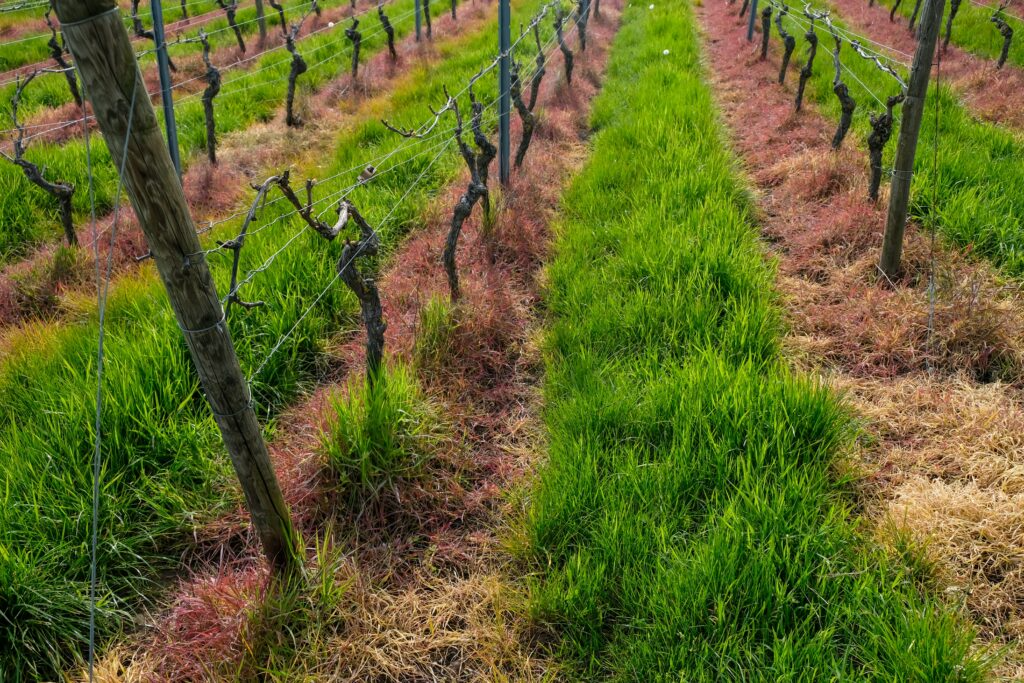
No-till coupled with covercropping helps build soil structure improving water-holding capacity and aeration of the soil by way of better porosity. It does this at the same time as it builds organic matter. Organic matter is a source of nutrients for the vines. Everything contained in the plant decomposes and becomes available to the vine. This is particularly important in the case of leguminous covercrops that fix nitrogen. Organic matter has a negative surface charge and so it holds onto all the positively charged cations your vine needs namely Ca, Mg, and K.
The breakdown of old plant matter into organic matter is driven by microbes and this is what people mean when they talk about the “living soil”. Herbicides and tillage disrupt the lifecycles of soil microbes and limit their ability to do this. No-till is supposed to leave these little guys alone to do the work we need to free up nutrients and make them plant available. In theory anyway.
Mismeasure of microbes
I say in theory because this is really hard to measure. I think this is one of those areas where agriculture lapses into the religious. Basically, it’s a hard thing to sample for and we see this all the time sampling for nematodes. You may have one pocket over here that has this number of some kind of microorganism and a few feet over you have a different one. It’s hard to establish scientifically that one tillage treatment or another favors diversity of microorganisms or how numerous they are. Many of the papers out there come up inconclusive even if it makes total sense that if you mess with something’s environment they aren’t going to thrive as much as if you left it alone.
But there are some shining examples of work that support this idea. Chen et al. found that conservation tilling (i.e. no till and reduced till) increased total soil microbial biomass by 37% at least in the top 8” of the soil. They found that this only worked in loamy soils, and that sandier or coarser textured soils didn’t see the same effect. This is mostly because you need higher levels of soil carbon and sandy soils don’t have a whole lot of that. It showed what we expected that fewer disturbances allowed for more efficient use of that soil carbon. Basically, the microbes did a better job breaking things down if you didn’t run a plow through their house every couple of months.
Nunes et al. is another paper that explored this topic. They looked at seven different indicators for soil health:
- Soil organic content
- Microbial biomass carbon, which is a measurement of carbon contained in the living portion of the soil i.e. microbe bodies
- Nitrogen
- Soil respiration, which is proxy for microbial activity
- Active carbon, which is the carbon that is available to the microbes
- Beta glucosidase, which is the enzyme involved in the degradation of cellulose (plant bodies)
- Soil protein, which is the soil’s ability to store nitrogen
They found that every one of these measures was improved by reducing till. Again, this is usually something we see only in the top portion of the soil (top 8”).
The bigger picture
Now neither of these studies are on vines. If you’re looking for some reading material on no-till in vineyards, Richard Smart from UC Davis did some incredible ahead of his time work. I urge you to take a look at some of his papers. This one in particular puts no-till into the context of global warming, which if anything, is the real reason we all should be looking at moving in this direction.
Bottom line is that untilled land sequesters more carbon than tilled. ½ of all the carbon in the atmosphere is estimated to come microbial respiration of carbon on the surface of the soil. A lot of this comes from the large-scale repurposing of land that has occurred over the last 200 years. All nitrogen (nitrous oxide is also a greenhouse gas) comes from microbial activity on the surface of the soil.
Covercrops alone don’t help the problem. Yes, the covercrop sequesters a lot of carbon but if you then till that into the soil, the benefit is lost. All that carbon gets released and it gets released quickly.
This is a great study. They looked at one vineyard over seven seasons and found that going no-till sequestered 1.5 metric tons per acre. It also increased the oxidation of methane which is good even though that technically increases CO2. Methane’s global warming potential is 27 times that of CO2 so less methane is a good thing.
This study also took into account fuel burned up during tractor passes as well as N20 production. No-till is net negative. Even going to occasional tilling tipped the scales not just because it released sequestered carbon, but also just because it meant another tractor pass.
The limitations are numerous
From a practical standpoint, what does it mean to go no-till? The first limitation we face is that, you have another plant whether a covercrop or a weed, that competes with your vine for water and nutrients. This is going to be a lot more severe if you are going wall to wall no till i.e. where you leave the undervine row untilled as well. Most growers we work with if they do go no-till opt for just leaving the midrow or the tractor row untilled. Leaving the undervine untilled is a whole lot harder.
A lot of the studies that are out there on no till point out that going no-till significantly reduced yield in whatever crop they were working on. Grapes are a little different since, if you’re a fine wine maker, yield may not be your main target. Some of the growers I’ve spoken to about their experiences say that in the first year they noticed stunted growth. Keep in mind that the cover crop is growing in the spring, right when your shoots are trying to develop. It’s the worst timing, but there’s not a lot you can do about it. This is of particular importance in climates with wetter winters. In those cases, there’s a lot of spring nutrient uptake that goes on in the midrow since roots are active there due to all the rainfall. Other dryer areas go into the growing season with pretty dry soils so the only area where you have to worry about competition is right under the emitters.
There seem to be a lot of growing pains in the first year of switching to no-till as you’re suddenly without the easy button to deliver a slug of nutrients to your vines. The benefits that no-till provides are soil structure and organic matter. These things take some time to form. You may need to fertilize more than you normally do. If you’re an organic producer, which you may be if you’re considering no-till, that’s going to be a significant expense if you suddenly have to give everything a shot of expensive organic nitrogen.
On the flipside, if you have an overly vigorous vineyard, no-till can do a good job soaking up some of that extra vigor.
Plants don’t just compete they actively sabotage by way of what’s called “allelopathy”. If you’ve ever wondered why your vines look like crap around an oak tree, that’s allelopathy. Vines don’t play well with others and some weeds and covercrops especially if they’re in the vine row have a similar action.
Another limitation is that there is no ideal covercrop. Ideally you have a nice low-lying covercrop that you can seed once. It reseeds itself. It doesn’t take over. It gets tall and you cut it and it shades out all other growth. In the case of grasses, you have to cut before they seed otherwise they’ll be too tall. Leguminous cover crops aren’t nearly as assertive, but they also don’t provide nearly as much organic matter or ground cover.
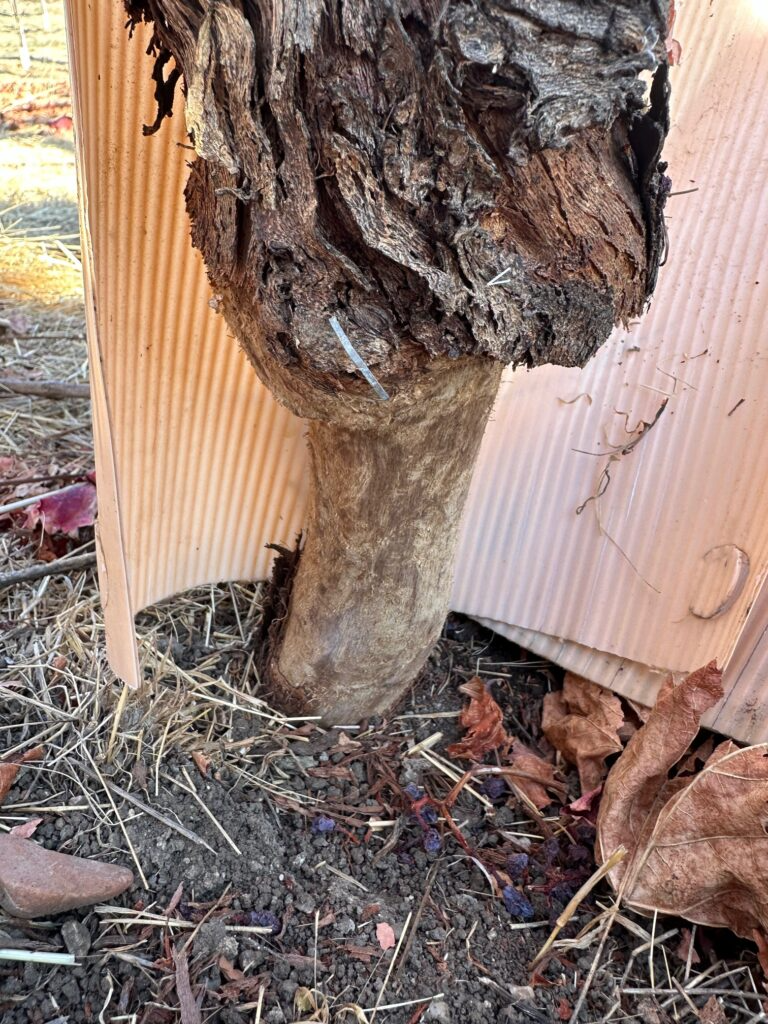
The big problem that a lot of growers face when going no-till is rodents. That nice mulch you create by mowing is the perfect place for gophers and ground squirrels to hide. If you have untilled vine rows, voles can be a problem. I’ve seen new vineyards (and some fairly mature ones) scrapped entirely because voles girdled the trunk of every vine.
Tilling also does a really good job of getting rid of burrow systems, which is important if you struggle with ground squirrels and gophers. The occasional till chops those guys up and doesn’t allow them to build a city under your vineyard. I’ve seen infestations of ground squirrels so bad you can’t even take a step without falling through the ground into a burrow. They will eat the roots right out from under your vine.
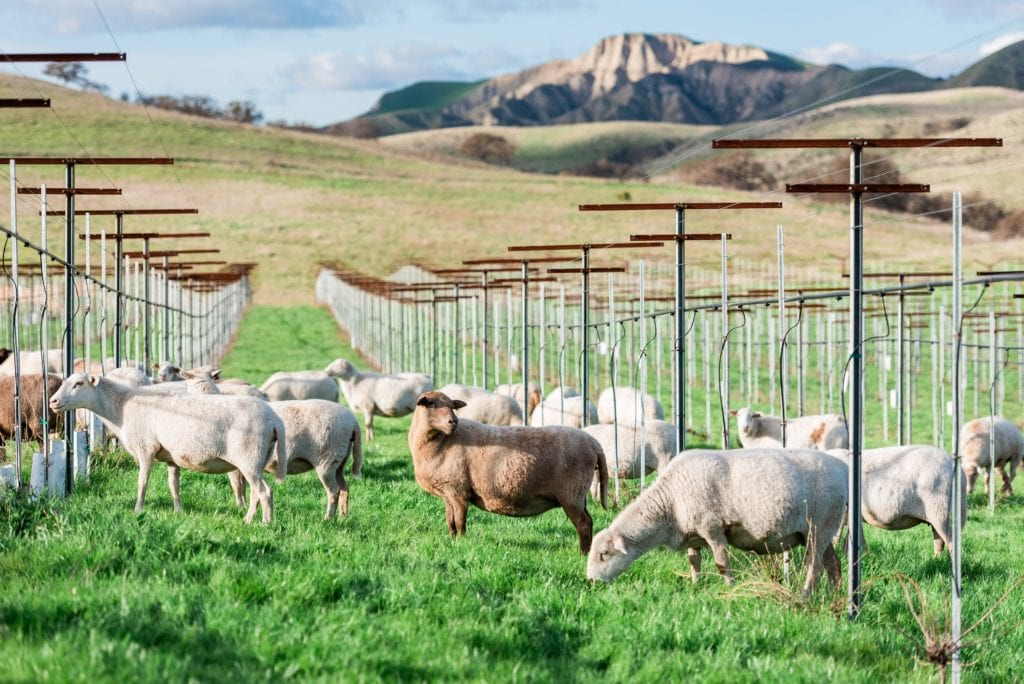
Definitely not the easy-button
All of this boils down to the fact that going no-till is going to be more expensive and more time-consuming than conventional farming. The growers I’ve spoken to who have gone no-till have a worker whose specific job is trapping rodents for at least two to three days a week all season long. That adds up to a lot.
Another thing to consider when going no-till is that you’ll probably need some specialized equipment. If you’re just doing the tractor row no-till, a mower may suffice plus a weed knife…assuming you are also getting rid of herbicide. There are a lot of fun toys out there that you can check out for undervine weed control. The finger weeder is an interesting one. It’s actually a passive implement that doesn’t require any power from the tractor to work. It just rotates with the forward movement of the tractor. The Multiclean is another minimal-disturbance implement. Our farming company has one of these and they seem to like it. Timing is really everything. If you let the brush get too high, you will have a tangled mess on your hands. It’s especially hard in vineyards with high-water holding capacity as you may not be able to enter the vineyard with a tractor before the weeds have already taken over.
You’ll need to rethink how you reseed your cover crop. You can’t just broadcast seed over an untilled surface and assume they’re going to take root. There are some direct seeders out there specifically for this reality but again, it’s an investment.
The limitations to undervine weeding or tilling, if you’re still planning on tilling the vinerow are topography and vine spacing. These implements are always harder to use on a steep and/or uneven incline. If you have tight vine spacing, the tool may not have time to fully rebound and swing back in between vines. That will leave a lot of missed spots.
One thing to keep in mind when transitioning to a reduced or no-till system is to adjust your expectations. Nothing looks cleaner than an herbicided vineyard. You’re going to have missed spots here and there and you’re going to have some weeds. Getting over the mental block is a big one for some people.
Find what works for you
Even if you aren’t going hard core no-till, there are ways to simply reduce tillage, which is still a step in the right direction. A lot of vineyards we work with till alternate rows and switch every 3 to 5 years. As I mentioned, wall to wall no-till under the vines is a whole lot harder, so maybe you just want to keep your midrow non-tilled and use a weed knife undervine. That’s still good.
If this is something you want to do, the best option is to design future blocks with no-till in mind. The above picture is from a ranch in Paicines managed by Kelly Mulville, who’s the viticulturist who thought this design up. He’s trained the vines on a high wire and the dripline is also really high. This allows him to run sheep all year long, which is great because normally you have kick your sheep out once your vines get tasty. The high dripline too is a really good idea. It makes a lot of undervine implements easier to use as a low dripline gets in the way. I know growers who have spent all winter raising the dripline wire 6 inches just so they can get a Multiclean to work.
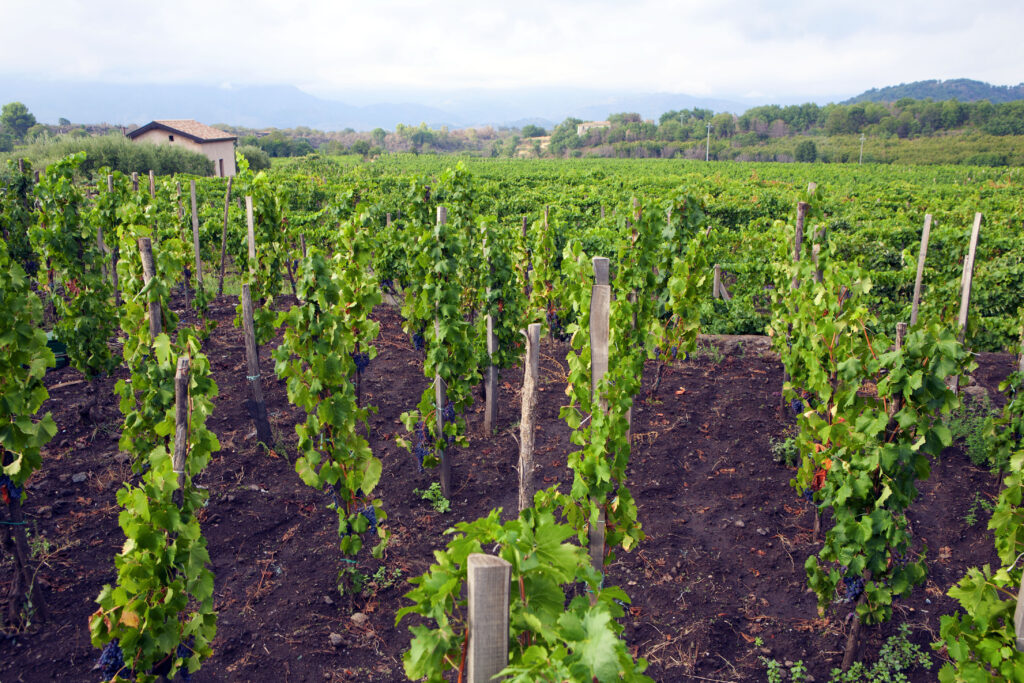
There are some places where despite the benefits, we really don’t recommend no-till. Don’t plant a new vineyard on untilled soil. Your baby vines are not going to be able to handle the competition. Also ripping is the only way to break up any hardpans you have and incorporate any amendments that you’ve added.
Rodents can get out of hand and so can weeds. If you have an outbreak of star thistle or something else that is really aggressive or if you have an underground city of squirrels under your vines, just till. There’s no point in being a martyr.
The picture above is of a vineyard on Mount Etna in Sicily. The Etnean viticultural area is spectacular and it’s almost completely tilled, mostly because they have this one kind of wild chestnut that, if left alone for a season, will grow a tree right in the middle of your vineyard. Like Etna, there are some places where no-till just doesn’t work.
If this is something that interests you though. Go for it. Throw everything against the wall and see what sticks. Like everything, a one-size-fits-all mindset isn’t going to work. If you’ve been growing grapes for a while though, you already knew that.
Articles:
Chen, H., Dai, Z., Veach, A. M., Zheng, J., Xu, J., & Schadt, C. W. (2020). Global meta-analyses show that conservation tillage practices promote soil fungal and bacterial biomass. Agriculture, Ecosystems & Environment, 293, 106841.
Nunes, M. R., Karlen, D. L., Veum, K. S., Moorman, T. B., & Cambardella, C. A. (2020). Biological soil health indicators respond to tillage intensity: A US meta-analysis. Geoderma, 369, 114335.
Wolff, M. W., Alsina, M. M., Stockert, C. M., Khalsa, S. D. S., & Smart, D. R. (2018). Minimum tillage of a cover crop lowers net GWP and sequesters soil carbon in a California vineyard. Soil and Tillage Research, 175, 244-254.
Read this first!
As agricultural consultants in California, irrigation consulting during the growing season is our bread and butter. A lot of times, especially in vineyards with lighter soils where I recommend short and frequent irrigations, I know my desired schedule amounts to a tall order. Not everyone can feasibly do two hours, three times a week. No matter what’s best for the vines, I have to work with a human irrigator, who is still going to turn the valve on at 5 pm and turn it off at 7 am the next day.
In a lot of cases, this amounts to a vineyard that is both over- and under-watered: the 14-hour irrigation percolated past the rootzone in under 3 hours and the rest of the week (after the root zone water was depleted) the soil was dry as a bone.
So, I’m happy to see so much interest these days in valve automation.
I’m also apprehensive because I’ve automated valves and it’s not a silver bullet. It’s not any bullet. It’s a useful tool that needs to be applied to what is already a functioning irrigation system. And some of y’all don’t have that.
How does valve automation work?
To get why this is the case, you have to understand how automatic valves are automated. You may have a diaphragm or a bonnet valve in the vineyard already that you manually turn on and off. That valve is then automated via a solenoid, which is a small electromagnetic device with a plunger. When actuated, the plunger moves up to open the valve, or down to close it.
Given that very few farms have line power at valve locations to provide the constant AC power needed to hold open the solenoids, most ag valves use solenoids known as “DC latching solenoids”. They are actuated by ~12V pulses of electric current powered by a solar panel/battery, and held in that position by a mechanical latch. This can be reversed by applying a reverse polarity pulse, in which case the plunger is latched in the opposite state. These actions are triggered by the control system which is ultimately controlled by you via whatever app came with the automating system.
The contact between the solenoid plunger and the actual closing mechanism can be either direct, indirect, or semi-direct (see above video). Most situations you see in vineyards are indirect. The solenoid plunger basically just redirects water from moving on one side of the diaphragm to the other. This creates a pressure differential to open the valve or a pressure equalization to close the valve. The water pressure itself is used to both open the valve and to close it.
This is nice because you can open and close a high water flow valve using only a tiny solenoid plunger actuated with very little energy. The water pressure itself is doing all the work. This is why, for example, a 6-inch valve can be operated using the same solenoid as a 2-inch valve.
The million-dollar question: What if you don’t have enough pressure?
Long story short, your valve isn’t going to open or close the way it should.
To get a more complete answer, I got in touch with Saul Medrano over at AvidWater. Saul has a lot of experience with valve automation in everything from greenhouses to berry farms to vineyards. Vineyards tend to have more challenging topography than other growing situations, so I was interested to hear his opinion on some of the common culprits of dropping pressure in these cases. According to Saul:
“Incorrect usage and placement of air vents is a big one. Some people may think that just because there is an air vent, it’s going to work, but really it depends on what air vent you have and where. That and just not understanding what pressure losses you get across all the components like valves, air vents, filters, check valves. You need to understand what it takes for them to work properly.”
He added:
“You really have to stick to whatever the manufacturer says the valve can handle. If the manufacturer says, ‘Hey, this thing can operate properly at 10 PSI’, it should be able to operate at that.”
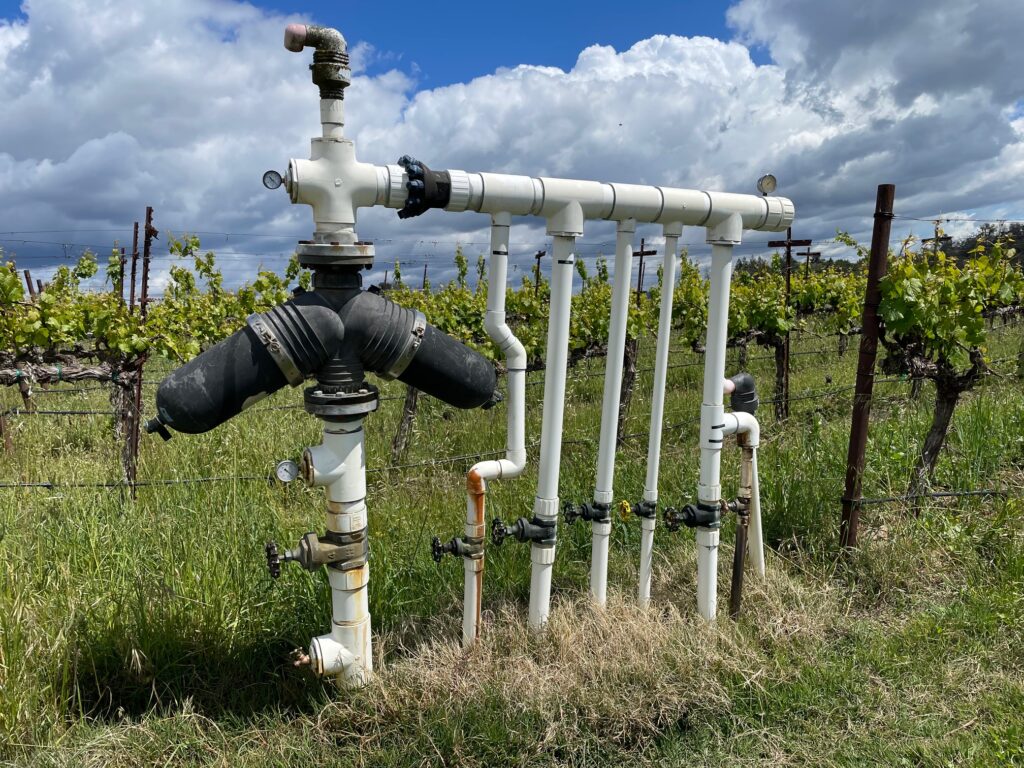 There are some creative work arounds out there. Anytime water passes through a filter, there's a drop in pressure whether it's clogged or not. You may have high pressure at your pump but low pressure at your valve, especially with changes in elevation.
And you may not even have that…
A few years ago, we installed 10 PSI (threshold) pressure switches wherever we had soil moisture probes we monitored to give us irrigation feedback for our weekly recommendations. This was effectively just to measure the duration of irrigations: switch turns on when irrigation starts and turns off when irrigation stops. We chose 10 PSI assuming that people would have at least that in their driplines. For the record, most pressure-compensating drip emitters are designed to function between 12 and 58 PSI. Below (or sometimes above) that range, the emitter output will be erratic and outside the specified flow.
We found in many blocks both hilly and flat, the irrigations failed to actuate the switch. This means that when irrigations get going, the line isn’t even being pressurized to 10 PSI. Aside from issues with distribution uniformity of water and fertilizer, a system like this would need to be automated specifically with valves that could function at low pressure. We’ve often seen automated valves that don’t work consistently because of low system pressure. This usually translates into a valve that doesn’t shut off once it’s turned on because the pressure is too low to impact the diaphragm.
At the source, the pressure these growers are getting is probably adequate. That doesn’t mean that by the time it gets to the valve the pressure is the same. In fact, laws of physics dictate that it is not the same. Filters, fittings, pipes themselves and changes in elevation continually eat away at the pressure you have in your system and that will determine what your options are for automating.
I asked Saul what some of the reasons for poor pressure in vineyards are. He responded:
“Over the last three years, obviously, it’s been a tough market. There are a lot of designs out there that are just designed to be cheaper. Everyone has sacrificed some performance in the system to reduce cost. If your irrigation system isn’t designed properly and you’re not using the right equipment to handle that, low-pressure or high-pressure system, then it’s not going to work.”
And on the other hand,
“I’ve seen some sites where they have all the bells and whistles. They have a VFD (i.e. Variable Frequency Drive) at their pump. They have a pressure-regulating valve at the irrigation site. And then they have pressure-compensating emitters. The diaphragm valve with the pressure-reducing pilot is going to open and close to try to match the pressure that it needs. And in turn, the pressure-compensating emitters are going to do the same thing. You have three things that are trying to achieve this one common goal, and it just creates chaos.”
Most modern irrigation installations I’ve seen have a VFD either installed in tandem or built into the pump control. In the past, VFDs have been incentivized via several government programs (e.g. EQIP, SWEEP). However, just having a VFD isn’t the end of the story. Saul reiterated:
“There’s a misconception that if you have a VFD, you’re going to have the most energy-efficient pumping system. That’s not always true. It may use less energy, but it’s not necessarily going to be the most efficient usage. All it’s going to do is vary the speed of the motor to ramp up or down based on whatever pressure you’re trying to achieve. You need to make sure your VFD is programmed properly in order to have the most efficient energy use that you can have.”
Don’t let me scare you
Saul and I agree that automation is a good thing. With rising labor costs, it’s becoming more of a necessity. It’s also more time efficient when you have to get water to a bunch of blocks in the course of a week. When asked if he had any advice for those thinking of automating, Saul said:
“I think the first thing anyone should do if they’re interested in automation, is do some remote monitoring. Put some sensors on your field and keep track of what’s going on. You can monitor flow, monitor pressure, monitor EC, pH, just know what’s going on now in your field. Then you go into valve control. Now you have control and monitoring. I think everyone should have good data based off a sensor, not from a person who’s subject to human error.”
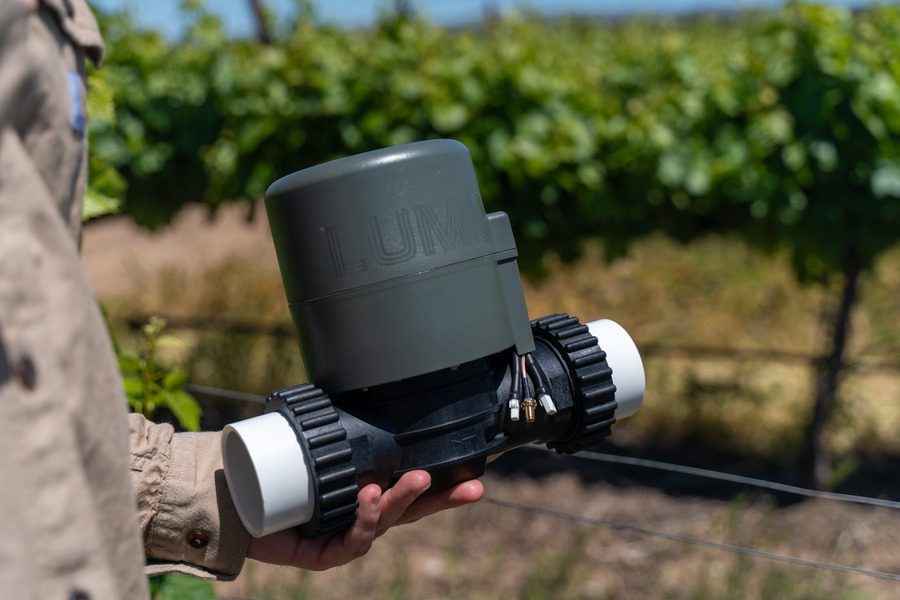 Lumo valves contain a flowmeter and pressure switch to both automate irrigations and monitor flow and pressure. This allows the grower to quantify their water use on a block-by-block basis and detect problems in realtime.
The com-bi-nation valve control and flowmeter
Let’s talk about the new kid on the block, shall we?
Lumo seems to be the latest and greatest in irrigation Agtech and they certainly give us a lot of food for thought. For those who aren’t familiar with the product, Lumo offers an all-in-one valve with built-in flowmeter and telemetry for control and monitoring. Compare this to a more classic automation arrangement where the telemetry device is wired to an external solenoid and (hopefully) a pressure switch (or transducer) to determine whether the valve actually opened and closed when you told it to.
Instead of working via a solenoid, Lumo valves work via a worm drive mechanism that moves up or down when actuated and directs the flow of water over or under the diaphragm. I’ve worked with a couple devices that use this method in place of a solenoid and they seem to perform better in low-pressure systems. Regardless, these valves are specified to operate at between 15 and 80 PSI and I would stick to manufacturer’s specifications…always.
Lumo solves an issue we often see in viticulture where individual valves are spread throughout the vineyard. In the past, this arrangement made automation expensive given that each valve needed its own telemetry device, which typically starts at around $1800. If all your valves are located at one central location, you may have automated years ago because one device can service a handful of valves. Single Lumo valves clock in under half of this price tag, so it’s a good option for when you have valves scattered around the farm.
What Lumo hangs its hat on though is its continued monitoring of water usage and fluctuations in flow. This allows for precise applications of water to each block as well as keeping a lookout for leaks and blowouts. For a lot of growers who have used Lumo, there tends to be a big discrepancy between how much they thought their output would be and what it is.
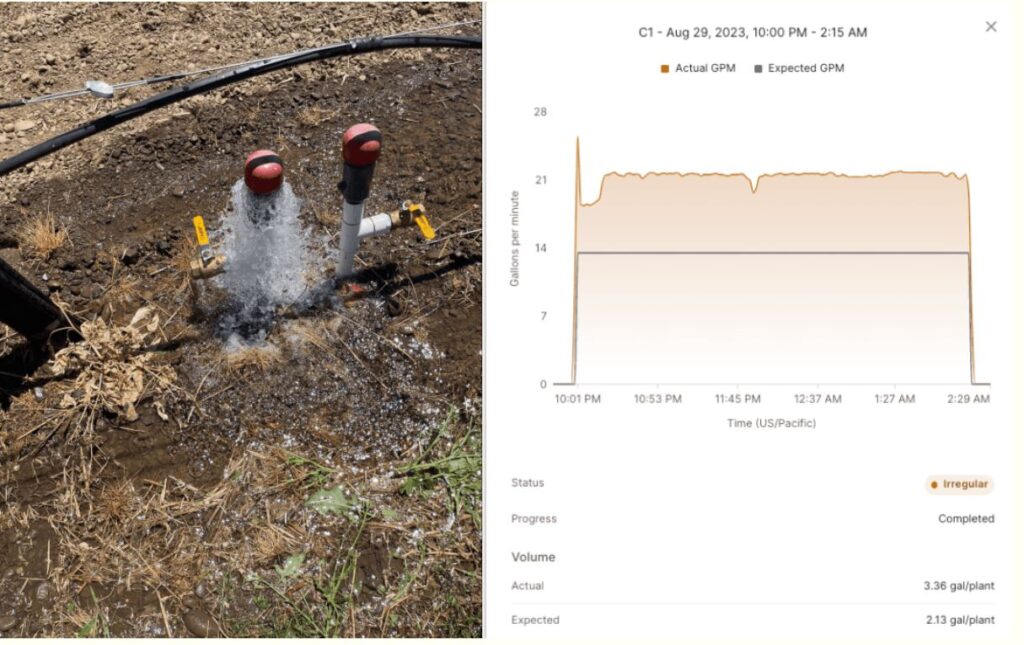 The above photo showcases how Lumo can be used to detect problems in an irrigation system. If the reported GPM is much higher than what you expected, you may have a leak, or in this case, a malfunctioning air vent.
Kick the tires
Will automation work in your vineyard? The best way to determine that is to have a qualified irrigation professional assess your system. Here at Advanced Viticulture, we partner with irrigation specialists throughout California to ensure that you put your best foot forward in any project. As Saul said,
“Automation is not going to fix a poorly designed system. You need to understand how your system works and make sure that it’s designed properly to handle an automation system on it. We’re honest with customers. We’re not going to sell them a system if we know it’s going to fail. We’ll say, hey, you need some upgrades to do before any automation to work here. I would say that’s a really important thing that sounds like common sense, but I’ve seen some stuff out there that had no business being installed.”
For the most part, no automation company, Lumo or otherwise, wants the application of their equipment to fail. Dissatisfied customers are infinitely more vocal than satisfied ones. It’s one of the reasons Lumo works with companies like AvidWater and Advanced Viticulture to make sure their product is a good fit for each system prior to installation. Regardless of what company you go with, ask around. Ask the company selling you the devices to put you in touch with an irrigation expert. Then plan your budget accordingly. You may need to do some work on your infrastructure first and put off automation for a year or two. That’s still better than getting stuck with an expensive system that doesn’t work.