

A tumultuous 2025 economy likely depressed wine sales. In 2026, the higher-end segments should continue to outperform, and the grape market should be less oversupplied when harvest begins.
REPORT SNAPSHOT
Situation: Wine sales softened across the board in 2025, and prices stagnated as a result of consumer price sensitivity and heightened competition among producers trying to move excess inventory. Although the wine market slump continues, relative bright spots include premium and luxury wines, nonalcoholic and ready-to-drink wines, and white and sparkling wines.
Outlook: I’m not expecting a material change in the trajectory of U.S. wine sales in the near term, though I see the most potential for progress in the second half of the year. There should be less excess supply burdening the grape market when the 2026 harvest begins than there was in 2025.
Impact: For wineries that are fairly certain about their grape needs, it may be prudent to act sooner rather than later.
Download the Spring 2026 issue of Winescape
This issue:
- Shines a light on the influence of the economy and consumer preferences
- Gives an update on the 2026 outlook for the wine and grape markets
- Draws implications from the 2025 crush for the 2026 grape market
An exceptionally small 2025 grape harvest would help balance wine inventories and potentially stimulate grape demand next year
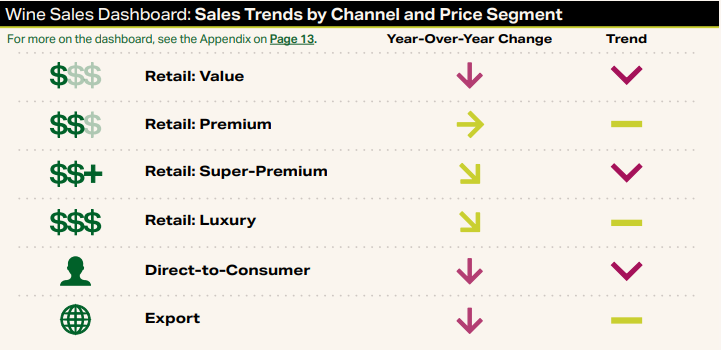
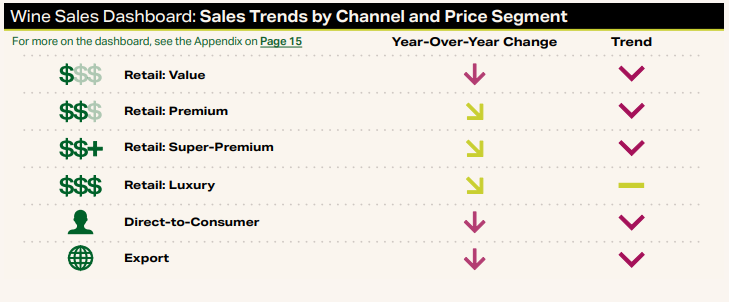
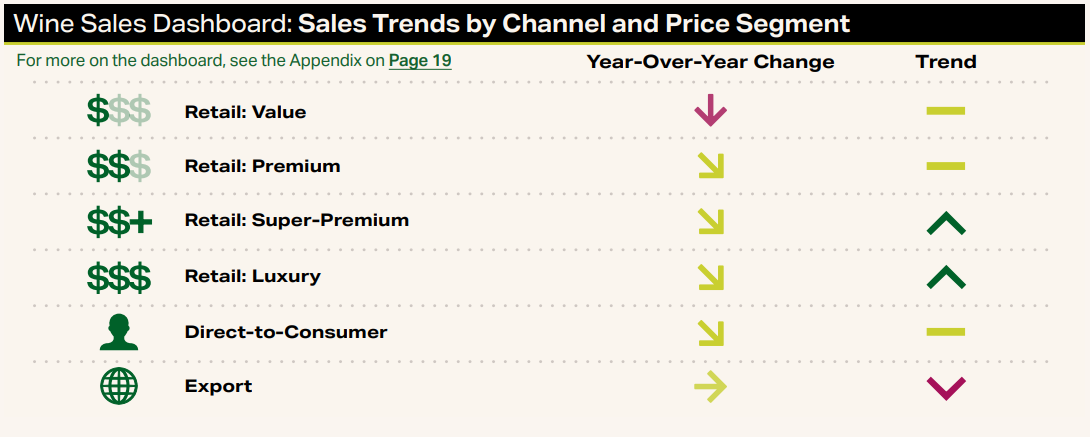
There wasn’t much change in the complexion of the wine market in the third quarter. Sales continued to decline across channels and price points, though at varying rates. Some segments improved while others worsened. Wine exports continued to flag because of provincial bans in Canada.
I continue to believe the slump is mainly structural, particularly at the lower end of the market (see Page 3). But I also believe economic factors such as inflation and depressed consumer sentiment have played a role, and I expect wine sales to firm up once the economic backdrop improves. Unfortunately, we aren’t expecting much change in the economy, for better or worse, in the months ahead, so the wine market isn’t likely to see much improvement either.
2025 was a painful year for California grape growers. Weather was an issue, but the grape market proved to be an even greater challenge. There simply wasn’t enough demand to absorb all the fruit due to slumping wine sales, excess inventory and gun-shy buyers. Hundreds of thousands of tons were thought to have been left hanging. Experts believe the crush will come in below 2.5 million tons, which would be the slightest of the 21st century.
I expect some improvement in the grape market in 2026 because of the ongoing supply-side correction (nearly 40,000 acres were removed between October 1, 2024, and August 1, 2025) and a potential reduction in wine inventory stemming from the small harvest, though this is far from certain.
This issue’s Trending Topic focuses on the wine inventory glut (see Page 9). The inventory overhang is difficult to measure now, let alone forecast, because of imperfect data and uncertainty regarding the 2025 crush size and trajectory of wine sales. If the harvest turns out to be as small as predicted, inventories should be more balanced heading into next year’s harvest. However, my analysis indicates that a wide range of outcomes are possible.
A material reduction in inventory would stimulate grape demand next year. Under my base-case scenario, I expect more grapes to be sold in 2026. This, coupled with lower grape production potential, should result in a better balance between supply and demand in the aggregate. No matter the scenario, the balance will continue to vary widely across appellations, varieties and quality tiers.
Wineries and growers should closely monitor the situation in the months ahead as fresh datapoints are released. I’ll provide an update in the spring edition of “Winescape.”
This issue:
- Assesses the nation’s wine inventory glut and how quickly it might be resolved
- Gives an update on the size of the California grape harvest and its potential impact on inventory
- Shares an early outlook for how the wine and grape markets will fare in 2026
Download the winter issue of Winescape

It’s no secret that people are drinking less.
The consistent, downward trends in alcohol consumption are presenting significant challenges to the wine industry, which is already having to operate in a complex, competitive marketplace.
In order to dissect what is happening in the world of wine and figure out how to make adjustments, industry leaders need solid information on which to base their current business practices and future projections.
Fortunately, the industry has Terrain, a group of experts providing exclusive insights and forecasting to customers of American AgCredit and other participating Farm Credit associations in order to promote a more vigorous agricultural economy.
Chris Bitter, Ph.D., a senior wine and grape analyst with Terrain and American AgCredit, has recently written two comprehensive articles for "Winescape", a publication that delves into current wine sales data and explores what those show about trending topics such as overall alcohol consumption.
We spoke to Bitter about his work that, importantly, identifies significant opportunities for wine to reclaim market share.
| Q: | What have you learned through your research about current trends in U.S. alcohol consumption, particularly for wine? |
Trends
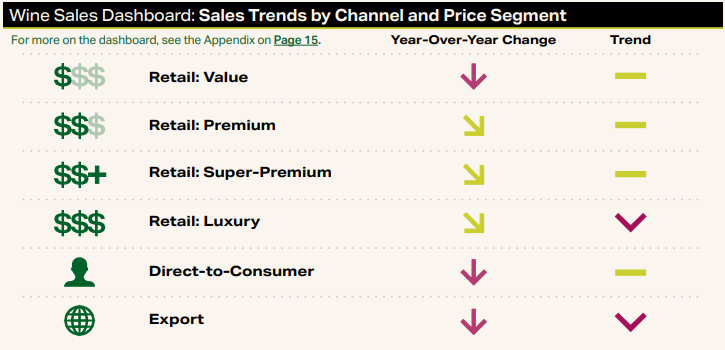
Retail wine sales fell across all price segments in the first half of 2025. Direct-to-consumer sales, while still down, firmed up a bit over the summer, but exports deteriorated markedly in the second quarter as shipments to Canada collapsed. Sluggish economic growth, sticky inflation and a softening labor market are the most likely scenarios in the near term, which will not help the wine industry. Unfortunately, I’m not expecting much improvement in the near term.
| Q: | You’ve identified five primary structural causes for the decline in consumer preferences for alcohol. Could you discuss them? Why are people drinking less? |
The five primary structural factors are demographics, cannabis, GLP-1 class drugs, less in-person socializing, and changing attitudes toward alcohol and health.
Demographics
The U.S. population is both aging and becoming more diverse. This is a problem for alcohol because consumption typically declines later in life and multicultural consumers drink substantially less than their non-Hispanic white counterparts. The move towards moderation or abstinence is highest among younger generations, particularly Gen Z and, to a lesser extent, millennials. We’ve noted that the current decline in alcohol use has been more pronounced for men than women and for non-Hispanic whites.
Cannabis
Cannabis is now fully legal in 24 states and the District of Columbia, and marijuana use has surged since 2012, when Colorado and Washington first legalized cannabis as a recreational substance. In addition, THC-infused drinks have skyrocketed in popularity, with low-dose hemp-based versions even being sold in some states where cannabis is illegal due to a loophole in the 2018 farm bill. Research is still inconclusive; however, cannabis likely has been stealing some recreational and social occasions from alcohol.
GLP-1 class drugs
Drugs such as Ozempic, Mounjaro and Wegovy, which help regulate blood sugar and appetite, also reduce desire for alcohol. Studies show that people taking the medications have reduced their drinking, with one finding a reduction of 70%. Although a relatively small percentage of the population is on the drugs now, 35% of adults expressed interest in a recent PwC survey, and drugmakers are beginning to reduce prices, making adoption almost certain to surge in the years ahead.
Less in-person socializing
Americans are spending progressively less time socializing in person, in both their personal and professional lives. A recent study shows that leisure time spent socializing fell by 20% from 2014 to 2022, while time spent on social media and in front of screens rose sharply. Given that alcohol has long been associated with social gatherings, it makes sense that less in-person socializing is reducing the number of potential drinking occasions.
Changing attitudes toward alcohol and health
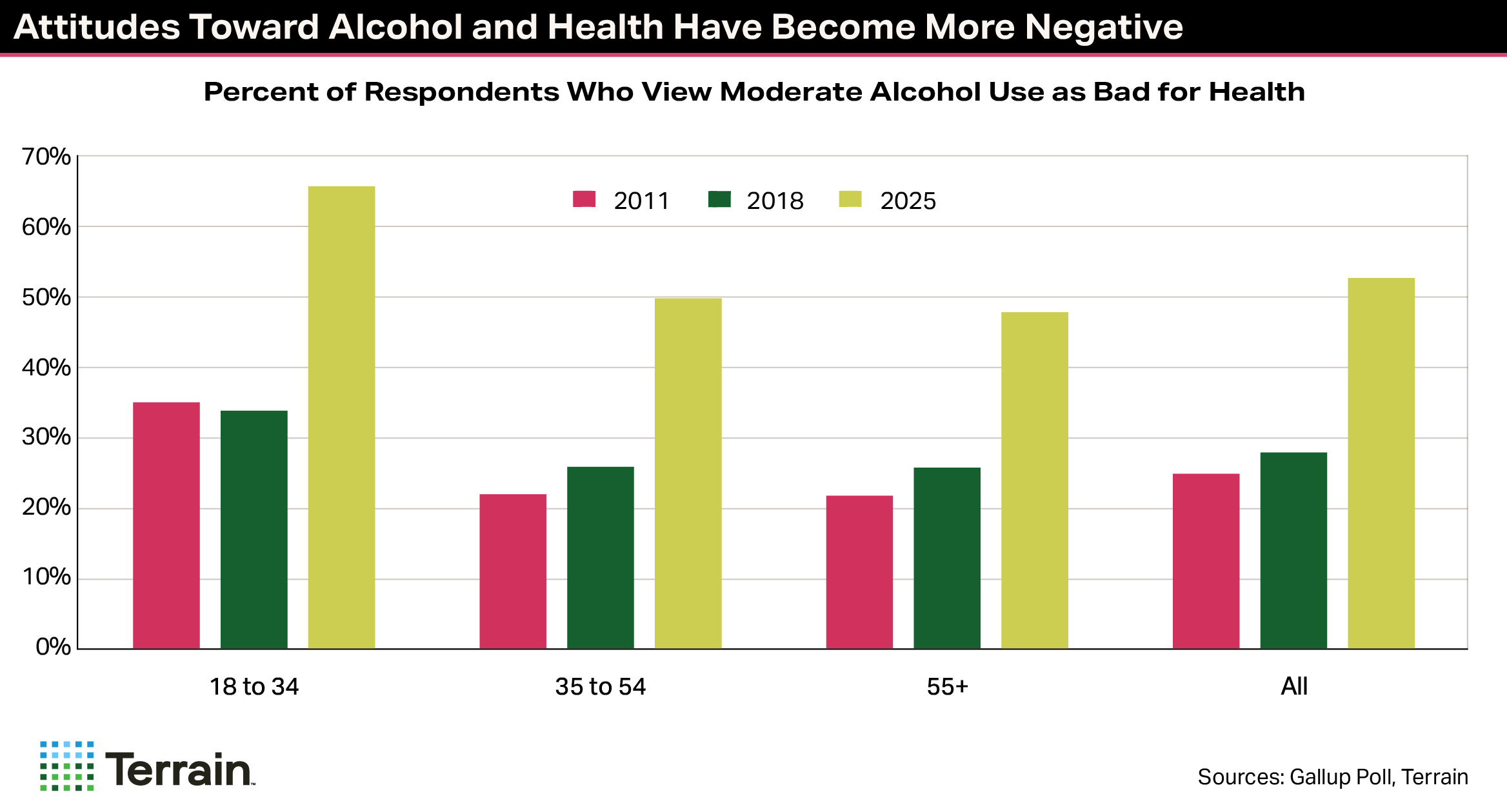
A Gallup poll conducted in 2018 found that 28% of respondents said that moderate drinking is bad for your health. In 2025, that number rose to 53%. Rising health skepticism has almost certainly weighed on alcohol consumption in recent years. A sophisticated and well-funded anti-alcohol movement that has gained influence over the last decade has accelerated the swing. That movement will continue to exert its influence on public opinion and policy going forward.
| Q: | Given these data and trends, what are some takeaways for the wine industry in terms of opportunities? |
Some opportunities involve premiumization, wine styles and packaging formats.
Premiumization
If consumers drink less, they are apt to treat it like an indulgence and consume higher- quality beverages when they do drink. Presumably, they will also be able to spend more, as they are purchasing fewer bottles, so the premium and luxury segments of the industry should be less impacted. It will be essential to maintain quality.
Wine styles
If consumers are more concerned with health and wellness or taking GLP-1 drugs, lighter, crisper wines with less oak, alcohol and calories may be more appealing. This has implications for both winemaking and grape-growing practices.
Packaging formats
If consumers are drinking alone or less due to age, health concerns or GLP-1 drugs, the 750ml bottle may not be suitable on as many occasions. There may be a shift toward smaller formats (splits, cans, etc.) and containers that preserve freshness for longer periods of time (such as bag-in-a-box wine).
| Q: | What are some of the advantages wine has over other alcoholic beverages? |
I believe wine is well-positioned to attract consumers, especially those concerned with health and wellness, as it has some distinct advantages over other alcoholic beverages.
It is a natural product with no fat, generally no added sugar, and dry wines are relatively low in carbs and calories. Moreover, the antioxidants in wine, particularly red, are thought to promote heart health when consumed in moderation.
Wine is also steeped in history, culture and geography. It is a beverage meant to be savored and shared with family and friends. In essence, it is the drink of moderation.
These virtues should appeal to consumers of all ages. The industry must strive to tell the story of wine in a simpler and more compelling manner.

For more information, on Chris Bitter, Terrain and American AgCredit, go to: https://www.terrainag.com

Price-sensitive consumers have kept a lid on wine sales this year, while grape sales are likely to remain slow. As for the moderation movement, a range of factors are contributing.
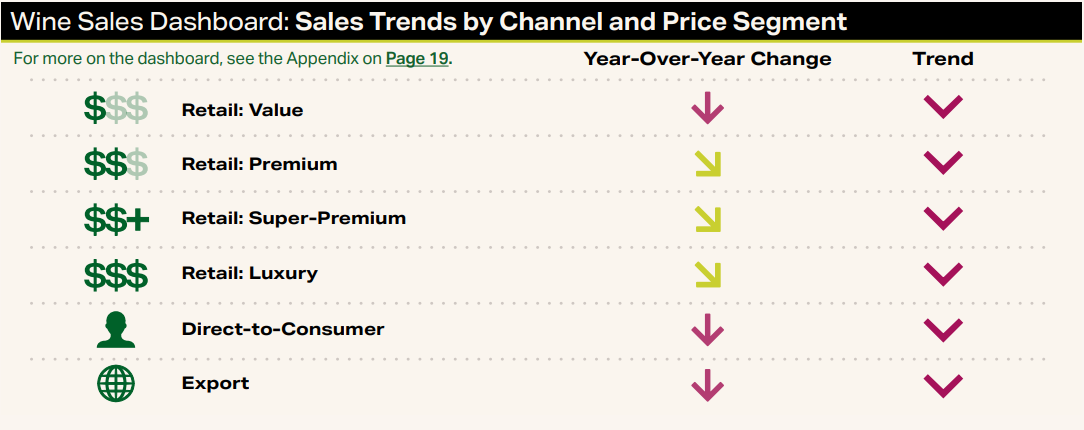
It was a disappointing first half of the year for U.S. wine sales as a shaky economic backdrop quashed the signs of progress that were evident in late 2024. Nonetheless, there has been modest improvement in some areas since spring.
Retail wine sales fell across price segments in the first half but declined at a slower pace in the second quarter than in the first (see Page 3). Following a bleak first five months of 2025, direct-to-consumer sales, while still down, firmed in June and July. Alternatively, exports deteriorated markedly in the second quarter as shipments to Canada collapsed.
Unfortunately, I am not expecting much improvement in the near term.
The economic outlook remains murky, but the Terrain team believes that slow economic growth, a gradually eroding labor market, and sticky inflation are the most likely scenario. Consumers are apt to remain gloomy and price-sensitive.
The California grape crop looks healthy, though perhaps a bit light at this point. Grape sales remain painfully slow, and I don’t expect a resurgence before the harvest concludes. Fruit will almost certainly be left hanging again this year.
This issue’s Trending Topic focuses on the causes of the recent decline in alcohol consumption (see Page 8). Transitory influences, including a post-pandemic hangover and economic pressures, are playing a role, but structural factors appear to be the root cause.
These include demographics, competition with cannabis, GLP-1 drugs, health concerns, and less socializing in person. None of these headwinds are likely to dissipate soon, so I expect consumption to decline for the foreseeable future.
It is impossible to predict the magnitude of the drop, but it could be more pronounced than during the last drinking recession (1980 to 1995) simply because the adult population is growing at a much slower rate.
The moderation movement is an obvious challenge for the wine industry. Wine will need to take market share just to hold sales volumes steady. I believe it has some advantages over other alcoholic beverages in the battle for drinkers, but it must tell a more compelling story.
The premium and luxury segments look better positioned with respect to the moderation trend, and I expect the shift in consumer preferences toward lighter, lower-alcohol wines to continue. This has implications for both wine making and grape growing practices. Finally, consumers are apt to gravitate toward smaller formats or packages that preserve freshness for longer.
This issue:
• Identifies the root causes of declining alcohol consumption
• Shares a lackluster market update for the first half of 2025
• Presents opportunities related to shifting consumer preferences
Download the Fall 2025 Winescape

Event Type: Webinar
Location: Vritual
Date: 9/17/2025
This free webinar is designed for young, beginning, or small-scale farmers looking to build a stronger financial foundation in agriculture and will include:
- The fundamentals of building a business plan, crafting an annual budget, and understanding your balance sheet
- Practical insights from an experienced lender
- Access to free resources that offer additional tools to support your financial journey
As the agricultural landscape evolves, so do the financial tools and strategies needed to support the next generation of producers.
Wednesday, September 17 at 12 p.m. PT
Economic uncertainty continues to dampen consumer confidence and wine demand, with no apparent threats to an abundant grape crop.
Wine sales are off to a slow start in 2025 and the glimmers of progress evident in the second half of 2024 have mostly dissipated.
I had initially expected to see progress continue in 2025, particularly in the premium and luxury segments, due in part to an improvement in consumer sentiment that began after the November election. This looks overly optimistic now.
Consumer sentiment has plummeted over the last several months, though the hard economic indicators have generally remained positive.
Nonetheless, I expect the labor market to soften and progress on inflation to stall as we move into the back half of the year, though the outlook remains extremely uncertain. Thus, wine sales are not likely to improve anytime soon.
Consequently, the grape market has continued to soften. This is despite the fact that there will be likely less excess fruit this year because many growers have pulled or mothballed vineyards.
The vineyard market also remains slow, and values appear to have declined substantially from their prior peak in most regions.
In the Trending Topic Section, I share insights on alcohol consumption. Alcohol sales and tax data suggest that alcohol consumption is declining, though this trend is not yet well established due to data lags and pandemic-related distortions. Survey evidence also indicates that the number of Americans that are drinking is sinking.
The Spring 2025 Issue of Winescape includes:
- Details disappointing wine sales data for early 2025
- Outlines trends in alcohol consumption
- Identifies opportunities for wine to win market share
State of the Industry; The Wine Market and Consumer Are Evolving – So Should You
In this data-driven session, Dr. Chris Bitter, Senior Wine and Grape Analyst for Terrain / American AgCredit, will break down the key trends shaping both retail and direct-to-consumer wine sales. He’ll examine the structural headwinds impacting the industry, provide a forward-looking outlook on wine sales, and highlight areas where innovative wineries are still finding growth.
Wine consumption is declining, and that trend isn’t likely to reverse anytime soon. But beneath the headlines, there’s a more complex story—one that reveals important nuances, shifting consumer behaviors, and untapped opportunities for wineries willing to evolve. The brands that succeed in this new landscape will be those that understand the challenges, adapt to market realities, and embrace strategic change.
This interactive session will also include live polling to establish industry benchmarks, allowing attendees to compare their performance with their peers. Come prepared to gain valuable insights, challenge assumptions, and walk away with a clearer picture of where the wine market is headed—and how your business can stay ahead.
Wine Sales Symposium, May 14 at the Hyatt in Santa Rosa, CA
Chris Bitter, Ph.D., Senior Wine & Grape Analyst / Terrain, American AgCredit
 Chris Bitter, Ph.D., is Terrain’s senior wine and grape analyst. As a part of the Terrain team of economists, he delivers expert analysis to the customers of American AgCredit, Farm Credit Services of America and Frontier Farm Credit. Chris is responsible for the Winescape™ report series, which shares research and insights for the business of vineyards and wineries.
With more than 20 years of experience as an economist and market analyst, Chris is a former faculty member of the University of Washington’s Runstad Center for Real Estate Studies. In 2016, he left his academic position to launch Vintage Economics, a market research and consulting firm focused on the wine industry. Chris earned his Ph.D. in economic geography with a minor in agricultural and resource economics from the University of Arizona. His research has been published in a variety of national and international publications, including the Journal of Wine Economics, and he has delivered presentations at wine industry conferences around the globe.
Flexibility and focus will be key this year, as the economic backdrop for wine sales has become murkier, and the grape market still looks long despite a short harvest in 2024.
The 2024 numbers are in, and they confirm that off-premise wine sales have not bottomed yet. They are descending at a slower rate, though, due mainly to improvement in the super-premium and luxury segments. Alternatively, the slump deepened in the direct-to-consumer (DtC) and on-premise channels.
The economy continues to sail along at a reasonable pace, and the labor market remains solid. But consumer sentiment, which has been treading water, took a dive in early 2025 due to intense uncertainty and negative inflation news.
The Spring 2025 Issue of Winescape includes:
- Breaks down the 2024 grape crush numbers by variety and region
- Lays out key factors for a recovery in the grape market
- Reviews wine sales data for 2024 and shares the outlook for 2025
Download the Spring 2025 Winescape
The most pressing topic for the California wine industry is the state of the market. This issue provides a detailed outlook for the wine market in 2025 and beyond.
This issue of “Winescape” focuses entirely on the state of the market. As the fruits of the recent harvest are now being converted into wine and beginning their journey to market, the most important topic for the California wine industry is, what’s next? In this issue’s Trending Topic, I provide a detailed outlook for the wine market in 2025 and beyond.
This issue:
- Focuses on the wine industry's most pressing topic: the state of the market
- Provides a detailed outlook for the wine market in 2025 and beyond
- Discusses the economy and wine’s post-pandemic new normal in a time of uncertainty
Download Winescape Winter 2024/2025