The One Big Beautiful Bill Act (OBBBA) introduces changes and new requirements for reporting overtime pay in 2026. The changes are required to enable employees to claim certain overtime deductions on their personal tax return.
The new tax deduction applies only to the ‘Qualified Overtime Compensation’ portion of overtime pay. The Qualified Overtime Compensation is the premium portion of overtime pay, or that extra “half” portion of “time-and-a-half” compensation.
For example, if an employee earns $20/hour and works overtime, the overtime pay is $30/hour. Of the $30/hour, in this example the $10/hour is the Qualified Overtime Compensation that may be deductible under the new rule.
Not all overtime will qualify for the deduction by employees. Only overtime pay required by the Federal law Fair Labor Standards Act (FLSA) is eligible. Overtime Pay required by California regulations will not be included in the tax deduction. This means the California Overtime Pay for working over 8 hours in a day, or double time for over 12 hours, will not be allowed to be deducted.
Starting in 2026, employers may need to make changes to how they track and report overtime. The IRS has recently announced transition relief for 2025, and tax forms for 2025 will not be adjusted. The IRS will provide further guidance on the specifications for the 2026 tax returns later this year.
While these deductions are in effect now, the tax deductions are taken into account on the employee’s individual tax return when it is filed. The new overtime tax deduction is not taken through payroll. Additionally, all overtime is still subject to Social Security, Medicare, unemployment, and state taxes.
Eligibility: The overtime deduction is available for both itemizing and non-itemizing taxpayers.
From 2025 to 2028, employees who qualify can deduct up to $12,500 annually for the Qualified Overtime Compensation’ (or $25,000 for joint filers). To claim the deduction the employee must Include their Social Security number on their return and file jointly if married, to claim the deduction. Employees who make over $150,000 individually (or $300,000 jointly) will have the deduction phase out. Whether the employee itemizes or not, overtime deduction may be available.
The One Big Beautiful Bill Act (OBBBA) requires changes to tax reporting on overtime and tips. However, the IRS announced that, as part of the phased implementation of the OBBBA, there will be no changes to tax returns or federal withholding tables for Tax Year 2025.
The IRS will not be making adjustments for 2025 related to the OBBBA, and forms will remain the same. Specifically, Forms W-2, existing Forms 1099, Form 941, and other payroll forms will not change for 2025. Federal income tax withholding tables will continue as they are. Employers should continue using current reporting and withholding procedures until 2026.
The IRS explained that delaying changes until 2026 is meant to reduce confusion during the upcoming tax filing season and give businesses and tax professionals more time to prepare for implementation.
“These decisions are intended to avoid disruptions during the tax filing season and to give the IRS, business, and tax professionals enough time to implement the changes effectively,” said the IRS in a written statement.
The IRS is developing guidance and updated forms for Tax Year 2026. One of the most significant changes will impact how tips and overtime pay are reported. The IRS has stated that additional guidance will be released in the coming months.
California’s minimum wage will be increasing in 2026. For hours worked on or after January 1, 2026, the new California minimum wage will be $16.90/hour, a 2.49% increase from the current rate of $16.50/hour. This new rate applies to all employers, regardless of size.
The wage increases also apply to full-time exempt employees, whose minimum salaries will increase to $70,304/year ($1,352/week), also an increase of 2.49% from the current salary minimum of $68,640/year ($1,320/week)
To view the certified letter from the California Department of Finance (DOF) regarding these new minimum wages, click here:
https://dof.ca.gov/wp-content/uploads/sites/352/2025/08/Minimum-Wage-Increase-Notification-Governor-and-Legislative-Letter.pdf
For a current listing of the California City & State Minimum Wages, view our page here: https://californiapayroll.com/california-minimum-wage/
Don’t forget, the required Labor Law Posters will also need to be updated. Contact us if you need an automated solution for your company’s posters.
One often overlooked aspect is the language in which mandatory posters are displayed. California, known for its diverse population, has specific requirements to ensure that all employees have access to workplace information.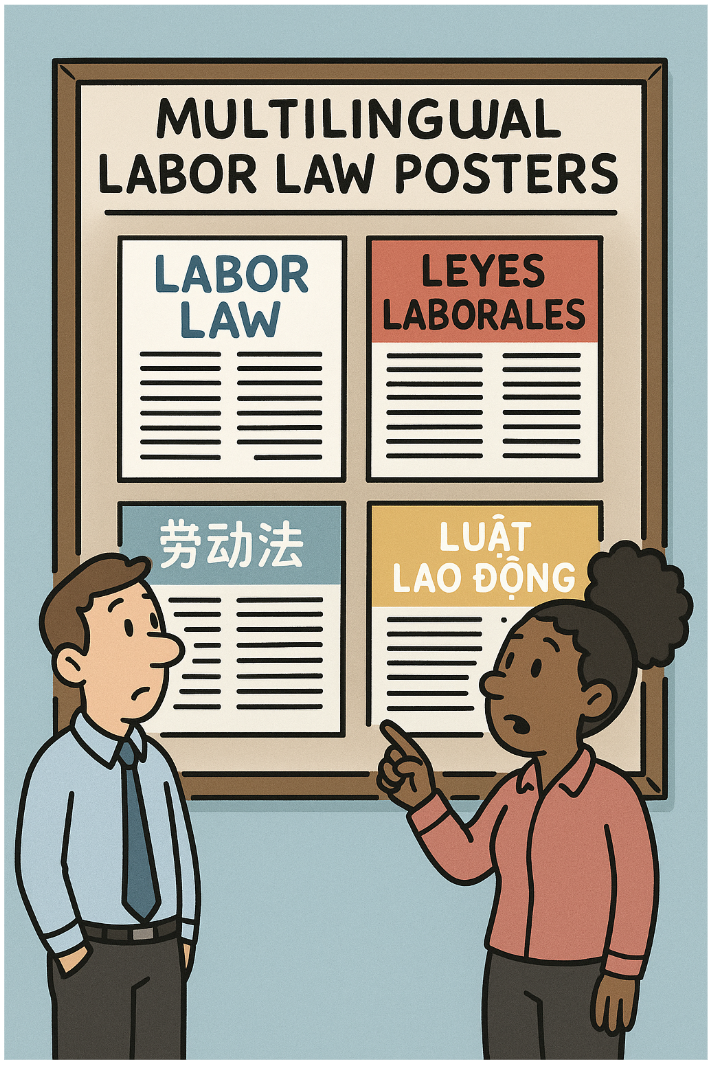
Federal Language Requirements for Workplace Posters
The U.S. Department of Labor (DOL) recognizes the importance of communicating with employees in their native languages:
- Family and Medical Leave Act (FMLA): Employers must provide notices in a language their workforce understands if a significant portion of employees are not literate in English.
- Migrant and Seasonal Agricultural Worker Protection Act (MSPA): Posters must be available in languages commonly spoken by migrant workers who are not fluent in English.
- Executive Order 13496: Federal contractors and subcontractors must post notices in languages spoken by employees who are not proficient in English. Translations are available through the DOL upon request.
- Immigration and Nationality Act (INA): Employers must provide notices in languages common to a significant portion of their workforce if they are not fluent in English.
California’s Additional Requirements
California agencies have specific language guidelines:
- California Civil Rights Department (CRD): If 10% or more of a company’s workforce speaks a language other than English, posters must also be displayed in that language. Employers can request additional translations through the CRD.
- California Department of Industrial Relations (DIR): Employers are required to display minimum wage posters in Spanish for workers who only speak and read Spanish.
Why Language Compliance Matters
California has the largest Hispanic and Latino population in the United States, making Spanish the most commonly required language alongside English. By addressing the linguistic needs of their workforce, employers meet legal obligations to ensure employees are provided important information.
Conclusion
Employers should stay informed about language requirements for workplace posters and adapt to the needs of their workforce. Requirements may differ for each company and regulation, and it’s ultimately the employer’s responsibility to stay informed.
This content is provided for general informational purposes as a courtesy and should not be interpreted, taken or construed as guidance or legal advice. California Payroll is not engaged in the practice of law or providing accounting, tax or legal advice. Employers and organizations are encouraged to consult with legal counsel, CPA, financial advisor, and/or a tax advisor to address any specific concerns, risks, or requirements relevant to their jurisdiction and circumstances.
There is much more to learn about labor law poster compliance in California. That’s why we wrote a 10-page guide on the topic and made it free.
 Download your copy today and stay in the know

 Join us at the 2025 Unified Wine & Grape Symposium in Booths #120 and #A2502 to discover how our integrated HR/Payroll technology, Timekeeping solutions, and flexible Benefits Administration software provide effective workforce management solutions for wineries, growers, Farm Labor Contractors, and businesses across the Wine & Ag market supply chain.
Our enhanced HR, Payroll, Timekeeping, and Benefits Administration packages integrate completely with leading agribusiness HR platforms to help you navigate the complex compliance of:
- The fluctuating needs of seasonal workforces
- Agriculture-specific California labor laws
- Piece rate & job codes
- 941 and 943 Reporting
- Farm Labor Contractors (FLC’s)
Our flexible payroll systems are designed to accommodate your business’s unique circumstances, helping you streamline your operations, improve efficiency, and remain competitive in the Ag labor market with:
- Payroll solutions
- Benefits Administration
- Human Resource software
- Timekeeping
- Workforce Management
California Payroll
Unified Symposium Booth: 120 & A2502
For over two decades, California Payroll has offered comprehensive Payroll, Timekeeping, and Human Resource technology solutions to businesses of all shapes and sizes, from 5 to 10,000 employees, across all 50 states. Our modern software provides flexible and robust solutions tailored to the unique needs and policies of the Wine & Ag industry. Our dedicated support professionals will help you get the most out of every product and feature so you can HR faster and have more time to grow your business.
Visit us at the Unified Wine & Grape Symposium to discover how we can empower your business with the solutions you need to successfully navigate the complexities of the Wine & Ag industry.
Employers reimbursing employees for mileage, take note: The IRS has updated the standard mileage reimbursement rates for 2025 to $0.70. 💰
To view all other reimbursement rates click below:
https://hubs.li/Q030Byq40

Join us at the 2024 WIN Expo in Booth #235 and discover how our integrated HR/Payroll technology, Timekeeping solutions, and flexible Benefits Administration software provide effective workforce management solutions for wineries, bottling companies, farm labor contractors, and businesses across the wine market value chain.
Our enhanced HR, Payroll, Timekeeping, and Benefits Administration packages integrate completely with leading agribusiness HR platforms to help you navigate the complex realities of:
- The fluctuating needs of seasonal workforces
- Compliance with agriculture-specific California labor laws
- Extensive record-keeping reporting requirements
- Union-related management and benefits administration
- Complicated job role and pay rate situations
- Worker safety and health benefits
Our flexible payroll systems are designed to accommodate your business’s unique circumstances, helping you streamline your operations, improve efficiency, and remain competitive in the labor market with:
- Tailored solutions for the wine industry
- Complete integration
- Automated annual census and enrollment processes
- Applicant Tracking
- Onboarding and Benefits Enrollment
- Performance Management
- Earned Wage Access and Financial Wellness programs
California Payroll
WIN Expo Booth: 235
For over two decades, California Payroll has offered comprehensive Payroll, Timekeeping, and Human Resource technology solutions to businesses of all shapes and sizes, from 5 to 10,000 employees, across all 50 states. Cutting-edge HR, Payroll, Timekeeping, and Benefits Administration software provides flexible and robust solutions tailored to suit the unique Payroll and Benefits policies and offerings of businesses across the wine industry.
Visit us at the WIN Expo to discover how we can empower your business with the solutions you need to successfully navigate the complexities of the wine and agricultural industry’s labor laws and regulations, streamline your operations, and get the most out of your workforce.
What Are Labor Law Postings/Posters?
Every employer should be familiar with labor law posting requirements. Postings are required Federal, State, or local regulations regarding employee rights under their employer.
Various agencies issue labor law postings to ensure employees receive notice of their rights in the workplace or protocols they must follow. Some common topics in these postings are workplace safety, federal and state minimum wage laws, workplace conduct, and COVID-19 protocols.
Depending on the industry or state your company is based in, new postings or the content of existing postings may be updated by their issuing department at any time and often at different intervals. Once their content changes or there is a new posting, employers must display them within specific grace periods to stay compliant.
The Department of Labor (DOL) requires employers to display applicable postings at their place of business in an area frequented by all employees. Poster services condense these individual postings into one poster and replace them with updated legislation when needed.
Do I Have to Provide Labor Law Posters to Remote Employees?

The abovementioned process works well for in-person jobs, but how are employers expected to display important postings to remote employees who never visit a company’s worksite?
Employers must still communicate mandatory postings to workers who rarely or never visit the office. Fortunately, agencies like the DOL that require these postings have accepted digital postings and posters in addition to hard copies to keep remote employees informed of their rights in the workplace. Digital posters are available for employees who don’t visit their company location at least 3-4 times a month to update them on new labor laws or protocols.
If I Employ Remote and In-Person Employees, Do I Still Need Physical Posters in My Workplace?
Employers with physical workspaces must still display updated versions of required postings, even if they have only one in-person employee. Federal agencies only allow solely digital postings if all their employees work remotely and can readily access them electronically.
So, if your workforce is comprised of both remote and on-site employees, you’ll need to comply with both required labor law postings and ePosters.
Penalties for Non-compliance
All employers with at least one employee must post federal and state labor law postings at each of their locations in an area frequented by all employers. Allowances for digital posters have only been made recently to accommodate the rise of remote work.
If employers fail to keep all of these postings up to date, they can face fines of up to $17,000 per location or be liable for employee lawsuits. For example, if an employer fails to accurately notify employees of their most recent rights and resources regarding discrimination in the workplace and an employee files a discrimination lawsuit, they are more likely to be liable for damages.
How Do I Keep up With Changing Workplace Postings for Remote AND In-Person Employees?
Technically, employers can manage their postings, posters, and digital labor law posters on their own. Individual agencies provide required listings for free as PDFs. However, many employers prefer to outsource this task for several reasons.
• Many employers have to update required postings several times a year
• Agencies requiring postings don’t allows communicate required updates well, so employers must stay vigilant
• Required posters do not update on the same date annually, so they are difficult to anticipate
• Labor poster compliance is an essential prerequisite to running a business, but it’s not the work you want to scratch off your to-do list.
• Employers with remote teams must make other arrangements to provide current labor law postings to them effectively, in addition to their on-site posters
Our Solution
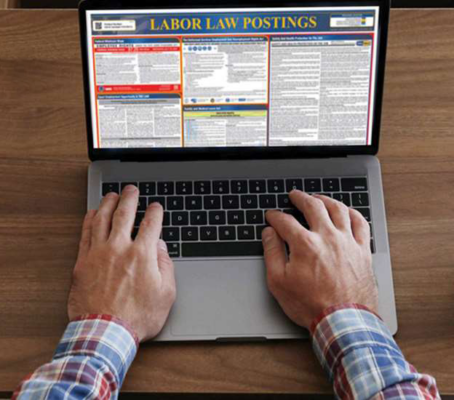
Fortunately, California Payroll offers a poster solution to help employers stay compliant, with a guaranteed $25,000 fine Reimbursement policy to protect you. Our poster service can compile applicable postings for your company into one poster and mail it to you whenever there is a new update.
As for your remote employees, our brand-new digital labor law posters Service Center can deliver current federal, state, county, and city notices to your remote workforce digitally. Learn more about this new product through our new blog. If you’re ready for a demo about the ePoster Service Center, request one on our website.

California's Department of Finance certified a minimum wage increase from $16 per hour to $16.50 per hour, beginning January 1, 2025. This determination will apply to most California employers regardless of size, that don't have special wages for their industry or localities.
Why was this CA minimum wage increase implemented?
The California Director of Finance analyzes inflation annually via a U.S. Consumer Price Index (CPI) and determines whether or not to adjust California's minimum wage accordingly. Per California's Labor Code, it's either increased by 3.5 percent or the actual rate of change per CPI, whichever is less.
Joe Stephenshaw, California Finance Director, certified the latter option, a 3.18 percent increase in accordance with the department's CPI calculations.

How does this minimum wage increase affect full-time exempt employees?
This increase also affects the minimum salary requirements for full-time exempt employees. It's currently $66,560 per year ($1,280 per week) and will increase to $68,640 per year ($1,320 per week) on January 1, 2025.
Exceptions to the CA Minimum Wage Increases Employers Should Know
Employers should remember there are some instances where this minimum wage increase does not apply:
- Many California cities and counties have their own local minimum wage rates that override the state requirements.
- Fast food restaurant employees covered in California Labor Code Section 1474-1476 have their own minimum wage of $20 per hour on April 1, 2024.
- Health care workers will also have a special minimum wage that will be effective no later than January 1, 2025, depending on their facility type.
For information directly from California's Director of Finance, view or download the full PDF on the 2025 minimum wage increase here.
Don't reinvent the wheel. Integrate success into your business with payroll and HR solutions that connect to leading platforms for benefits administration, applicant tracking, financial wellness, and more. Empower your HR staff to handle various tasks and duties without the hassle or headaches of juggling disparate systems.
https://hubs.li/Q02GsMc-0