Wine Industry Sales Education (WISE), the leading provider of Direct-to-Consumer (DTC) sales education, leadership coaching, and certification for the wine industry, today announced the launch of WISE Public Speaking Pathways, a new suite of live, practice-based public speaking courses developed in partnership with Clear Communication Academy (CCA).
Designed specifically for winery professionals, WISE Public Speaking Pathways delivers role-based communication training across every level of the organization, from frontline tasting room staff building confidence with guests, to managers and winemakers representing the winery publicly, to executives speaking with influence and authority.
With both live Zoom and in-person options, the program offers flexible access for individuals and organizations to select the experience that best aligns with their goals, team structure, and growth initiatives.
“Strong communication is not a ‘nice to have’ in today’s DTC environment. It is foundational to sales, brand, and long-term customer relationships,” said Lesley Berglund, Co-Founder of WISE. “Whether it’s a tasting room conversation, a winemaker dinner, or a leadership presentation, wineries need a consistent, compelling brand message delivered with confidence at every level. This partnership allows us to equip teams, from frontline to executive leadership, with the skills to communicate with clarity, authenticity, and impact.”
The curriculum blends WISE’s proven sales and hospitality frameworks with CCA’s globally recognized communication methodology, creating a highly practical, immersive learning experience grounded in real winery scenarios.
WISE is launching the pathway with two core courses:
WISE #120: Public Speaking Fundamentals
Designed for frontline winery staff, this program focuses on the core skills of clear and confident communication. Participants learn how to structure messages, speak comfortably with guests, and deliver engaging explanations of wines, tastings, and experiences. Through guided practice and feedback, participants develop the confidence to represent their winery with clarity and professionalism.
WISE #221: Public Speaking for Managers
Managers and supervisors often serve as the bridge between the winery team and the public. This program expands foundational speaking skills with a focus on storytelling, helping managers communicate the winery’s story, philosophy, and experiences in ways that resonate with guests, partners, and industry audiences. Participants learn how to deliver clear messages, tell meaningful stories, and speak with confidence in leadership situations.
Additional courses, including an in-person advanced workshop and a program designed specifically for winemakers, will be introduced throughout the year, further expanding the pathway to meet the evolving communication needs of winery teams.
Clear Communication Academy (CCA) brings a proven, globally recognized approach to communication that focuses on clarity, connection, and impact. Led by founder LaQuita Cleare—a seasoned communication strategist, keynote speaker, and former media professional—CCA combines psychology, performance, and Hollywood storytelling techniques to help professionals communicate with intention, strengthen credibility, and inspire action. Drawing on decades of experience working with executives, entrepreneurs, and global teams, CCA’s approach emphasizes real-world application in high-stakes moments, powered by CCA’s proprietary Engagement Code™ a methodology designed to turn communication into meaningful audience engagement. As she shares, “What excites me most about this partnership with WISE is helping wine professionals translate their expertise into communication that truly connects—whether sharing the stories behind their wines or speaking in ways that engage and inspire audiences.”
WISE Public Speaking Pathways reinforces a critical industry need: transforming everyday communication moments into opportunities to build connection, strengthen brand, and drive measurable DTC outcomes.
Courses within the WISE Public Speaking Pathway are now open for enrollment, however, spots are limited. Register now for WISE #221 (beginning April 28) or WISE #120 (beginning May 14) to equip your team with the communication skills that directly impact sales, club growth, and long-term customer relationships.
About Wine Industry Sales Education (WISE)
Wine Industry Sales Education (WISE) is the leading provider of Direct-to-Consumer (DTC) sales training, leadership development, and certification for the wine industry. Through live courses, coaching, and Mystery Shopping programs, WISE helps wineries build strong leaders, healthy teams, and successful businesses.
About Clear Communication Academy (CCA)
Clear Communication Academy (CCA) is a global communication and storytelling training company helping professionals communicate with clarity, confidence, and impact. Through a unique blend of psychology, performance, and storytelling techniques, CCA equips individuals and organizations to connect with audiences and inspire action.

When the Super Bowl and Olympics approach, we celebrate the performance we see on the field. What we don’t see is the year-round conditioning, repetition, and skill-building that made that performance possible.
Winning teams don’t train only when the lights are brightest. They train all year long. The same principle applies to winery DTC teams.
Downtime Is Where Advantage Is Built
Periods of slower visitation or economic uncertainty can feel like a signal to pause. But research shows that the opposite approach separates leaders from laggards.
A landmark study published by Harvard Business Review analyzed more than 4,700 companies across multiple recessions. The findings were striking: “Only 9% of companies emerged from recession stronger than before.”
Even more telling: “Companies that balanced cost discipline with continued investment in people and capabilities recovered faster and gained market share.”
Training Is a Growth Strategy, Not an Expense
Organizations that pulled back hardest on training struggled to regain momentum. Those that stayed committed to skill development entered recovery phases with sharper teams and stronger results.
In Winery DTC, that advantage shows up as:
- Higher conversion to purchase rates
- Stronger club conversion
- Better data capture for engagement beyond the tasting bar
- Higher measurable guest satisfaction scores
Training during slower cycles isn’t about staying busy. It’s about conditioning. It is about strength training.
What WISE Teams Are Focusing On Right Now
We’re seeing wineries use this moment to build both new capabilities and refined mastery:
Building new skills
- SMS strategy that drives response through WISE #117 DTC Text Messaging Professional
- Outbound phone sales with confidence and structure via WISE #116 Outbound Phone Sales Professional
- Roadshow events that convert relationships into revenue by WISE #222 Roadshow Events
Sharpening existing skills
- Advanced tasting room selling through WISE #121 Advanced Tasting Room Professional
- Managers are developing their people leadership soft skills and financial acumen in WISE #201 Management Core
- More consistent guest experiences across teams
Going deeper with onsite coaching
- Custom training aligned to each winery’s goals
- Live observation and real-time coaching
- Practical skills teams can sustain long after we leave
This spring, WISE is also launching WISE Public Speaking Pathways, a NEW suite of live, practice-based public speaking courses designed for winery professionals at every stage of their career. From frontline staff building confidence with guests, to managers and winemakers representing the winery publicly, to executives speaking with influence and authority, each course is tailored to the real communication demands of the role. With virtual and in-person options, Public Speaking Pathways allows individuals and organizations to select the experience that best fits their needs – without a one-size-fits-all approach.
Why Acting Now Matters
Training calendars fill quickly, and the wineries securing time now are positioning themselves ahead of the curve.
Waiting until traffic returns often means:
- Less time to train
- More pressure on staff
- Missed revenue during peak moments both in the tasting room and beyond
The teams that invest now are doing exactly what high-performing organizations do in every industry: preparing before demand returns.
A Final Thought
Championship teams don’t train during the game. They train so the game feels familiar.
The same is true for your tasting room.
This is the season to condition, refine, and strengthen your team — so when the crowd returns, you’re already performing at your best.
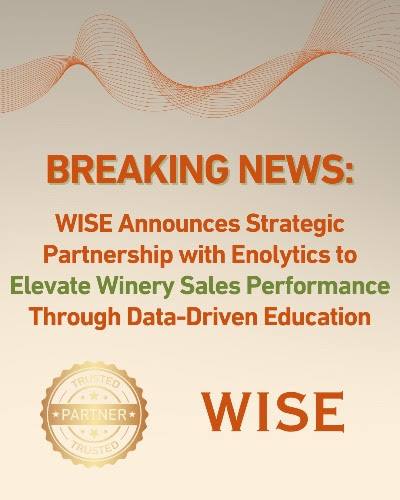
WISE and Enolytics are officially partnering up—and we couldn't be more thrilled about the benefits and value that this partnership will bring our clients and colleagues. Together, we aim to redefine how wineries turn data into action—improving sales execution, revenue outcomes, and long-term customer relationships.
“This partnership is about empowering winery teams to succeed, even in headwinds,” said Cathy Huyghe, co-founder & CEO of Enolytics. “By aligning Enolytics’ insights with WISE’s sales expertise, we’re helping wineries move faster from insight to ROI. The WISE team is so well-respected and intelligent, plus they are simply interesting and fun people to spend time with.”
Lesley Berglund, WISE co-founder & chairman, went on to add “Data becomes impactful when leaders know how to use it. This partnership with Enolytics allows us to ground sales training in real customer behavior and data insights. That’s where visibility, confidence, and action align to drive measurable improvements in sales performance.”
We proudly announced the recipients of the inaugural WISE Rising Stars Scholarships during a live presentation at the DTC Wine Symposium last week, celebrating the next generation of DTC wine industry leaders in front of more than 500 winery professionals.
As one of the event’s original sponsors, WISE continues to invest in the Symposium’s mission of education, collaboration, and forward‑thinking leadership. The Rising Stars Scholarships extend that commitment—supporting people, developing leadership, and strengthening the DTC community across the industry.
The Rising Stars Scholarships received an overwhelming response from across the country. The strength of applications prompted Commerce7 to step in and match one of the scholarships, allowing WISE to expand the program and support additional recipients.
Join us as we raise a glass towards this year's recipients!
Kelsey Gomes is the DTC Marketing Manager at Lange Twins Family Winery & Vineyards. Upon receiving the WISE Rising Manager Scholarship, she noted she is proud of the work she does at LangeTwins Family Winery and Vineyards, building a successful wine club and DTC business while connecting customers with the stories behind the wines they love. Through the industry-specific education and mentorship offered by WISE and the Rising Star Manager Scholarship, she hopes to accelerate her development as a leader so she can empower her team, create meaningful experiences for customers, and help shape a strong future for the business and the industry.
Ivy Thompson is the DTC Manager at Center of Effort Winery in Arroyo Grande, and is also earning her MBA at Cal Poly. She told us her career has been shaped by strong mentorship, community, and a passion for hospitality. Through WISE, she looks forward to expanding her strategic impact by strengthening her data-driven and marketing skill set in an ever-evolving industry.
Giselle (Gigi) Panaigua is the Sales and Engagement lead at Emeritus Vineyards in Sebastopol. She is quoted as saying:
"My approach to winery DTC blends thoughtful strategy with authentic guest connection—because great wine experiences should feel as good as they taste. WISE represents the next step in growing as a leader and contributing to the future of the wine industry"
Zoe Lucas is the DTC Manager at Black Ankle Vineyards, located in Frederick Maryland. She shared "I am incredibly excited to have received this scholarship and am looking forward to all that WISE has to offer, and can't wait to bring what I learn back to Maryland!"
In addition, earlier this month, we were pleased to announce a special WISE Scholarship in partnership with the Texas Hill Country Wineries. Awarded to Michelle Padilla, a Global Hospitality Leadership student at the University of Houston, she was bit by the wine bug at her Wine Appreciation course with Dr. Taylor. She reflected that she became "Much more interested in learning about wine and how it reflects the people and culture behind it...my eyes were opened to the growing potential of the Texas wine industry and made me want to be a part of its future."
To our five scholarship recipients Kelsey, Ivy, Gigi, Zoe and Michelle: we see you. We celebrate you. And we can’t wait to see where your paths lead next!
WHY: We believe a rising tide lifts all boats and that the wine industry deserves strong leaders, healthy teams, DTC mastery and winery success.
HOW: We serve by continually raising the bar for professionalism and leadership in the wine industry. We provide opportunities for experiential learning that changes behavior.
WHAT: We are wine industry leaders in professional development, focused on both DTC & General Leadership. We provide Relevant Classes, Mystery Shopping, Coaching, Consulting and Cabinet Programs.
At WISE, we offer a variety of courses, workshops, and coaching that are interactive and hands-on to help enhance your skills and advance your career.
Courses are designed to deliver take-home value using real-life, relevant examples through a combination of lecture, group exercises, and role play, these classes build on existing skills and teach best practices for meeting the demands of today’s changing DTC marketplace.
Courses are live – offered in-person and remotely – so that attendees gain ideas and insights as well as access to a community of their peers. With a true understanding of the value of our attendees’ time, our courses are succinct, efficient and targeted, covering maximum material in a minimum of time.
Visit us at the Unified Wine & Grape Symposium, booth 233, for more information and get started on your wine industry career today.
Ten years of data show execution, not traffic, is the defining factor in DTC success
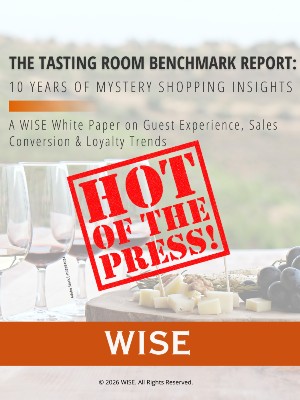 As wineries navigate softer tasting room traffic, rising costs, and heightened pressure on Direct-to-Consumer performance, a new white paper from WISE underscores a critical industry truth: sustainable DTC growth is driven less by volume and more by consistent execution inside the tasting room.
The report, The Tasting Room Benchmark Report: 10 Years of Mystery Shopping Insights, draws on more than a decade of WISE Mystery Shopping data, analyzing 6,000+ real guest experiences across U.S. regions, winery sizes, and business models. The findings point to a persistent gap between strong hospitality and the behaviors that most directly influence revenue, loyalty, and lifetime value.
WISE Mystery Shopping evaluates tasting room performance using a consistent, behavior-based framework that measures both hospitality and sales skills across more than 80 observable criteria. These insights roll up into overall guest satisfaction and three actions proven to drive results: asking for the sale, presenting the wine club with relevance, and capturing guest contact data. Collectively known as the WISE Triple Score, these behaviors represent the measurable link between hospitality and long-term DTC success. While most teams excel at creating welcoming experiences, the data shows these high-impact actions are often uneven or overlooked.
“Mystery shopping has evolved significantly over the past decade,” said Jennifer Warrington, Partner at WISE and Operations Manager for the Mystery Shopping initiative since its inception in 2012. “What began as a simple feedback tool has become one of the most effective ways for wineries to understand how their training, culture, and leadership show up in real guest interactions. The most successful wineries use this data not to critique their teams, but to coach them.”
According to the white paper, wineries that treat mystery shopping as a development and accountability tool, rather than a compliance exercise, see measurable improvements in average order value, club sign-ups, close rates, and post-visit engagement. The most consistent gains occur when results are shared transparently with teams and paired with ongoing coaching.
The research also reinforces a key industry insight: guest satisfaction alone does not guarantee financial performance. The wineries that outperform, even in challenging conditions, are those that intentionally connect hospitality to sales behaviors and follow-up, embedding these practices into daily operations rather than relying on individual talent or intuition.
“Winery metrics tell you what is happening, but mystery shopping helps explain why. This data gives leaders a shared language,” Warrington added. “It helps managers move from instinct to insight, and from anecdotal feedback to actionable coaching. It helps keep teams focused on continuous improvement.”
The full white paper outlines foundational hospitality behaviors, tactical execution strategies, and benchmarking insights drawn from a decade of real-world observations, offering winery leaders a clear framework for turning everyday guest interactions into long-term business results.
The white paper is available at wineindustrysaleseducation.com.
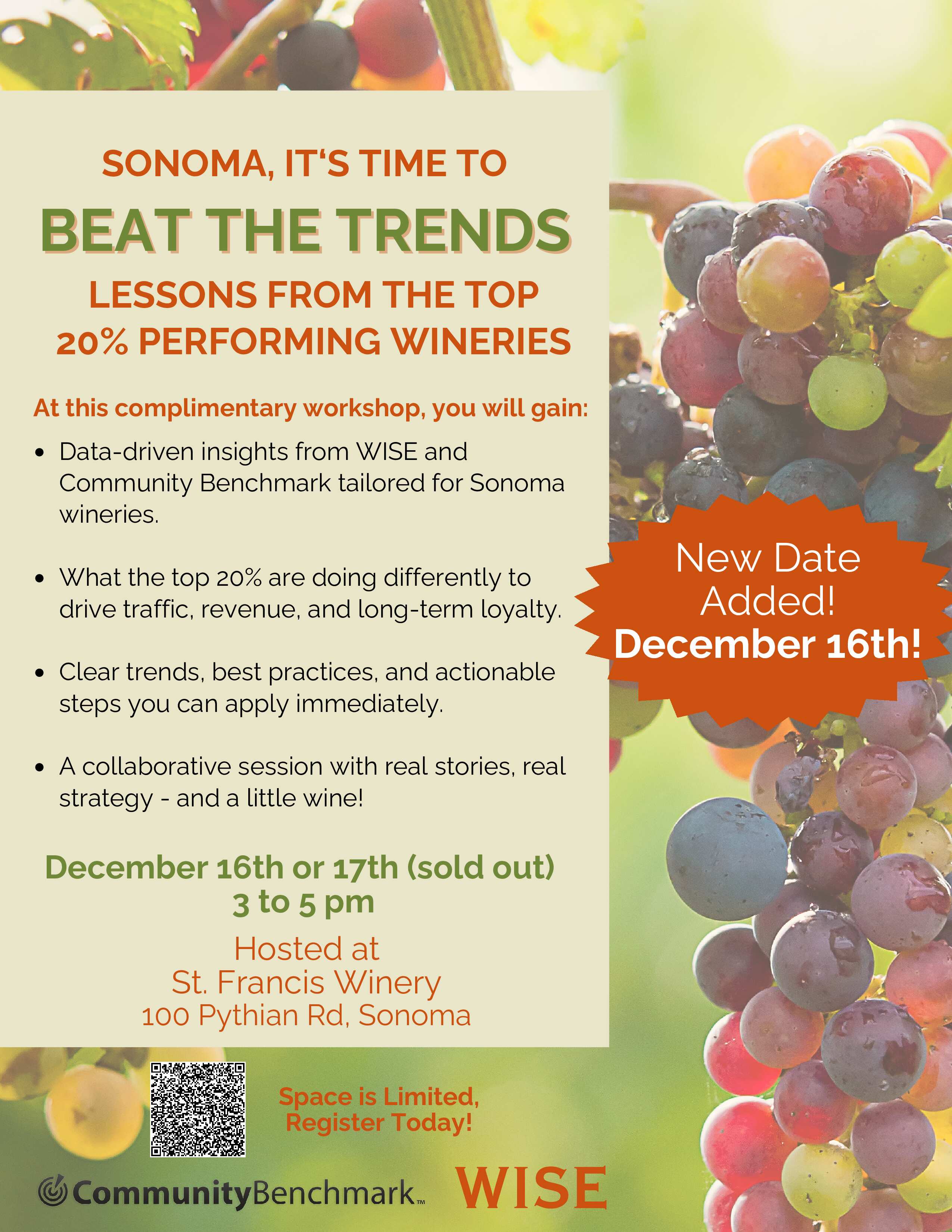
Event Type: Seminar
Location: St. Francis Winery - 100 Pythian Rd, Sonoma
Date: 12/16/2025
Sonoma wineries and tasting rooms are navigating a challenging year - softening visitation across the county paired with rising pressure to sustain revenue, club performance, and long-term guest engagement. And yet, across Community Benchmark’s dataset, the top 20% performing wineries are doing more than adapting… they’re excelling.
So what are these leaders doing that others aren’t?
Join WISE Chairman Lesley Berglund and Community Benchmark Founder John Keleher for a complimentary, interactive, data-driven session built specifically for Sonoma wineries. We’ll spotlight the behaviors, strategies, and decisions that set top performers apart - whether they’re growing qualified traffic, generating more revenue beyond the tasting room, or strengthening loyalty in ways that directly impact the bottom line.
You’ll gain a clear, practical breakdown of the trends that matter most, the best practices emerging from the top 20% performing wineries, and the actionable moves you can take to apply these lessons at your own winery - so you can beat the trends, not just ride them out.
If you want real data, real stories from those in the trenches, and real strategies that work in today’s shifting environment, this session is for you.
Come learn, share, strategize… and sip. Bring a bottle and join the conversation. Register here.
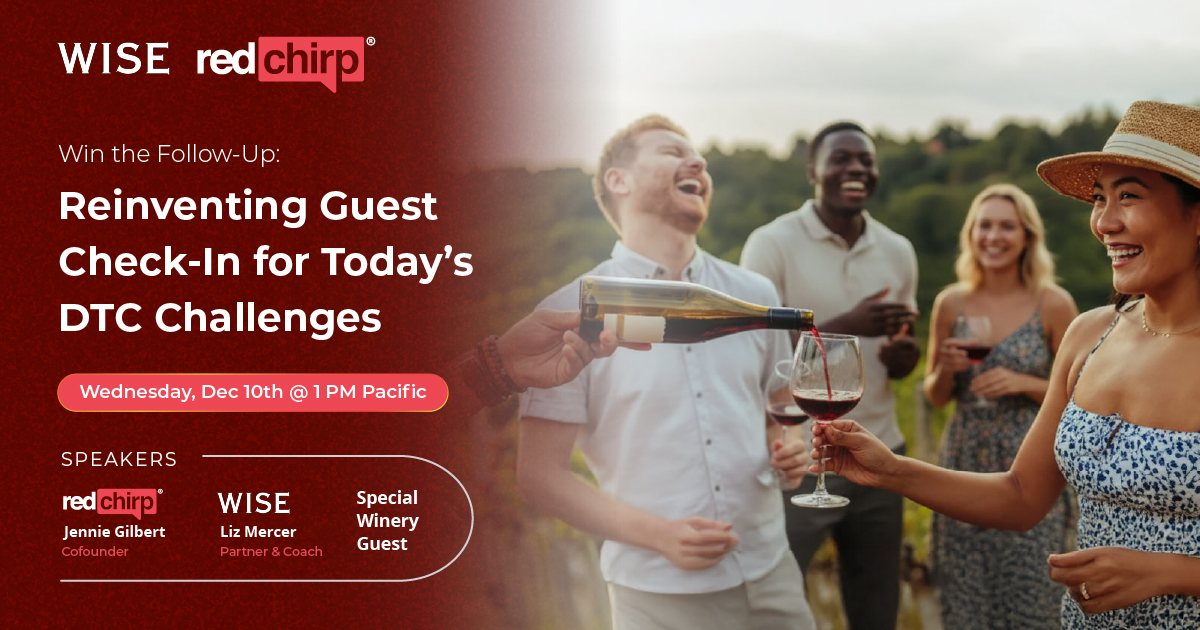
Event Type: Webinar
Location: Online - 1:00pm PST
Date: 12/10/2025
Join WISE Partner Liz Mercer, RedChirp Cofounder Jennie Gilbert, and a special winery guest for a forward-looking session on one of the biggest challenges in DTC wine sales: capturing guest information and consent. In-person tastings are among the richest — but often the most underutilized — sources of customer data, and wineries need fresh tools and strategies to grow their lists, stay connected after guests leave, and drive incremental revenue in today’s challenging landscape.
We’ll introduce an innovative new approach featuring customizable guest check-in forms, seamless integrations, and thoughtful opt-in processes that helps wineries collect actionable data from more visitors while maintaining a great guest experience. You’ll leave with practical guidance on implementation, staff adoption, creative incentives, and goal tracking, giving you a powerful new approach to grow your lists and revenue.
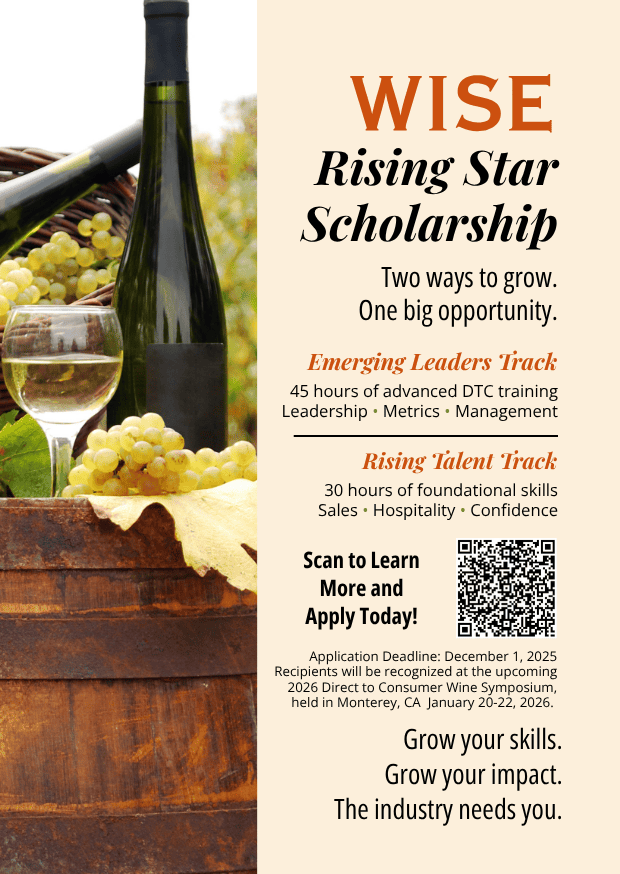 Wine Industry Sales Education (WISE) is proud to announce the launch of the WISE Rising Star Scholarship Program, three professional development scholarships designed to invest in the people shaping the future of the wine industry.
Now in its 16th year supporting winery DTC, WISE continues its commitment to helping winery professionals grow through hands-on education, coaching, and certification. The new scholarships support both emerging professionals and rising managers who demonstrate heart, hustle, and a commitment to excellence. Recipients will be recognized at the 2026 Direct to Consumer Wine Symposium, held in Monterey California January 20-22, 2026.
Two Tracks, One Goal: Empowering DTC Growth
Rising Star Professional Scholarship (Value: $1,275) One Available.
For individuals new to the wine industry or early in their DTC journey.
Includes:
- WISE #111 Tasting Room Professional OR WISE #113 Wine Club Professional
- WISE #117 DTC Text Messaging Professional
A total of 30 hours of foundational, skill-building training focused on guest experience, communication, and sales confidence.
Rising Star Manager Scholarship (Value: $2,050) Two Available.
For emerging managers, supervisors, and team leads ready to expand their impact.
Includes:
- WISE #201 – Management Core Foundation, which is 21 hours of People Leadership and Winery DTC financial acumen
- WISE #211 Tasting Room Management OR #213 Wine Club Management – channel specific management coursework
- WISE #205 DTC Metrics – for all DTC Channels
A total of 45 hours of advanced leadership, team performance, and cross-channel strategy.
Both scholarships offer flexible scheduling through live, interactive Zoom sessions offered in multiple cohorts throughout the year, allowing the recipients to select the timing that works for their busy schedules.
Why It Matters
“Our industry thrives when we invest in people,” says WISE Partner Liz Mercer. “These scholarships help us recognize and support both new talent and emerging leaders who are committed to improving the guest experience, driving performance, and elevating our industry as a whole.”
How to Apply
Applications open November 10 and close December 1, 2025.
Recipients will be notified December 15, 2025, and recognized at the upcoming Direct to Consumer Wine Symposium.
Applicants are asked to submit a short form, résumé, one letter of recommendation, and an essay tailored to their chosen track.
More Information: Full details and application process is found here – WISE
Apply for Scholarship: Apply here, please indicate which scholarship the application is for.
Questions: Info@WineIndustrySalesEducation.com
About the Selection Committee: Lesley Berglund, WISE Co-Founder and Chair, is joined by Erin Kirschenmann, Managing Editor of WineBusiness, Kasey Helt, DTCWS Steering Committee Member with WISE Partners Jennifer Warrington and Liz Mercer. Together, they will select the three recipients of the scholarships.
Let’s raise a glass—and raise up the people who make this industry exceptional.
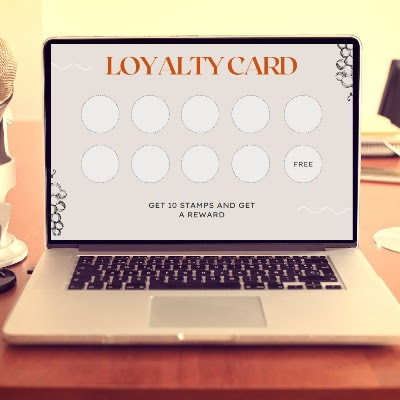
For years, discounting has been the default lever wineries pull to spark sales and reward loyal customers. But in today’s crowded marketplace, deep discounts can erode brand value and condition customers to buy only when the price drops.
There’s a better way: loyalty points programs. Retention, without discounting, comes from making customers feel known, valued, and part of something special. They’ll stay not because it’s cheaper, but because it’s theirs. Instead of discounting away margin, wineries can encourage repeat visits and purchases by offering rewards that feel aspirational, personalized, and memorable. Loyalty points add up over time, giving guests a reason to come back again and again, all the while protecting your brand’s premium image.
10 Reasons Why Loyalty Points Work
- Shift from price to experience. Points reward frequency and engagement, not bargain hunting. The program should reinforce experience, access, and emotional loyalty, not just transactions.
- Encourage long-term relationships. Customers with points in their “bank” are more likely to return to redeem them.
- Create exclusivity and surprise. Points can unlock experiences money can’t buy, deepening emotional connection.
- Protect your margins. Unlike blanket discounts, points give you flexibility – you decide what’s redeemable.
- Loyalty points = engagement currency. When we use points to encourage engagement, guests can earn beyond purchases, redeem for things that inspire (not discounts) and people love seeing their points add up.
- Tiered programs = status, not discounts. We see examples all the time with the airline and hotel industries. It’s about recognition and privilege, so guests don’t leave because they don’t want to lose their status.
- Complement, not complex. Loyalty programs that complement memberships can add flexibility and a sense of choice, but too many choices can cause analysis paralysis. Loyalty is about connection, not fine print.
- On-Ramp for Non-Members. Loyalty points keep casual guests engaged, giving them a reason to come back even if they’re not ready for a club commitment.
- Insights That Drive Retention. Points activity provides wineries with rich data to personalize outreach and strengthen relationships.
- Tell the Brand Story. A loyalty program with winery-specific naming and experiences feels authentic, not generic, and strengthens emotional bonds. This is a time to have fun!
Technology Enables Loyalty
The good news? Technology makes loyalty programs easier than ever to manage; it makes a loyalty program seamless, sticky, and scalable. Many winery POS and CRM systems (read more here) now offer built-in tracking, reporting, and simple redemption tools. Plus, loyalty points are treated as a deferred expense (not an immediate discount, a ‘promise’ of future value owed to the customer), giving accounting teams more flexibility and protecting your bottom line. Until redeemed or expired, they usually sit on the balance sheet as a liability.
Accounting Considerations: Check with a CPA.
We consulted with Geni Whitehouse of BDCo for the ground rules of loyalty points. Of course, please consult with your own CPA before implementing. In general, when a winery issues loyalty points, it’s making a promise to the customer: “You can use these points for wine, events, or experiences later.” From an accounting standpoint, that promise creates a future obligation – similar to a gift card or store credit.
Here’s the basic flow:
- When points are earned:
• Don’t treat them as an immediate discount (which lowers revenue on the spot).
• Instead, record them as a liability (a balance sheet item), because you owe the customer something in the future.
Example: A customer spends $100 and earns 10 points (worth $10 in rewards).
• Record $90 in revenue.
• Record $10 as a liability (“loyalty program liability”). - When points are redeemed:
• Reduce the liability by the value of points used
• At the same time, recognize that portion of revenue as redeemed.
• Record COGS for whatever was redeemed (wine, tasting, event).
Example: The same customer redeems their 10 points for $10 off wine.
• Reduce the liability by $10.
• Recognize $10 of deferred revenue from the balance sheet to match the redemption. - When points expire (if applicable):
• If your program has an expiration policy and points lapse, you can clear the liability and recognize it as “revenue” (essentially,
revenue you no longer owe).
Why This Matters for Wineries
- Protects margins: Not all customers redeem the loyalty points.
- Smoother financials and better forecasting: Recording points as a liability spreads the impact over time. This gives leadership a clearer picture of true revenue performance. You’ll know what’s “out there” in outstanding obligations, just like you would with gift cards. The data informs staffing (hospitality), production (small-lot allocations), and marketing spend. Without proper accounting, you lose the visibility that makes these insights trustworthy for planning and forecasting
- Unique reason to engage: When a guest accumulates points, it becomes a perfect reason to reach out and invite them back to the winery and bring a friend to ‘spend’ their points. If you have a robust gifting program, this allows the purchaser to redeem points for wine or experiences that they can enjoy, strengthening customer relationships.
The key takeaway: Loyalty points aren’t a ‘sunk’ cost on day one. They are a deferred obligation. This means they preserve your revenue until customers actually redeem them, and often, a portion never gets redeemed at all.
Key Takeaways for Wineries
- Think experiences, not discounts. Make rewards aspirational like exclusive tastings, behind-the-scenes access, or unique bottles that reinforce your brand.
- Keep it simple. Easy tracking and redemption encourage adoption and keep staff/guests engaged.
- Offer meaningful choice. Let customers use points for wine, experiences, or merchandise – people love options.
- Tie it to your story. Rewards should reflect your winery’s unique identity.
- Plan for Technology and Accounting. It is not as complicated as it may seem, but it is worth it to check with your technology and accounting professionals before implementing new programs.
In a market where consumers are tightening their wallets, loyalty points programs offer a smart, brand-protecting alternative to deep discounting. They build lasting relationships, create excitement, and give guests one more reason to choose your winery—again and again.
Winery Examples Leading the Way
- Domaine Serene (Oregon): Rewards include merchandise, exclusive dinners, and overnight accommodations at their Oregon winery as well as at their Chateau in Burgundy.
- Jordan Vineyard & Winery (Sonoma): Guests redeem points for private food-and-wine pairing tables, overnight stays in estate suites, or elegant dinner parties. High-value rewards that keep guests engaged.
- Ruby Hill Winery (Livermore): Their “Grape Rewards” program makes it simple, points go toward wine, events, or merchandise of the member’s choosing.
- Broken Earth Winery (Paso Robles): Loyalty points add an exclusivity factor with access to perks and events.
- Gloria Ferrer (Sonoma): Points unlock elevated sparkling wine tastings in a private lounge. Earn experiential rewards that feel luxe.
- Donelan Wines (Santa Rosa): Points create tiers: special shipping pricing that is earned after the 24th bottle purchase.
Beyond wineries, wine focused retailers show innovative programs show how widespread this strategy is:
- Cooper’s Hawk Winery & Restaurants (multiple states): Points scale into trips and dinners, encouraging repeat dining.
- Vino Volo (Airport wine bars): Points mean instant gratification for travelers, discounted tastings and unique gifts. We at WISE spend a lot of time in airports, and we LOVE this program!
Outside the Wine World: Proof It Works
- Starbucks Rewards: Up to 50% of sales come from loyalty members, driven by stars redeemable for drinks and food. Furthermore, these members spend 2.5 to 3X MORE than non members. (Source)
- Sephora’s Beauty Insider: Customers earn points toward exclusive products and experiences, driving both retention and upsell. The majority of their income comes from their tiered members, with Ulta reporting up to 95% of their revenue is from loyalty members. (Source)
These industries prove the point: customers will go out of their way to stay loyal if they see value beyond a price cut.