
Filter Post Type
NewsVideoProductEventLink
Sort:
Relevance
1–10 of 116


Imagine your VP of Sales announcing they’ve ditched CRM for a Rolodex. Or your finance director saying Excel is too modern, so they’re switching to chalkboard. And yet, here we are — 2025 — squinting at billbacks for hours on end and sending reps to visit every retail account like the entire industry is running for sheriff. Automation isn’t new, but for the wine & spirits world, it might as well be black magic. We love to talk about efficiency, scaling, and modernizing — right up until someone proposes replacing busywork with bots. Suddenly, it’s “But our rep relationships!” or “This is how we’ve always done it.” As if nostalgia for manual labor is part of our brand identity. Let’s get one thing straight: no one’s asking you to hand your label design to Midjourney or let ChatGPT pick your clones. We’re talking about automating the parts of your business that drain time, w
00

The wizard behind the curtain. That has always been the image that comes to mind when I ask wine people about data from their distributors. We’ve made headway on pulling back the curtain on distributor data, thanks to our relationship with VIP (Vermont Information Processing) and our ability to combine it with a winery’s DTC data. There’s clarity now. And visibility. And much less of a sense of mystery or smoke and mirrors. For wineries, it’s empowering. Here's a use-case example. Today we’re announcing a new development that goes even further. We call it RFV, or Recency-Frequency-Volume. It’s a twist on RFM (Recency-Frequency-Monetary), which is a key variable in DTC data to track customer behavior and their risk of dropping out of wine clubs. We’ve taken that idea and applied it to wholesale depletion data, to help wineries track their risk when it comes to their distributors. That’s RFV. We take the value of distributors' Rece
00

What are the benefits and return on investment considerations for a trade promotion management platform like Tradeparency to manage your three-tier distribution profitability? Remove margin leaks instantly with automated claims processing you can use today to realize ROI fast. Get visibility on all spend and return to control the bottom line better. This includes by-the-glass (BTG), incentives, free goods, and samples. Raise brand value and improve customer service with readily available chain pricing and the ability to empower a mobile sales force. Increase and maximize your margins by covering the 30% third-party depletion data reliance gap in all of your markets. Understand the drivers that improve performance and deliver better results with accurate, accessible analytics and reporting specifically built for three-tier distribution. Remove inefficiencies by eliminating duplicate, manual efforts. Get centralized price grids and ERP integration that str
10
January 31, 2022

What Does Centralized Pricing and Promotions Management Actually Look Like? See Now! If a global pandemic and material scarcity in the supply chain weren’t already a factor, the recently released State of the Wine Industry Report 2022 (SVB) clearly shows that changing industry trends are putting more pressure on wineries to adapt to new market conditions than ever before. Premium wines sales are growing at an exceptional rate (21%), while wineries face the challenge of volume wholesale depletions decreasing in a post-lockdown market favoring spirits. It’s no wonder that the demand for centralized and governed trade spending, promotions, and pricing management within the three-tier wine industry is growing fast. Gaining complete control and visibility over the full-cycle of three-tier distribution is paramount to reining in the right incentives and market attributes for your product to stay competitive, meet your consumers where they are, and control your brand. But w
10
July 27, 2021
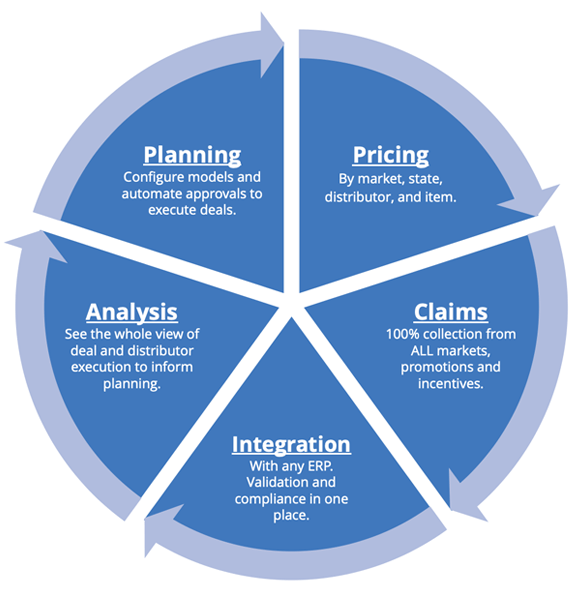
Perhaps you’ve seen the hype around ‘full-cycle’ promotions management and you’re wondering— what exactly does that mean? From managing depletion allowances and processing billbacks to steering distributor sales incentives for success, three-tier wineries and importers must focus beyond pricing alone to stay profitable, efficient, and competitive. That’s because pricing is only one piece of the trade spend and promotions cycle. Traditionally, wineries had to rely only on third-party depletion data for chargeback invoice reconciliation. The problem is that only covers 70% of the pricing visibility you need. What about the actual data from invoices? How do you get insight into the entire range of promotions such as BTG spend, free goods, incentives, and samples? How do you integrate all that data with your financial management or ERP solution and leverage it for accurate analytics and promotions planning? Enter full-cycle margin management, the latest
10

With finance endlessly hunting and pecking for data while sales scrambles for approvals on their ‘gut’ guess for the best pricing models and incentives with a distributor, it’s no wonder that planning and executing successful promotions are often a WAG. The problem is – while you can get lucky or play mediocre odds on accidental wins, only accessible data, accurate numbers, visibility into performance, and the ability to execute quickly in the market can help you turn the dials on consistent, repeatable profitability through promotions. It’s time to implement and execute on the Three in Three rule. What is the Three in Three rule exactly? It’s a tried and true, simple, three-step looped approach to promotions in the three-tier wine industry: Track Plan Automate. To elaborate, this means, you need to: Centralize and govern collecting the outcomes of absolutely trade programs and promotions, such as by-the-glass (BTG), depletion allowa
00
February 22, 2022

Are your three-tier pricing management tools and processes giving you the ability to price your wine and evaluate trade spending correctly? After all, tracking, optimizing, automating, and reporting on all your DAs, trade spending, and promotions is how you’ll stay competitive, protect your brand, and ensure a healthy bottom line. To help you determine if your workflows, infrastructure, or governance allow for efficient and profitable pricing management, Tradeparency’s industry data experts compiled 9 initial questions to ask and answer internally. These will help you reveal where you may have gaps in the complete cycle of your pricing management or what could be preventing you from pricing for profit effectively in the three-tier market: How do you track and analyze approved deals by product, date, region, or distributor? Can your sales managers access price grid reports on-demand? What is your process for handling exception-based managerial approval of new deals? D
00
February 7, 2022

Full Demo: Three-Tier Wine Pricing Management | Tradeparency
A recorded live, 25-minute demo to see centralized three-tier wine pricing management solution first-hand. Watch the Tradeparency demo now!
00
January 19, 2022

Choosing the Right Wine Pricing Tool | Tradeparency
The profitability and brand integrity of your winery ties to how you manage your pricing. Learn how to select the wine right pricing tool.
00

It’s already 2022, but how your winery or import business approaches pricing and trade spend management might be stuck in Y2K. Good news. It’s not too late to resolve to update and repair your approach to depletion allowances, distributor incentives, and promotions to make this year the most profitable yet. But where do you begin? Commit to tackling these top 3 common pricing issues: Get a handle on everything (ALL of it) gross-to-net: Most wineries focus on depletion allowances and often fall short of getting the whole picture of their product pricing and margin management. But, DAs aren’t the only expenses you need to factor in. Calculations commonly miss sample costs, sales incentives, non-distributor vendors, or expense buckets kept in separate systems. Read Beyond Depletion Allowance: The Top 8 Mistakes Wineries Make With Pricing Management to learn what might be absent from your pricing and margin analysis and how to fix it. Cover the 30% gap in third-
00