
 The Duckhorn Portfolio, North America’s premier luxury wine company, has selected InnoVint as its winery operating system following a comprehensive evaluation and RFP process. The decision reflects Duckhorn’s focus on modernizing its winemaking operations with a platform and a partner capable of supporting both current complexity and long-term growth.
Why The Duckhorn Portfolio Chose InnoVint
The Duckhorn Portfolio sought a modern, scalable solution to unify winemaking operations across multiple facilities while maintaining accuracy, compliance, and operational visibility. InnoVint was selected not only for its integrated, production-first platform, but for its deep industry expertise and proven ability to guide complex wineries through system transitions with confidence.
“InnoVint stood out as more than a technology provider,” said PJ Alviso, Vice President of Winegrowing at The Duckhorn Portfolio. “During our evaluation of the winemaking software options that are out there, InnoVint was a clear winner. Their exceptional product, extensive knowledge base, and unwavering passion as builders align perfectly with the values we hold dear at Duckhorn. Just as importantly, we trusted their team to advise us through the migration process and help us make smart decisions along the way.”
InnoVint’s winery operating system brings together vineyard tracking, grape intake, bulk wine movements, lab analysis, work orders, costing, and compliance in a single, purpose-built platform. Its API-driven architecture supports seamless integrations with broader business and ERP tools while providing the flexibility to support future growth, new facilities, and custom crush relationships.
What the Partnership Includes
As part of the partnership, Duckhorn will work closely with InnoVint’s implementation and customer success teams, leveraging a proven migration framework, hands-on training, and ongoing advisory support. InnoVint will also bring its internal technical resources to help design and deliver tailored solutions on top of the platform, supporting Duckhorn’s unique data, reporting, and operational needs across winemaking, operations, and finance teams.
“What stood out to us in this process was how thoughtful The Duckhorn Portfolio was in evaluating not just the software, but the partnership,” said Ashley Leonard, CEO of InnoVint. “They asked the right questions and were deeply focused on what it would take to support their teams through a transition like this. We’re proud they chose InnoVint to empower their operations, and we’re excited to work in partnership with such an incredible portfolio and their teams.”
The partnership reinforces InnoVint’s position as a trusted partner to premium and enterprise wineries seeking not just modern software, but experienced guidance in building healthier, more connected winery operations.
During our evaluation of the winemaking software options that are out there, InnoVint was a clear winner. Their exceptional product, extensive knowledge base, and unwavering passion as builders align perfectly with the values we hold dear at Duckhorn.
PJ Alviso – VP of Winegrowing
About InnoVint
Founded in 2015, InnoVint is the leading winery operating system, trusted by more than 2,000 wine brands of every size. Its all-in-one platform brings production, inventory, compliance, and costing into one simple system, giving wineries a single source of truth from vineyard to bottle. With tools tailored to how wineries actually work, InnoVint helps teams stay organized, reduce manual tasks, understand true costs, and make better decisions at every step. InnoVint’s mission is to help wineries run healthy, resilient, successful businesses. To learn more visit us at https://www.innovint.us
About The Duckhorn Portfolio
The Duckhorn Portfolio is North America’s premier luxury wine company, with eleven wineries, nine state-of-the-art winemaking facilities, five tasting rooms and over 2,200 coveted acres of vineyards spanning 38 Estate properties. Established in 1976, when vintners Dan and Margaret Duckhorn founded Napa Valley’s Duckhorn Vineyards, today, our portfolio features some of North America’s most revered wineries, including Duckhorn Vineyards, Decoy, Kosta Browne, Sonoma-Cutrer, Goldeneye, Calera, Greenwing, Paraduxx, Migration, Canvasback and Postmark. Sourcing grapes from our own Estate vineyards and fine growers in Napa Valley, Sonoma County, Anderson Valley, California’s North and Central coasts, Oregon and Washington State, we offer a curated and comprehensive portfolio of acclaimed luxury wines with price points ranging from $20 to $230 across more than 15 varietals. Our wines are available throughout the United States, on five continents, and in more than 50 countries around the world. To learn more, visit us at https://www.duckhornportfolio.com/
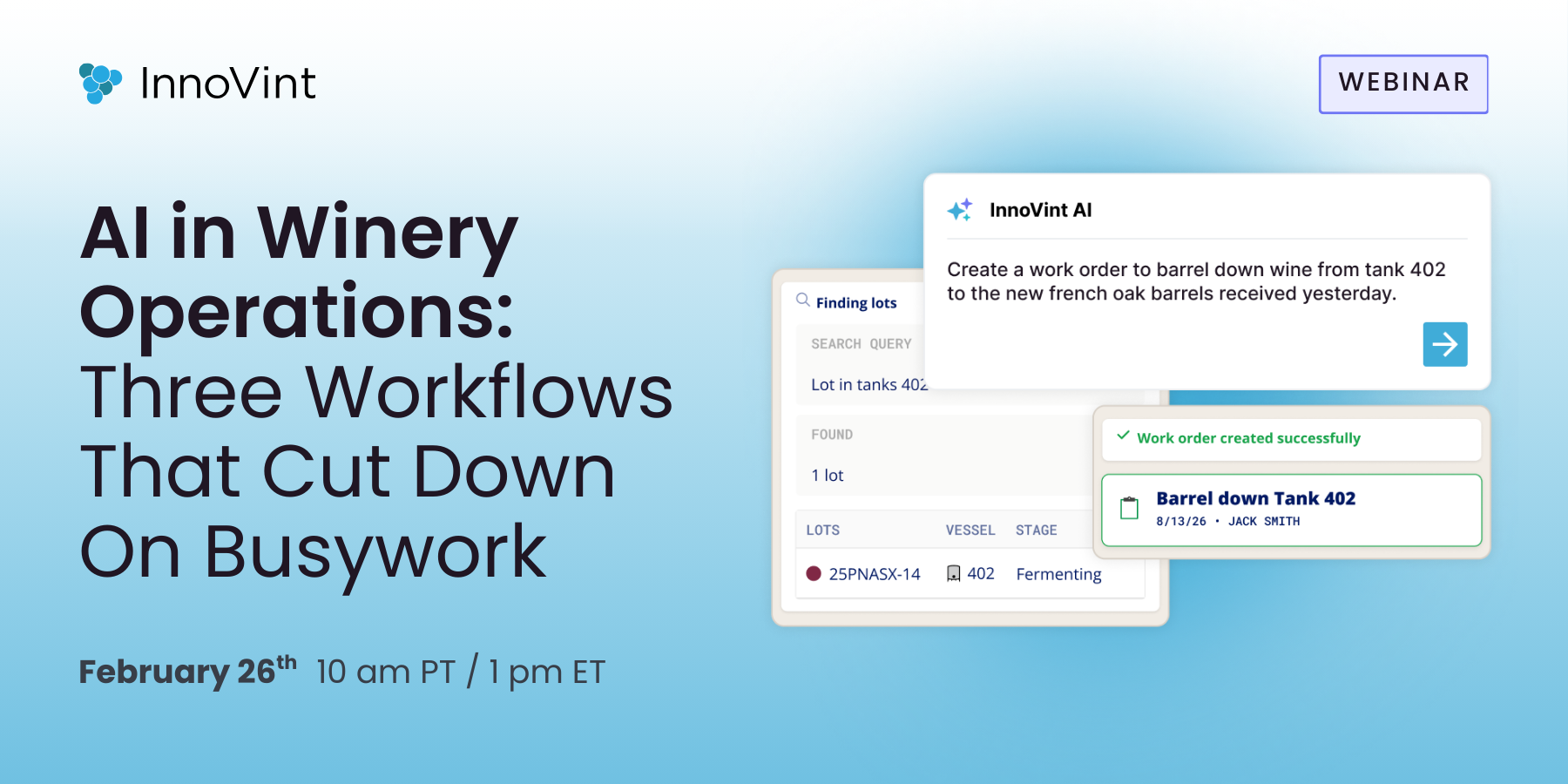
Event Type: Webinar
Date: 2/26/2026
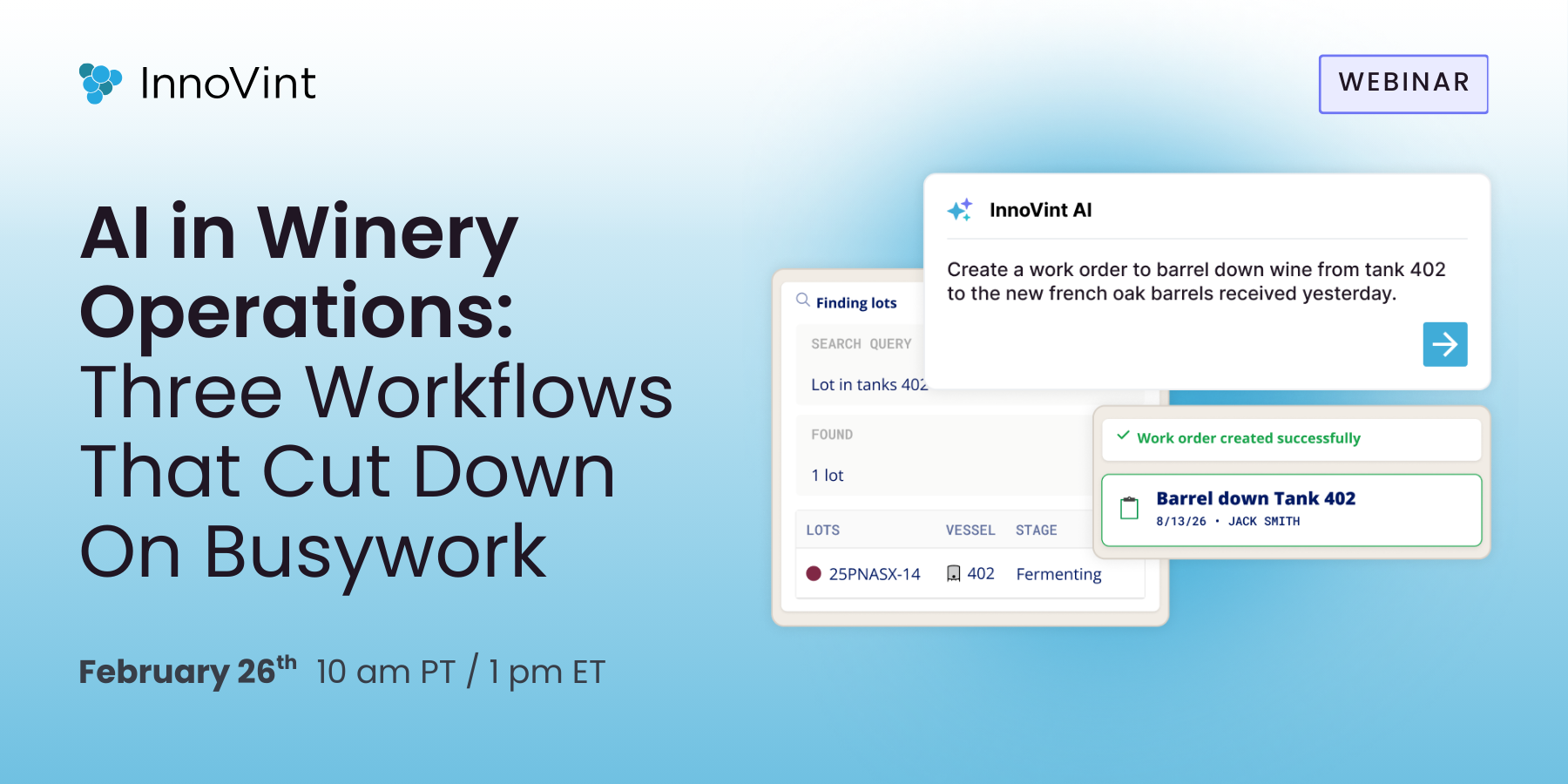
Winery teams deal with a lot of manual work—data entry, rewriting notes, digging through spreadsheets. That’s all time not spent making wine, and it adds up fast. ⏳
This Thursday, Feb 26 at 10 am PT, we’re hosting a short webinar to showcase three real examples of how wineries are using AI to reduce those manual efforts and make winemaking work easier.
✨ We’ll cover how AI can be used to:
- Turn handwritten notes into clean data
- Create work orders by voice
- Get quick answers to everyday questions (alcohol levels, fermentation progression, lot VAs) without digging through spreadsheets
As wineries across the country face softening tasting room conversion rates and increasing pressure on direct-to-consumer (DTC) sales, a new episode of Expert Talks: Wine Industry Insights highlights practical strategies from one of the industry’s leading DTC educators.
InnoVint recently sat down with Liz Mercer, Partner and Winery Coach at WISE Academy, to examine what the top 10% of tasting rooms are doing differently to consistently convert guests into wine club members and drive higher-margin sales.
Drawing on more than 25 years of wine industry experience, Mercer outlines the operational disciplines, team training strategies, and guest experience enhancements that set apart high-performing tasting rooms from the rest. Rather than relying on aggressive sales tactics, the discussion focuses on intentional hospitality, empowered front-of-house (FOH) teams, and structured yet authentic club conversations.
The episode offers actionable guidance for wineries looking to:
- Grow their DTC and wine club membership base
- Increase sales of higher-margin wines
- Strengthen and support tasting room teams
- Elevate the overall guest experience
For wineries seeking practical insights to improve tasting room performance, the episode is now available to watch or listen on your preferred platforms.
Check out the video below, and read the top 7 takeaways in the blog post here.
InnoVint Announces Intelligent Winery Workflows Powered by AI
New AI capabilities automate data capture, reporting, and work order creation to reduce manual work in winery operations
InnoVint, the leading winery operations & production platform, today announced the launch of Intelligent Winery Workflows, introducing artificial intelligence directly into core production workflows to help winery teams move faster with less manual effort.
As part of this launch, all InnoVint customers now have access to InnoVint’s AI Analysis Import functionality, which allows teams to snap a photo of handwritten lab notes or analysis sheets and automatically capture that data in InnoVint. During the recent harvest, wineries uploaded hundreds of documents and thousands of analyses, eliminating thousands of manual keystrokes from everyday workflows.
InnoVint also previewed two upcoming AI-powered capabilities:
- AI Generated Reports will enable wineries to create reports using plain-language text or voice, making it easier to access production insights without building complex filters.
- AI Work Order Creation will allow cellar teams to translate short text or voice instructions into structured work orders, speeding up task creation on both mobile and desktop.
These new workflows mark the first phase of InnoVint’s broader effort to thoughtfully weave AI throughout its winery operating system to reduce manual work and help teams move faster with less friction.
Wineries can learn more by registering for InnoVint’s upcoming webinar or by visiting the InnoVint booth (#114) at the Unified Wine & Grape Symposium to see these capabilities in action.
Learn more about InnoVint AI
Register for the upcoming webinar
Plata Wine Partners is a premium “vineyard-to-bottle” production house rooted in California’s top coastal AVAs. With more than 20,000 acres of sustainably managed vineyards, Plata provides bulk-wine, private-label, and custom-program solutions for brands of all sizes. Their team brings together expertise in viticulture, winemaking, production, and finance to deliver programs aligned with modern consumer preferences.
As the business evolved, Plata recognized that their Winemaker’s Database (WMDB) system lacked the accuracy, speed, and real-time visibility required by a 12+ facility production model. Plata implemented InnoVint in 2024, and the difference after just one harvest was remarkable.
The Challenge: A System That Slowed Down the Entire Business
Before InnoVint, Plata’s production and finance teams were burdened by manual processes that made everyday work harder and introduced costly risk.
- Excessive manual data entry. Every two weeks, the team manually entered transactions from multiple custom crush partners. During harvest, the workload doubled. One team member spent nearly a week each month updating records by hand, all for data that was still behind.
- Inaccurate and outdated costing data. Tracking fruit value, materials, overhead, additions, and ownership splits was nearly impossible. WMDB delivered what Jessica Valenzuela, Director of Operations, described as “behind-the-times information,” leaving finance without a clear or timely understanding of true production cost.
- Error-prone corrections. Fixing mistakes in their legacy system was painful. The “fix the tank transaction” tool rarely worked. As a result, their database itself was cluttered with unnecessary tanks, duplicate additives, and outdated data.
No visibility into blends, bottling materials, or program commitments. Blend tracking lived in a massive spreadsheet outside the system, bottling materials had no home at all, and unallocated gallons were frequently inaccurate because movements weren’t entered in real time.
The Turning Point: A Need for Real-Time Accuracy and Scalable Processes
When Plata began evaluating new solutions, accuracy and scalability were paramount. Plata needed more than just a wine production software and thus prioritized:
- Real-time visibility across programs and blends
- A single source of truth for costing and inventory
- Accurate ownership percentages for bottling and sales
- A system that eliminates duplicate work, not creates it
- A platform that the whole team could learn quickly
After evaluating their options, InnoVint stood out for its:
- Clean, intuitive workflows
- Powerful costing engine
- Robust by-client inventory tracking
- Trial blend management with cost, analyses, and composition prediction
- Ease of training and adoption
- Strong track record with premium producers
- Deep wine industry knowledge
And after seeing InnoVint’s simplified interface and real-world winemaking workflows, the decision was clear, as Jessica Valenzuela, Director of Operations at Plata shared: “We don’t want to switch systems again. We wanted a long-term partner — and that’s InnoVint.”
Seamless Migration from Winemakers Database to InnoVint
Plata’s transition from WMDB to InnoVint was far smoother than they expected. Despite years of accumulated data on a legacy on-premise system, the migration was clean, structured, and fully supported by the experienced InnoVint team. Workflows were mapped, data was validated, and users were trained quickly, allowing Plata to get up and running in less than 3 months without disrupting production. For a team that once worried about the pain of change, the move ultimately proved to be one of the most valuable decisions they made.
The Solution: A More Profitable, Efficient, and Healthy Wine Business
"InnoVint has made us incredibly efficient, saved at least a headcount, and cut our consulting needs by 70% during harvest. We now have immediate visibility to tank blends and costing enterprise-wide — and have saved margin points by costing projects with 100% accuracy."
- Jason Strobbe, President
One year after switching to InnoVint, Plata reported measurable gains in accuracy, efficiency, and profitability across the business:
Plata’s Smoothest Harvest Yet
2025 was a turning point. With real-time visibility and cleaner coordination across vineyard partners, facilities, operations, and finance, harvest ran more smoothly and predictably than at any point in Plata’s history. Jason Strobbe, President at Plata, shared, “2025 harvest was the smoothest we’ve ever had. That feedback came from every department.”
Key improvements included:
- Eliminated bottlenecks during the busiest weeks
- Real-time inventory tracking across all facilities
- Clear, accurate visibility into every tank and blend
- Faster decision-making during fruit intake, transfers, and lots splitting
With InnoVint, the entire operation ran faster, cleaner, and more confidently.
Dramatic Reduction in Manual Work – Saving over $250,000 Per Year
InnoVint removed layers of duplicate entry, manual blend tracking, and end-of-month cleanup work. The result is meaningful productivity savings across the organization, equating to over $250,000 in savings.
- 1–2 FTEs (Full Time Employees) of productivity gained through automation and streamlined workflows
- 10+ hours saved every week by eliminating the massive blend spreadsheet
- 70% reduction in outside consulting needs to manage wine allocations
Work that once required days of manual updates now happens in minutes… or automatically.
100% Costing Accuracy
Costing was one of Plata’s biggest pain points. It was also one of the greatest areas of transformation.
With complete visibility into fruit, materials, labor, overhead, and packaging, Plata can now cost projects with total precision. This level of accuracy equates to margin points saved, especially on large and complex production runs.
InnoVint gives the Plata team:
- Monthly fruit, material, overhead, and additions costs
- Accurate ownership percentages at the ranch and block level
- Cost per 750ml
- Real-time allocation across programs
- Full costing reports after bottling
But the biggest shift is how costing and program management now work together. With real-time costing tied directly to program allocations, Plata’s operations team can immediately understand the financial impact of moving volume between programs, facilities, or tanks. Every transfer, blend, or reallocation is reflected instantly, allowing them to make smart, margin-protective decisions instead of relying on delayed or estimated data.
"We understand our entire costing model better than anyone in the industry. Predictive costing is worth the price of admission alone."
-Alison Crowe, VP of Winemaking
Real-Time, Enterprise-Wide Visibility
Plata now has real-time, enterprise-wide visibility across its entire production footprint. Winemakers, operations teams, facilities, and finance can instantly see:
- Tank state and capacity planning
- Blend possibilities by client, program, and cost
- Actual volume allocations per program
- Material usage and packaging depletion
- Daily updates from every facility
With unified data across the entire production footprint, the organization operates with greater alignment, clearer communication, and sharper decision-making.
Conclusion: Company-Wide Efficiency Gains
By upgrading to a modern winery operating system with InnoVint, Plata transformed their business operations. They gained real-time visibility, reliable data, and a platform designed for modern winemaking teams.
For President Jason Strobbe, the impact was clear: “InnoVint has made us incredibly efficient, saved at least a headcount, and cut our consulting needs by 70% during harvest. We now have immediate visibility to tank blends and costing enterprise-wide — and have saved margin points by costing projects with 100% accuracy.”
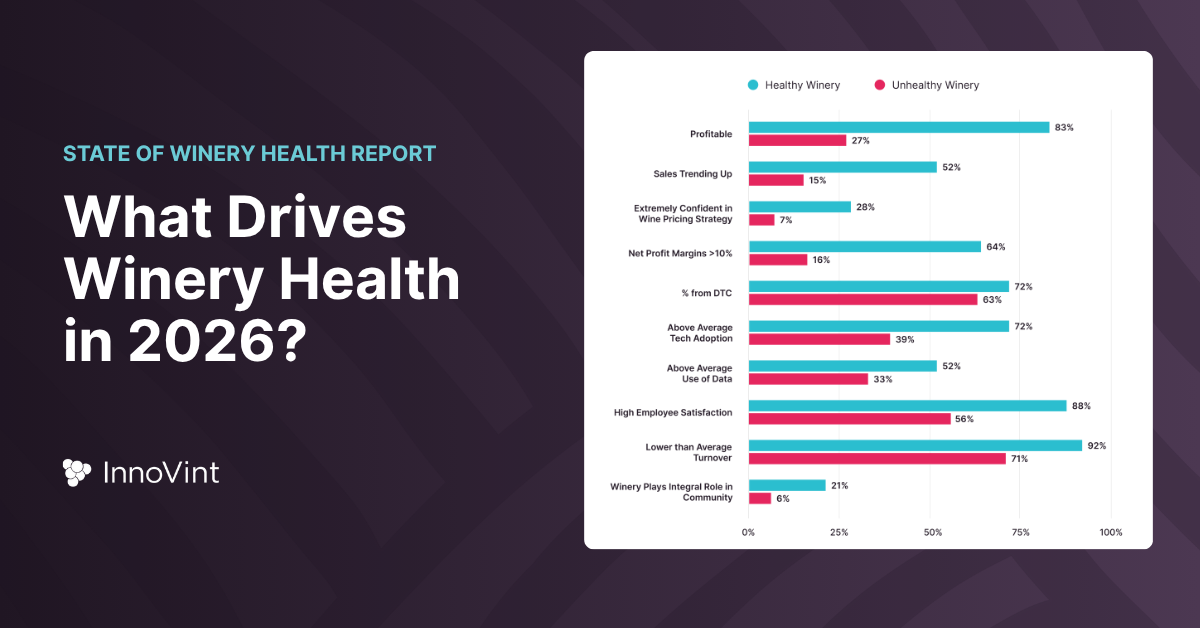
Winery health isn’t defined by one metric. It’s a reflection of how well a winery performs across three key dimensions: financial resilience, operational excellence, and cultural strength.
Every year, InnoVint surveys hundreds of winery professionals to understand what truly drives a healthy winery. In the 2025 State of Winery Health Report, our statistical analysis confirmed that all three dimensions matter, but financial performance stands out as the clearest signal of overall business health. Profitability, sales growth, and pricing confidence consistently separate the strongest wineries from those struggling to keep pace.
But the story doesn’t end there. Operational practices, technology adoption, and team culture all play vital roles in supporting long-term success.
What Does “Winery Health” Mean in 2025?
At its core, winery health represents a winery’s ability to stay profitable, efficient, and resilient — even as the industry faces rising costs and shifting consumer demand.
Healthy wineries aren’t just surviving. They’re forward-thinking, data-driven, and connected to their people and communities. They know their numbers, run disciplined operations, and foster cultures that retain talent and inspire collaboration.
Let’s break down each dimension and what the data shows.
Financial Health: The Strongest Indicator of Winery Health
What Financial Health for a Winery Means
Financial health reflects a winery’s profitability, cash flow stability, and pricing confidence. In other words, how effectively the business turns grapes into sustainable profit. Most wineries know their sales volume, but financial health goes beyond that. It’s about knowing your profit margins, tracking cost of goods sold (COGS) accurately, and making pricing decisions rooted in data, not instinct.
Healthy financials give wineries the freedom to plan for the future, weather downturns, and make smarter operational decisions.
What the Data Shows
The 2025 State of Winery Health Report found financial metrics to be the most reliable predictor of overall health:
- Profitability matters. Wineries with a 20–30% net profit margin rated their health as excellent or good 63% of the time, compared to just 26% for those with margins below 10%.
- Sales growth plays a role. 67% of wineries with increasing sales rated their health positively, compared to only 17% of those with declining sales.
- Pricing confidence is key. Nearly 64% of wineries extremely confident in their pricing strategy rated their overall health as excellent or good.
In fact, financial indicators alone explain over 60% of the variation in overall winery health ratings.
Operational Health: Why Efficiency Still Matters
What Operational Health for a Winery Means
Operational health captures how efficiently a winery runs — from vineyard management and production to collaboration, technology, and data use. Healthy operations mean clear processes, aligned teams, modern systems, and visibility across departments. A well-run winery can adapt quickly, reduce waste, and make informed decisions in real time. And they have systems to ensure alignment between supply and demand.
An operationally healthy winery runs like a well-tuned machine: teams are aligned, data is centralized, and decisions are made quickly and confidently.
What the Data Shows
While financial factors may be the clearest predictor of health, operational strength magnifies those gains. According to the State of Winery Health Report:
- Wineries with excellent operations were 3x more collaborative and 4x more confident in pricing.
- Technology adoption is a defining factor. 65% of high-tech wineries reported strong health, compared to only 14% of low adopters.
- Data-driven decision-making drives better outcomes. 70% of data-forward wineries rated their business as excellent or good, versus 22% of those lagging behind.
These findings reinforce that modern operations improve sales, satisfaction, and long-term sustainability.
Cultural Health: The Human Side of a Healthy Winery
What Cultural Health for a Winery Means
Cultural health measures the human side of winery success — employee satisfaction, leadership alignment, and community connection. A healthy winery culture is one where teams feel valued, communication is open, and the winery sees itself as part of a larger ecosystem, not just a business.
What the Data Shows
Culture, people, and community involvement may be harder to quantify, but their impact on overall wine business health is undeniable.
- Employee satisfaction matters! Wineries with high employee satisfaction rated their health positively 68% of the time, compared to just 20% among those with dissatisfied teams.
- Community involvement strengthens business health. Wineries considered integral to their local community were 3x more likely to be profitable and 3x more likely to report increasing sales.
- Workforce stability was linked to better outcomes. Low-turnover wineries reported stronger health ratings than high-turnover businesses.
A positive culture, both internally and within the community, fuels retention, strengthens collaboration, and drives profitability.
The Complete Picture of Winery Health
Financial performance may be the most visible driver, but the healthiest wineries understand that profitability is an outcome — not the goal itself. Sales growth, profitability, and pricing confidence are made possible by well-run operations, smart use of technology, and teams that are motivated and connected to their communities.
Wineries that invest in all three — financial, operational, and cultural health — position themselves to thrive no matter what the market brings.
We are proud to be one of five recipients of this year’s WINnovation Award. The Harvest Watch Dashboard is a tool that has quickly become essential during harvest. This data hub gives winery teams instant visibility into fruit intake, brix, TA, patterns, and harvest completion, all in one place.
Built on decades of InnoVint data, Harvest Watch was designed in direct response to the communication challenges wineries face each harvest. The dashboard centralizes local data into a clear view that helps teams make faster, more informed decisions when timing matters most.
In a new episode of Expert Talks, Anna Muthig, the project's Data Analyst, shares the behind-the-scenes story from the first whiteboard sketch to user feedback. She also offers a look at what’s next as wineries increasingly lean on real-time data to run smarter, more coordinated harvests.
🎧 Watch the full Expert Talks episode featuring Anna Muthig → Click Here!
Harvest Watch isn’t just an award-winning dashboard; it signals a shift in how wineries operate during their busiest season: with clarity, speed, and confidence.
Event Type: Webinar
Date: 11/13/2025
With harvest nearly in the rearview, it’s time to talk numbers. Join us for a short demo on Thursday, November 13, at 10 am PT to learn how leading wineries are getting a clearer, real-time view of costs, compliance, and inventory with InnoVint’s winery operating system.
See firsthand how InnoVint helps:
- Finance teams see clear cost traceability from grape to bottle in real-time
- Owners and management access important winery data from anywhere, at anytime
- Compliance teams generate fully-auditable reports in minutes
- Winemaking teams streamline ops with simple, digital workflows
- Sales and marketing view historical wine data instantly
How confident are you that your production plans are aligned with your sales goals?
In a market defined by shifting consumer trends, climate variability, and cost pressures, winery leaders are rethinking how to balance what they make with what they can sell.
In a new framework developed by winery operations consultant Andrea Savaiano, wineries can follow a clear, repeatable 6-step process to bring supply and demand back into balance.
This practical approach helps winery teams:
- Forecast more accurately and confidently
- Map inventory against sales velocity
- Identify long or short SKUs before it’s too late
- Make smarter production and sales planning decisions
Why It Matters
Supply and demand misalignment is one of the biggest sources of wasted resources and lost revenue in the wine industry. This 6-step framework helps wineries turn reactive decision-making into a proactive strategy and ultimately connect production planning to financial health.
👉🏼 See the full framework here
What does it take to build a healthy, profitable winery in today’s market?
The second annual State of Winery Health Report is here, offering a data-driven look at how wineries are navigating financial pressures, operational challenges, and cultural shifts across the industry.
Some Key Findings from This Year’s Report:
- Many wineries are thriving despite uncertainty: 80% report stable or growing sales, 82% are profitable or have a plan to get there within 1–2 years, and 82% rate their overall health as average or better.
- Leaders in tech adoption win big: Wineries embracing modern technology report higher health scores and are 50% more likely to see sales growth.
- Tracking profit margins remains a challenge: Only 38% know their per-product profit margins, despite 90% calculating production costs — but those that do are more likely to be profitable and in great health.
- Community involvement impacts the bottom line: Wineries engaged in their local communities are 3x more likely to be profitable and 3x more likely to report increasing sales.
- Culture & job satisfaction varies by role: 90% of leaders rate culture positively and 80% report high job satisfaction, while winemaking staff are least positive — only 58% rate culture favorably and 11% describe it as toxic.
Why This Matters
With two years of data, the report now tracks momentum and emerging trends. It paints a picture of an industry that is resilient but facing growing cost pressures and market uncertainty. For winery leaders, the benchmarks provide a practical way to compare performance, set priorities, and identify strategies proven to support long-term health.
👉🏼 Download the Full Report
The full 2025 State of Winery Health Report is available now, complete with detailed benchmarks, role-by-role perspectives, and recommendations any winery can apply.